MARIANI’S
Virtual
Gourmet
August 10,
2025
NEWSLETTER
Founded in 1996
ARCHIVE
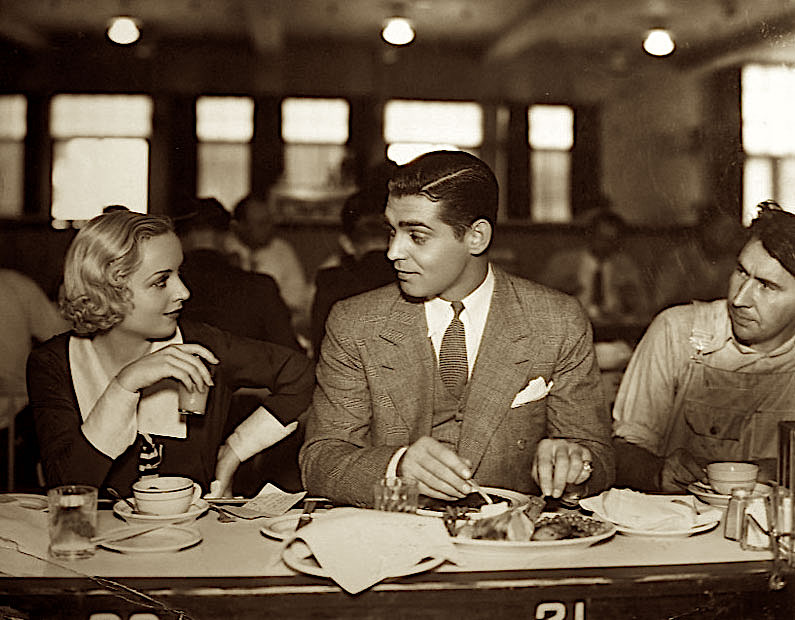
Carole Lombard and Clark Gable at the MGM Commissary, 1936
THIS WEEK
THE VIEW FROM MOUNT OLYMPUS:
WHAT DID THE GODS EAT AND DRINK?
By John Mariani
NEW YORK CORNER
ST. URBAN
By John Mariani
HÔTEL ALLEMAGNE
CHAPTER TWENTY-TWO
By John Mariani
NOTES FROM THE WINE CELLAR
THE WINES OF MICHIGAN
By John Mariani
WHAT DID THE GODS EAT AND DRINK?
By John Mariani
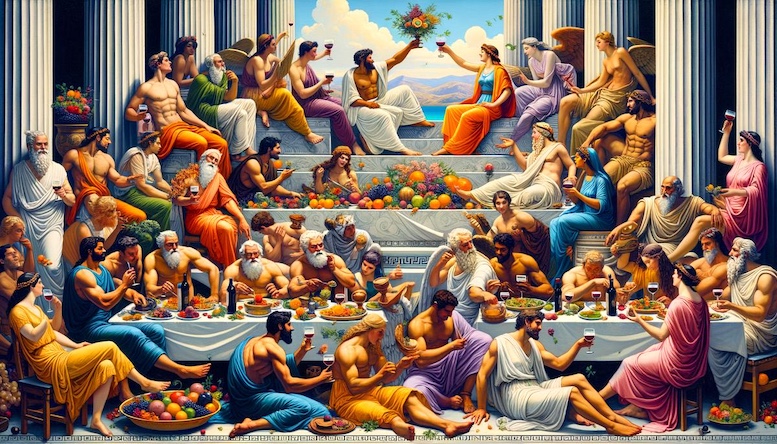
Rare is the
Greek god or goddess who is not a cosmic
annoyance to human beings. They are
immeasurably flawed, vindictive, irrational,
self-serving, mean-spirited and use their
powers to outwit each other and mankind.
.jpg) They were also
gluttons: According to Homer (left),
the gods lounging atop Mount Olympus
“feasted all day until sunset and ate to
their hearts content,” then they would put
up their feet and listen to music and poetry.
They were also
gluttons: According to Homer (left),
the gods lounging atop Mount Olympus
“feasted all day until sunset and ate to
their hearts content,” then they would put
up their feet and listen to music and poetry.
Dionysus
(right) was a god the Greeks
most happily imitated. Called Bacchus by the
Romans, he was the privileged son of Zeus
himself and god of agriculture, who showed men
how to grow wine grapes and make wine; he was
also a comic
sower of decadence, though he was never
depicted as obese by Greek sculptors.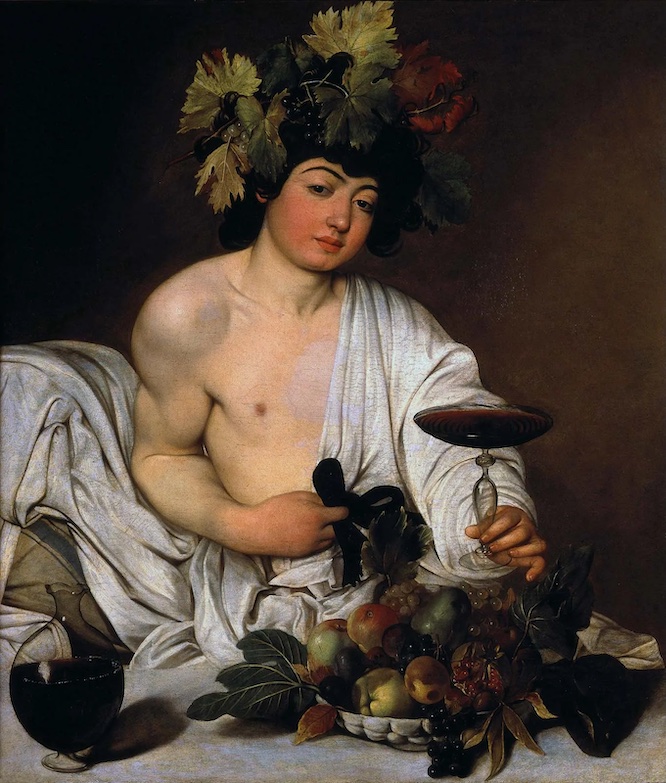
He would conduct his conquests
surrounded by a retinue of Bacchii that
included drunken satyrs and mad women known as
maenads who wore crowns of snakes and would
tear animals and enemies to pieces.
The feasts celebrating Dionysus date to
Attica, where a yearly wine festival was held
during the winter solstice and grew into
raucous, sexually charged, raunchy scenes in
which masked men dressed in goat skins, giant
phalluses were carried about and flaunted and
dances tended towards the obscene.
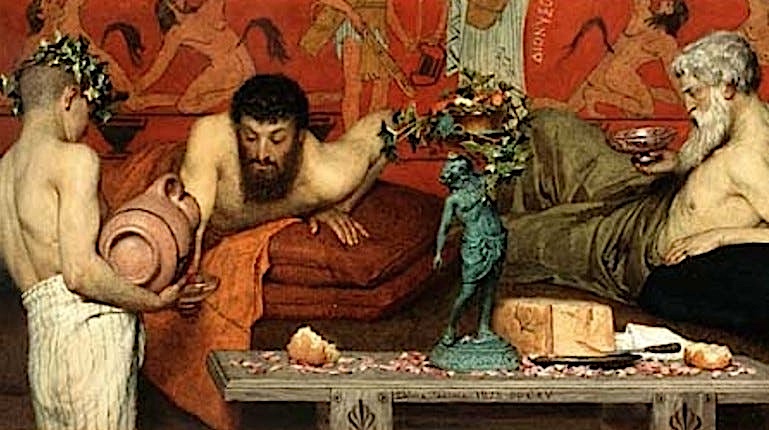
Drinking parties held in Dionysus’s
honor, called sympósions
(below), became very deliberate
gluttonous events, despite Dionysus’s own
dictum that a man should drink only three cups
of wine at dinner: toasting the first to
health, the second to love and pleasure and
the third to sleep, after which a guest should
go home to bed. Few paid much attention once
the party got going.
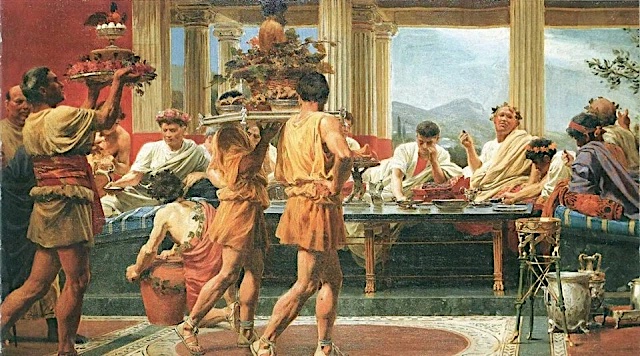 Such banquets
were all male, with the exception of naked
dancing girls, and the manners and rituals of
inviting guests, making the menus and deciding
on the entertainment were very involved.
During a sympósion guests arrived, their feet
would be washed by slaves, then they reclined
on couches; a communal cup called a psycter
(below) of aromatics was passed
around, and the eating part of the banquet
began. But the serious drinking came after
dinner.
Such banquets
were all male, with the exception of naked
dancing girls, and the manners and rituals of
inviting guests, making the menus and deciding
on the entertainment were very involved.
During a sympósion guests arrived, their feet
would be washed by slaves, then they reclined
on couches; a communal cup called a psycter
(below) of aromatics was passed
around, and the eating part of the banquet
began. But the serious drinking came after
dinner.
The meal would consist of an enormous
number of dishes. A
poem written around 400 BC called The
Banquet describes a feast well
appreciated by its enthusiastic author.
In
came a pair of slaves with a shiny table, and
another, and
another until they filled the room.
They fetched in show-white barley-rolls
baskets,
A casserole— no bigger than that—call
it a marmite, full of a
noble eel with a look of the conger
about him.
Honey-glazed shrimps besides, my love,
Squid sprinkled with sea-salt,
Baby birds in flaky pastry,
And a baked tuna, gods! What a huge one
fresh from the fire
and
the
pan and the carving knife.
Enough steaks from its tender belly to
delight us both as long
as we might care to stay and munch.
. . . . Then the same polished tables,
loaded with more good
things, sailed back to us, “second
table,” as men say
Sweet pastry shells, crispy flapjacks,
toasted sesame cakes
drenched in honey sauce,
Cheesecake, made with milk and honey,
baked like a pie;
Cheese-and-sesame sweetmeats fried in
the hottest oil in
sesame
seeds were passed around.
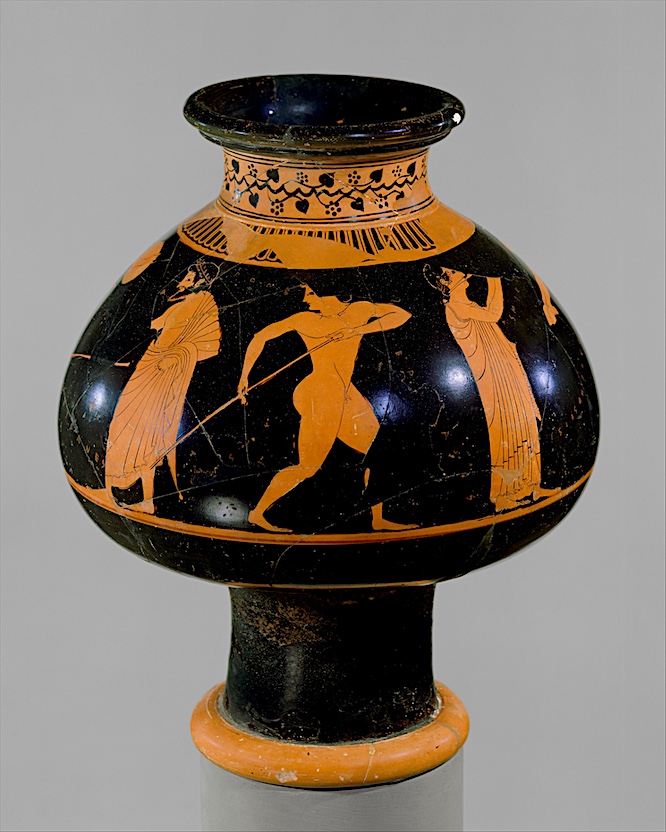
At that point, with
only small bites called tragemata
to nibble on, the guests began to drink as
much as they liked of wine cut two-thirds by
water. If a man protested that he’d had enough
wine and refused another cup, he had to
perform some silly entertainment, like dancing
naked or carrying the girl flute-player around
the room. Parasites was the name given to
those who arrived late to the party and
mooched off the remains. Only around 500 BC
were women invited to join the fun, but they
were largely courtesans, prostitutes and
female artists.
How such a gentle philosopher named
Epicurus became equated with the
term “epicureanism” as a license to excessive
indulgence, particularly in food and drink, is
a unfortunate because he actually advocated
“katastematic pleasure” that is experienced
through a harmonious state of mind free of
mental distress and pain achieved through a
simple life rather than by activating
unnatural pleasures like gluttony that take
hold of the mind’s free will.
In Homer’s Odyssey,
the poet
insists that while heroes need proper
nourishment, mostly meat and bread, it would
be foolhardy for them to indulge in
gluttonous behavior. Nevertheless,
in The
Iliad the hero Odysseus is called by an
opponent “wild for fame, glutton for cunning,
glutton for war,” while Odysseus uses the word
“glutton” to describe King Agamemnon as a
“dog-faced” glutton” and “people-devouring
king.”
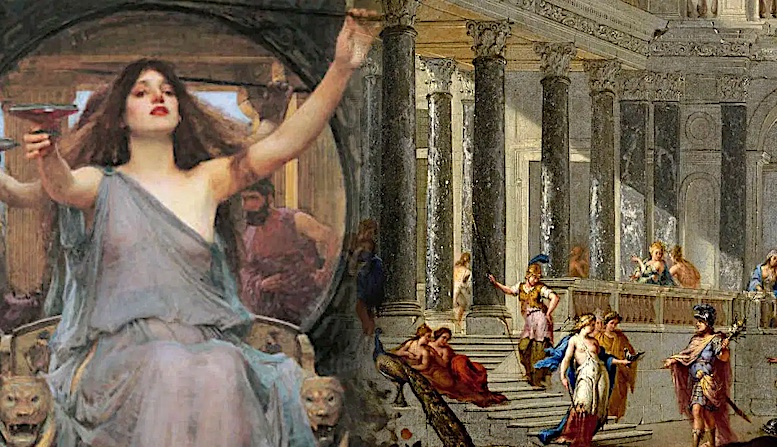
When Odysseus sails into
the clutches of the breathtakingly beautiful
goddess Circe (left), she turns
his
men into swine with a drugged drink (she turns
them back, too) and persuades him to feast
with her and her maidens on “enough food and
drink to last forever.” And then to bed.
Odysseus and his men gave in to her seductions
and stuck around the island “day
after day, eating food in plenty, and drinking
sweet wine” for an entire year.
But the candidate for Super Glutton is
the god Herakles (Hercules to the Romans), a
bastard son of Zeus whose wife Hera tried to
abort him and afterwards tried to make his
life miserable. Herakles (below) is, of
course, a person of inhuman 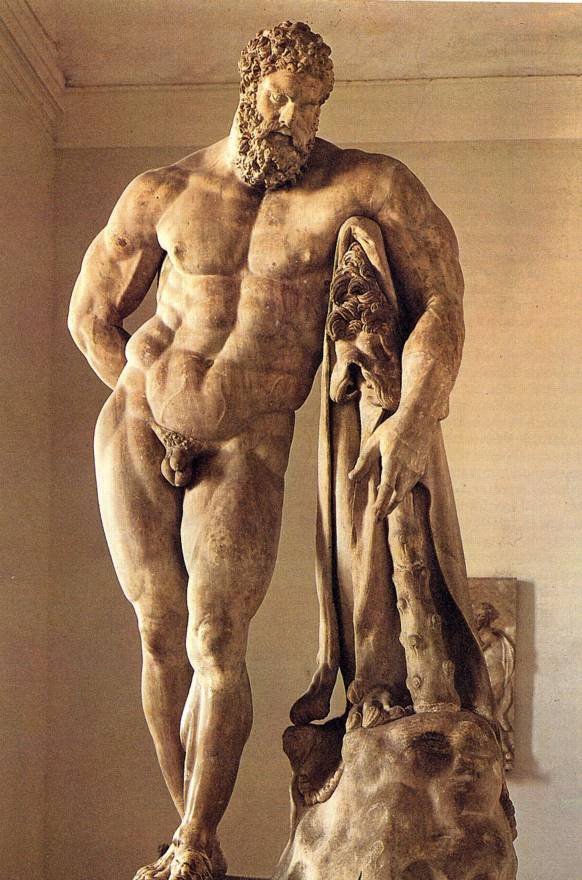 strength,
but he emerges as a comic figure among Greeks
who regarded his gluttonous antics as human
foibles. From the earliest days of Greek drama
Herakles is ridiculed for his brutish way of
eating his food, his preference for a good
meal versus a good woman and, in
Aristophanes’s The Bird,
even his reluctance to leave a barbecue in
order to help save his
own father. In an earlier play, The Frogs,
Aristophanes had also portrayed Herakles as a
god led around by his nose at the thought of
food, describing how in a trip to the
underworld he had gobbled up sixteen loaves of
bread, 20 portions of beef stew, a mess of
fish and a newly made goat’s cheese—baskets
included—then, bellowing and drawing his
sword, skipped out on the bill.
strength,
but he emerges as a comic figure among Greeks
who regarded his gluttonous antics as human
foibles. From the earliest days of Greek drama
Herakles is ridiculed for his brutish way of
eating his food, his preference for a good
meal versus a good woman and, in
Aristophanes’s The Bird,
even his reluctance to leave a barbecue in
order to help save his
own father. In an earlier play, The Frogs,
Aristophanes had also portrayed Herakles as a
god led around by his nose at the thought of
food, describing how in a trip to the
underworld he had gobbled up sixteen loaves of
bread, 20 portions of beef stew, a mess of
fish and a newly made goat’s cheese—baskets
included—then, bellowing and drawing his
sword, skipped out on the bill.
 Though
sometimes depicted in terracotta figurines
from the 5th and 4th
centuries BC as pot-bellied, overwhelmingly
Herakles was sculpted in marble and bronze by
both Greek and Romans as a male figure of
daunting musculature with what today are
called “killer abs.”
Though
sometimes depicted in terracotta figurines
from the 5th and 4th
centuries BC as pot-bellied, overwhelmingly
Herakles was sculpted in marble and bronze by
both Greek and Romans as a male figure of
daunting musculature with what today are
called “killer abs.”
Alexander the Great (below) was
a mere mortal and a big drinker who on “on such a day,
and sometimes two days together, slept after a
debauch.” On one occasion he held a drinking
contest with 41 contenders chosen from his
army ranks, others local citizens. Whoever
drank the most would be awarded a crown worth
a talent in gold––worth about $250,000
today. One of Alexander's soldiers,
named Promachus. won the prize after knocking
down four gallons of wine (unmixed with
water). But not everyone, especially the local
people, was used to drinking so much wine,
resulting in 41 deaths from alcohol poisoning.
Never defeated in battle, Alexander’s demise came at the age of thirty in 323 BC, in Babylon. The earliest reports say that after nights of excessive drinking, the young king fell ill with fever and died two weeks later. Others contend he was poisoned by his viceroy Antipater, while more modern conjectures propose the weary conqueror had picked up typhoid fever or meningitis or was done in by his over-use of the medicine hellebore, then prescribed as a purgative as well as for gout and signs of insanity.
NEW YORK CORNER
43 East 20th Street
646-988-1544
By John Mariani
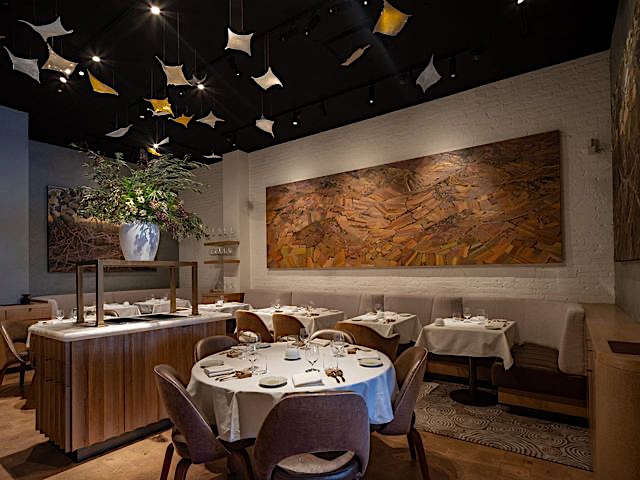
Despite
its
refined, romantic design, its 3,000 bottle wine
cache and a
chef with an exceptional career and recognition,
the new Saint Urban, which just opened in the
Flat Iron District this May, is not an easy
place to report on to readers who will not have
a chance to eat anything I recommend on a menu
that will be totally changed each and every
month to come.
It is the same dilemma the Michelin
Guide wrestled with for years in deciding
whether or not to review a restaurant named Next
in Chicago because the entire menu changed from
Modernist Italian to Parisian 1906 to––I
kid you not––interstellar space.
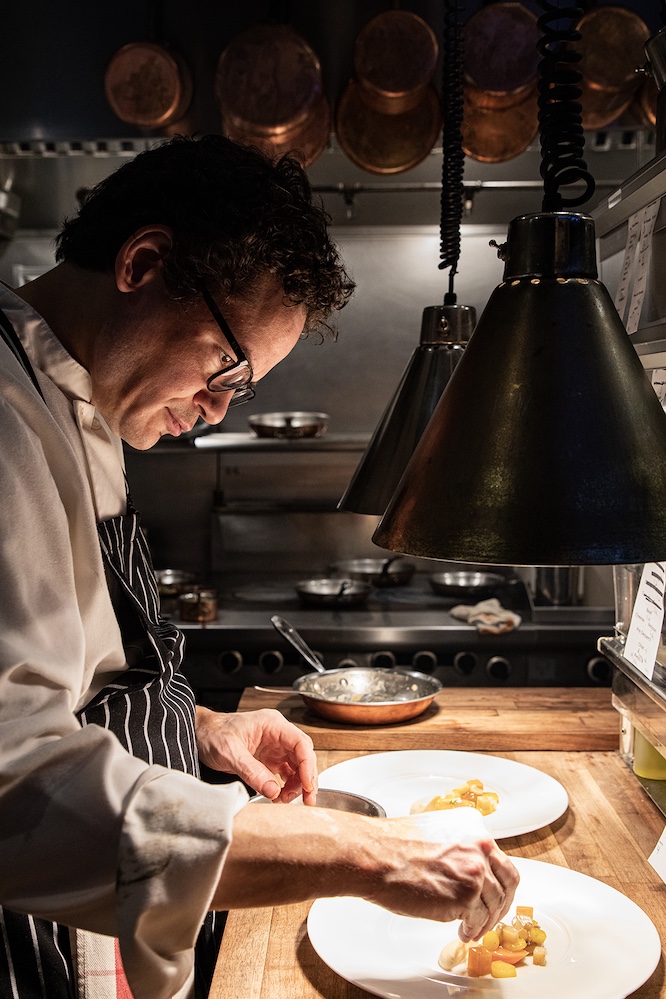 It
is a slippery slope Chef-and Sommelier owner Jared
Ian Stafford-Hill has set for himself, after
relocating Saint Urban from Syracuse (where it was
by default the finest restaurant in Northern New
York) to a Manhattan space that once housed the
wine-focused Veritas, where he once worked. Prior
to that his résumé included stages at Craft, Adour
by Alain Ducasse, Gramercy Tavern and Union
Pacific, all in New York.
It
is a slippery slope Chef-and Sommelier owner Jared
Ian Stafford-Hill has set for himself, after
relocating Saint Urban from Syracuse (where it was
by default the finest restaurant in Northern New
York) to a Manhattan space that once housed the
wine-focused Veritas, where he once worked. Prior
to that his résumé included stages at Craft, Adour
by Alain Ducasse, Gramercy Tavern and Union
Pacific, all in New York.
The décor is completely new and enchanting. Designed
by Bentel & Bentel (they also did The Modern
and Eleven Madison Park), it is not exactly
minimalist but dispenses with flourishes. Largely
it is done in earthen-gray stucco walls and
finished oak, with splendid glowing glass-leaf
sculptures overhead
and slatted wood 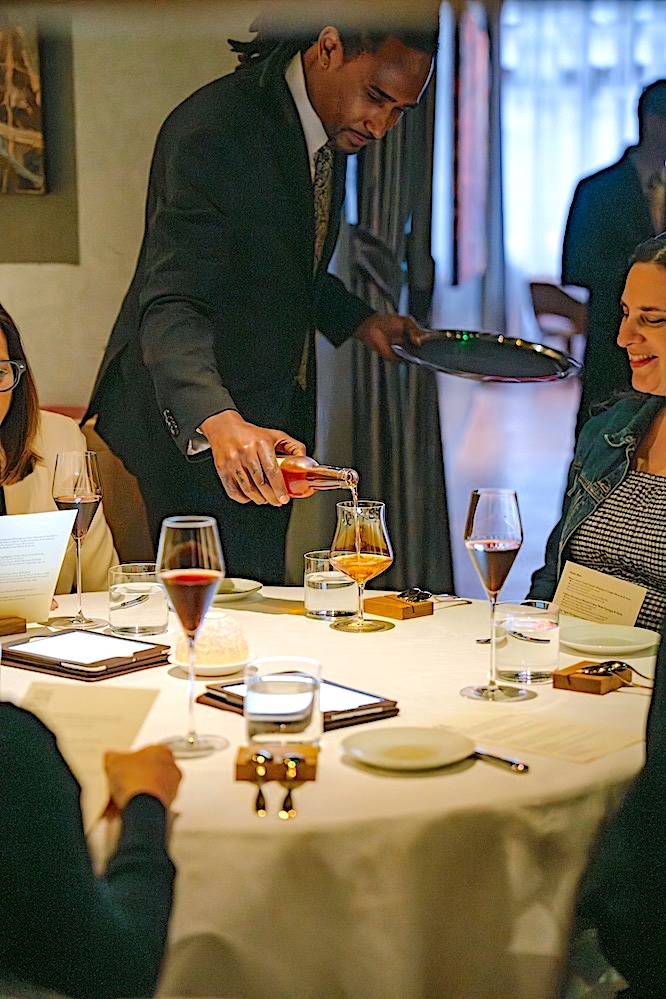 louvers
evoking
vine trunks. There is a pleasing contemplative
ambience about the dining room, with a smaller
room up at the entrance, and the focus on wine is
clear from the moment you sit down. Saint Urban,
by the way, was a Franco-German bishop deemed the
patron of winemakers.
louvers
evoking
vine trunks. There is a pleasing contemplative
ambience about the dining room, with a smaller
room up at the entrance, and the focus on wine is
clear from the moment you sit down. Saint Urban,
by the way, was a Franco-German bishop deemed the
patron of winemakers.
The whole staff is wine-imbued and very
knowledgeable, as they should be with a list as
long and comprehensive as St. Urban’s. Stemware
varies from wine to wine and all the amenities at
the table are first rate.
Stafford-Hill offers a four-course
themed tasting menu at $148, seven
courses at $188 and nine courses, called “Truffles
and Unicorns,” at $235, plus wine pairings at
three different levels of quality for $90, $175
and $410. The tasting menus are, by comparison to
similar ones around New York, something of
bargain––Restaurant Daniel, for instance, charges
$235 for five courses; at Jean-Louis $298 for six;
at Per Se $425.
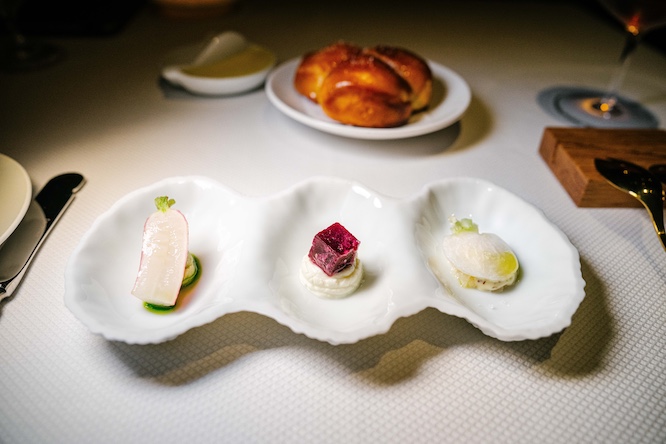 I
can readily say that the food, wine and service at
Saint Urban are all impressive, but my remarks on
what my wife and I were served are strictly based
on the July menu featuring Tuscan cuisine. This
was preceded by that of the Loire Valley in April;
the Cȏte de Beaune in May; Spain in June; and, to
come, the South of France in August and the
southern Rhȏne in September. Which, of course,
begs the question how can any chef, however
experienced and talented, embrace so many cuisines
with authority while refining them with his own
take?
I
can readily say that the food, wine and service at
Saint Urban are all impressive, but my remarks on
what my wife and I were served are strictly based
on the July menu featuring Tuscan cuisine. This
was preceded by that of the Loire Valley in April;
the Cȏte de Beaune in May; Spain in June; and, to
come, the South of France in August and the
southern Rhȏne in September. Which, of course,
begs the question how can any chef, however
experienced and talented, embrace so many cuisines
with authority while refining them with his own
take?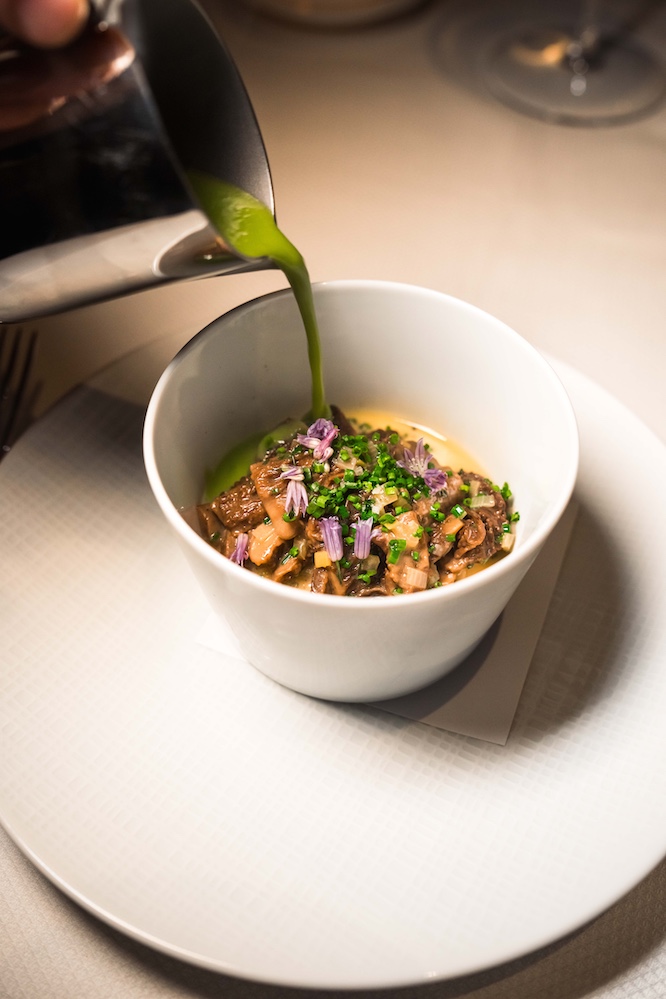
I can only report that we dined with
pleasure in July, with all dishes matched to
appropriate wines and vice-versa.
At
once a puffy, olive-oil moistened rosemary-flecked focaccia
and softened butter is presented while you sip a
small aperitif. Three amuses bouches
appeared––tender green fava beans with pecorino,
lentils, oregano and
olive oil; panzanella salad with a
confit cherry tomato, cucumber, basil, smoked
mozzarella and crouton; and braised Romano
beans, with Tuscan sofrito and opal
basil.
 There
is some choice within the courses to follow. We
began with a lustrous slice of bluefin tuna (tonnato),
dressed with basil and summer’s beans. There were
two pastas: a rich dish of cappelletti
with sweet corn, morels and a dash of
pecorino. Small, tender gnocchi were arrayed in a
ragù of winey wild
boar.
There
is some choice within the courses to follow. We
began with a lustrous slice of bluefin tuna (tonnato),
dressed with basil and summer’s beans. There were
two pastas: a rich dish of cappelletti
with sweet corn, morels and a dash of
pecorino. Small, tender gnocchi were arrayed in a
ragù of winey wild
boar.
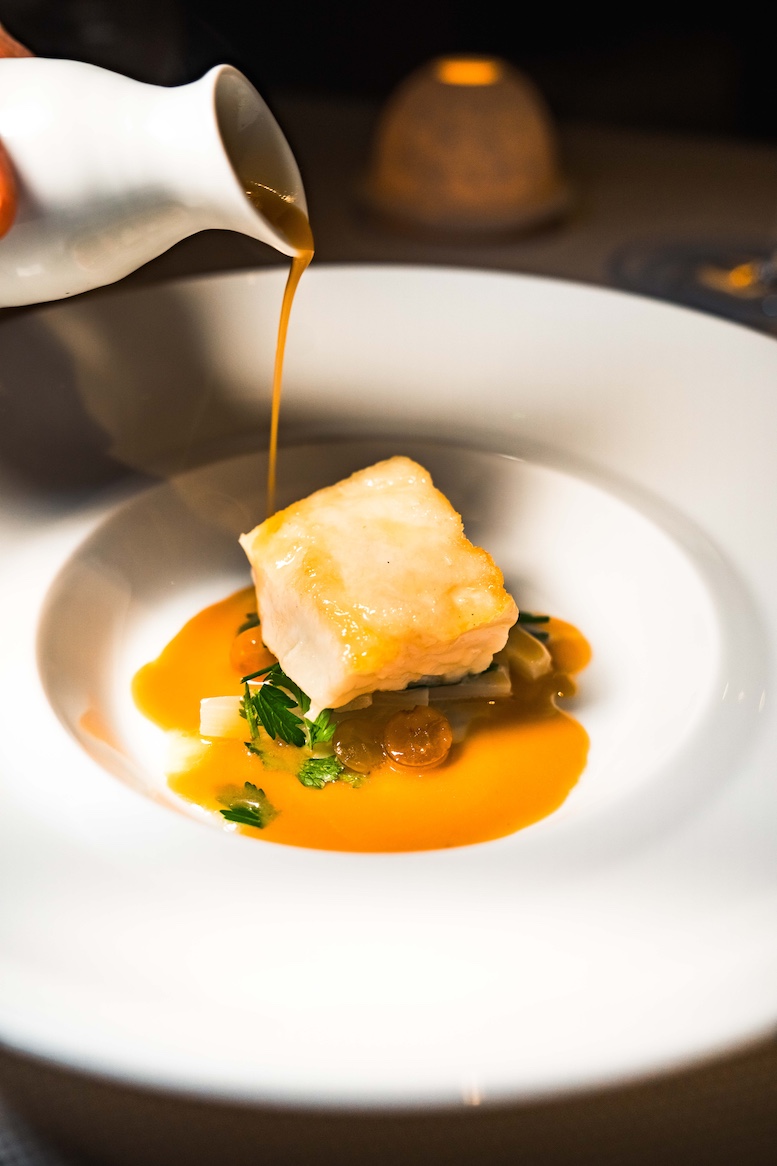
Wonderfully flakey and
velvety poached sea bass was afloat in a deeply
reduced minestrone aqua pazzo, while the
Livornese seafood stew called cacciucco
contained ample morsels of langoustine tail and
snowy cod flavored and made aromatic with fennel
and lemon. (Traditionally this dish contains
five species of seafood like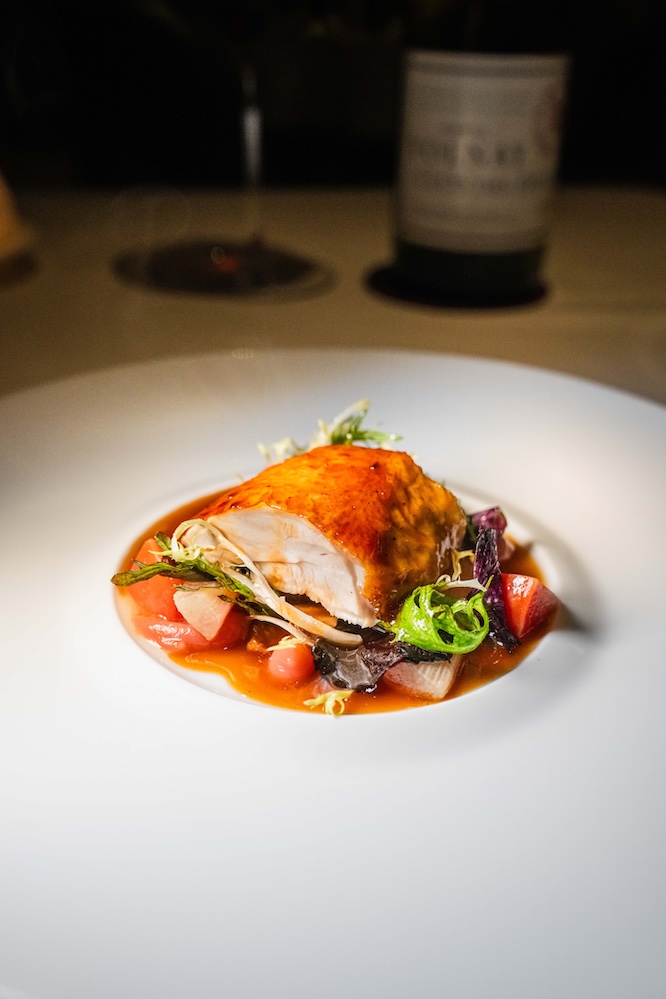 red mullet and scallops. )
Crisp-skinned guinea hen
cacciatore (hunter’s stye) with
peppers and wild mushrooms was a more subtle
dish than its name suggests, and then came a
rectangle of beef called “alla fiorentina,”
which would suggest a crusted but very rare
ribeye, but this was instead closer to tournedos
Rossini, in a luxuriously reduced demi-glace,
almost as thick as chocolate syrup, served with
eggplant, well-roasted onion and salsa verde. (Incidentally,
it’s good to see sauce spoons on the table here
so one can lap up every bit of such savory
sauces.)
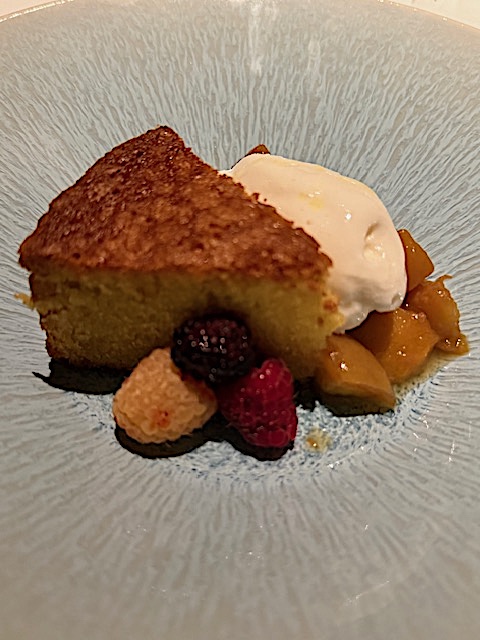
Before dessert there was
a slice of fine pecorino with arugula and
chestnut honey, followed by a simple olive oil
cake with summer fruits and delightful ricotta
sorbet.
 With
each of these courses carefully selected Tuscan
wines were poured, from a Montenidoli Vernaccia
di San Gimignano Carato 2019 and a Gaja
Ca'Marcanda Vistamare 2022 to Campriano Chianti
Classico Riserva 2012 s Fontodi Chianti Classico
2008 and a Casanova della Spinetta Toscana
Sassontino 2006, among others.
With
each of these courses carefully selected Tuscan
wines were poured, from a Montenidoli Vernaccia
di San Gimignano Carato 2019 and a Gaja
Ca'Marcanda Vistamare 2022 to Campriano Chianti
Classico Riserva 2012 s Fontodi Chianti Classico
2008 and a Casanova della Spinetta Toscana
Sassontino 2006, among others.
It was a meal to applaud,
and I would have loved for you, the reader, to
have the opportunity to enjoy it, too, but you
may have to wait another summer to do so. I can
readily understand why high-caliber chefs like
Stafford-Hill want to showcase their command and
technique in a wide array of dishes, and, had
the word “Tuscan” been taken off the July menu,
it might have been served as a meal of the season.
But I’m afraid you’re on your own if you go this
month or next or the one after that. Let me know
how it is.
Open Tues.-Sat. for
dinner.
HÔTEL ALLEMAGNE
By John Mariani
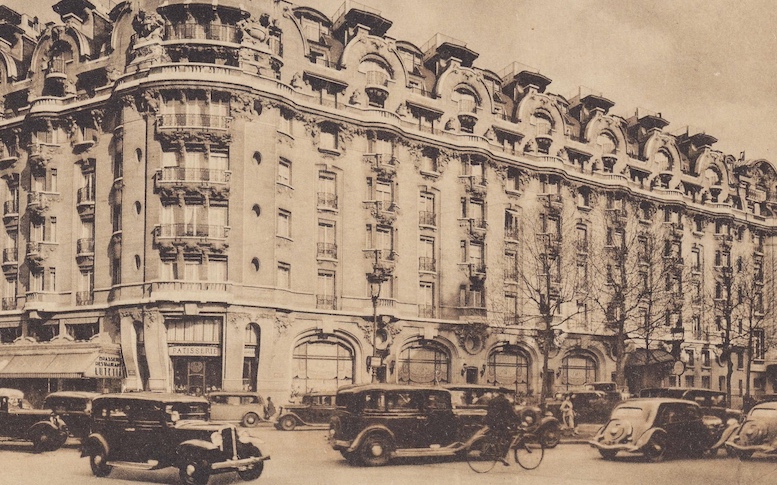
Kōvar said, “It
was a very excitable night, I can tell you
that. It was about eight o’clock, and I had
just come back from dinner with a Russian
friend who was also staying in the hotel. We
had had a Cognac in the bar, then I went
upstairs to bed. I was in the bathroom when
all of a sudden I began to feel strangely
fatigued. I thought it was the wine and the
Cognac, though I’d never felt quite that way
before. I
went to bed and fell asleep quickly, but when
I woke up I was feeling a little dizzy at
first. I went in to sit on the bed, and my
breathing became heavy and I started to cough
violently. In some ways it felt like a flu
when it first begins, but this was very, very
fast. I tried to lie down and let it pass but
by morning it was becoming more difficult to
breathe every moment. My head started
pounding, too. This was just not normal.”
“What time was this?” asked David.
“About nine in the morning. Then,
outside my room I heard a great deal of
bustling about, so I opened the door and found
all these people in the hallway, many of them
coughing and most bracing themselves on the
hotel wall. I was walking very weakly, trying
not to fall over. I passed my Russian friend’s
door and banged on it but there was no answer,
so I kept on to the stairs. We were only on
the third floor so some of us walked down,
holding onto the banister. From the first
floor landing I could see, I don’t know, ten,
fifteen people in the lobby, some sitting in a
chair and others collapsed on the floor. The
hotel night staff also showed signs of
illness. Within moments more people staggered
down the stairs and others literally fell out
of the elevator door when it opened. It was
terrible, and women started to scream in
panic.
“It felt like an eternity but I later
learned the police and the ambulances were
there at the front door within minutes. Next
thing I knew I was being placed on a stretcher
and carried to an ambulance. By then there
must have been a dozen ambulances at the
hotel, and the last thing I remember before
passing out was the sound of police cars and
emergency vehicles’ blaring horns coming from
all directions.
“I woke up in the hospital around five
o’clock that evening with an oxygen tube in my
nose.”
“It all sounds terrifying,” said
Catherine. “Not knowing what the cause was.”
“At first I thought it was some kind of
gas attack,” said Kōmar, “even though I didn’t
smell anything. There was no smoke, no
explosion. In the hospital I was told that it
had been some kind of germ that had gone
through the hotel and sickened everyone, or at
least those below the seventh floor. Only
later that day did I heard about the incidents
at the other two hotels. It’s a terrible,
terrible tragedy. But, at least no one has
died from it. Yet.”
“Did you ever find out what happened to
your Russian friend?”
“Ilya? No, I didn’t see him in the
lobby when I stumbled down there. I remember
that the
night before he got into the elevator
with me just before the door closed. We went
up to the third floor and I said, ‘After you,
Ilya,’ but he said he was going up to another
floor. Which was odd, now that I think of it,
because his room was on the third floor where
mine was. I don’t know where he was going.
Maybe a business associate.”
“So, this would have been before ten
o’clock?” asked David.
“Yes, perhaps eighty-thirty or nine. I
started feeling really sick about around
midnight.”
The three Americans looked at each
other, and Catherine asked, “Have you been in
touch with this Ilya since the attack?”
“No, we were not so close that he would
come see me in the hospital, assuming he was
not ill. Besides, all the patients were
restricted from having visitors until we were
released.”
 “So, you
don’t know if Ilya did become sick or not,”
said Katie.
“So, you
don’t know if Ilya did become sick or not,”
said Katie.
“No, I have no idea. He’s attached to
the Russian Embassy here so you might inquire
here.”
“I think we’d better,” said David,
glancing at Katie and Catherine.
They did so immediately by showing up
at the embassy on the Boulevard Lannes, just
off the Bois de Boulogne. It was a brutishly
modern structure with not a single reference
to French architectural tradition. It was very
wide, with two floors composed of two slabs,
with an endless series of banal rectangular
windows and a rooftop with visible heating and
air-conditioning units and other box
structures containing whatever it was they
contained.
The interior lacked any decorous
interest as well, and it reminded Katie of the
dreary quarters of the Russian security
service headquarters in Moscow that Katie and
David had visited on another investigation.
There was a long desk manned by three
attendants and four armed soldiers milling
around the lobby.
Catherine spoke to an attendant in
French, explaining that they she was a
journalist from CNN International and these
were journalists from the United States.
“We’d like to inquire if Ambassador
Ilya Bazarov would be available to speak with
us.”
The woman asked what this was in
reference to. Catherine said they were
interviewing people who had been at the Hôtel
Anastasia the night of the event. The woman
said nothing but made a phone call, speaking
in Russian. Two minutes later she picked up
the phone, saying several times, “Da. . .
da. . . da,” hung up then said, “I am
afraid the Ambassador cannot see you at this
time, but if you wish to e-mail some
questions, I will see that he gets them.”
Catherine said thank you and left her
card, in case the ambassador wished to speak
with her directly. The woman nodded, hit a
buzzer to open the door and said, “Au
revoir.”
“That’s about the way I thought it’d
go,” said Catherine, outside.
“I’m sure Ilya is a very busy man,”
David said sarcastically.
“And I’m sure he would never answer our
questions without having them in writing, then
gone over by his superiors, if they’d let him
answer at all.”
David suggested their next stop should
be to talk with Catherine’s concierge friend
at the Anastasia. Katie said, “Why don’t you
two go ahead. I’m going to try to speak with
Dr. Baer as to any update on the virus.”
Katie took the Métro back to her hotel,
while Catherine attempted to reach her friend
Yves, whose phone recorder said he would call
back as soon as possible.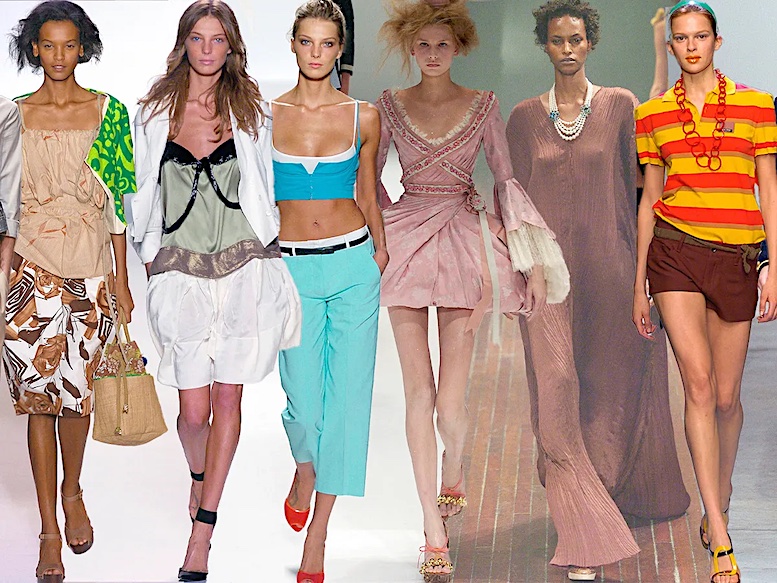
“What now?” asked David.
“Well, I’ve got to hustle to get to the
fashion show. It’s Courrèges today, then
Lagerfeld.”
“Okay, I’ll just stroll the boulevards.
I have to pick up my new jacket, too.”
When he was a cop, David
knew most every neighborhood in New York and
felt knowledgeable about most of them. He even
spoke a little street Spanish, so he could
make himself understood in various Latino
neighborhoods. On the rare occasions he had
been in a foreign country—outside of London
and Dublin—he usually only had contact with
English-speaking colleagues in the police
departments. Katie had been able to handle
Italian and French well enough so that he felt
pretty comfortable when they had travelled to
Rome, Naples and now Paris.
Now here he was feeling sheepish and
lost, reluctant to ask anyone for directions,
still queasy about how to plot a trip on the
Métro, and, even though he was getting hungry
for lunch, he felt funny about opening a menu
all in French. Why do so few Parisians speak
English? he thought. So, to alleviate any
fears of appearing like a total American jerk,
he simply returned to his hotel and had lunch
there. About an hour later, that’s where Katie
found him finishing off a slice of tarte Tatin
and coffee.
Katie knew enough not to ask a question
like “What are you doing here?” knowing it
would sound like she knew the reason why David
was having lunch in a safe place. So, she just
said, “Hey, I’m glad you’re here. I just got
off the phone with Baer and Catherine called
and said we could go over to Yves’s apartment
to speak with him this afternoon at four.”
“Great news,” said David, signing his
check. “Gives us time to pick up my new
jacket. So, what did Baer have to say?”
“She said that most people were being
let out of the hospital and that they’re no
longer infectious. Which means there are a lot
more potential guests we could interview, I
suppose. I asked her how serious the virus
was, and she said that it had been carefully
engineered not to be a killer,
although the immediate effects were far more
debilitating than a seasonal flu. She said
that many of the elderly patients would
probably remain in the hospital, and a few had
developed pneumonia, which kills more old
people than the virus itself, so there could
still be some deaths.”
“Meaning that whoever stole this
particular virus knew that it was not all that
deadly,” said David. “And that means that the
attack was more of a scare tactic.”
“Uh-huh, a tactic that would
effectively put the hotels out of commission
for a long time.”
“Did Baer say how long?”
“She said it’s hard to tell because,
first, it’s a brand new virus, and second,
because even if you scrub down and fumigate
every interior surface, it could linger deep
in the recesses of the air ducts for who know
how long.”
“So, there’ll be no way anyone will
want to stay at those hotels until there’s a
guarantee every trace had been wiped out.”
“That’s what she suggested would be the
case. And even after the hotels tell everyone
they’re absolutely in no danger, how many
people are going to take the chance?”
“Which all coincides with our theory
that this incident was not just to hurt and
embarrass the Saudi owners but to make the
value of the properties plummet.”
“Frankly,” said Katie, “Whatever the
Saudis spent to buy those hotels is a drop in
their bucket, or should I say just a few
buckets of oil. They must also be insured. I
don’t know what French insurance companies are
like, but this was obviously no act of God. I
don’t know where they stand on terrorist
attacks.”
“Neither do I,” said David, “but I hear
the insurers of all the 9/11 businesses are
eventually going to have to pay billions.”
“Well, we’ll see. Baer did say she
didn’t expect any more widespread infections,
although the people who did not get sick that
night may not have had symptoms and might have
carried the virus to wherever they went after
the incident, but it’s a low probability.”
The two had a couple of hours before
the meeting with Yves, so they walked over to
the men’s store to pick up David’s new jacket.
He’d even put on a fresh shirt for the event.
“Whaddaya think?” he said, hunching his
shoulders up and down, the way men do when
putting on a new jacket.
“You look really good, very. . .
debonair?”
“Maybe I
should buy a beret and start tying my scarf
the way they do over here.”
“One
step at a time, Monsieur, one step at a time.”
David
had to admit the jacket looked and fit a lot
better than his old blazer. “Makes me look
taller,” he said, pulling down his shirt
cuffs.
He paid the bill—which was
more than twice what he’d ever paid for a
jacket—extended his arm to Katie and said,
“Well, Mademoiselle, may I have the pleasure
of a stroll through Par-ee with you?”
© John Mariani, 2024
❖❖❖
THE WINES OF MICHIGAN
By John Mariani

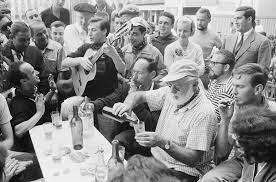 Michigan
homeboy Ernest Hemingway wrote that
“wine is one of the most civilized things in the
world and one of the natural things of the world
that has been brought to the greatest perfection.” If he could
return to the state today, he’d find a flourishing
wine industry. Ten years ago the state had 56 vineyards
spread over 1,800 acres, producing 425,000
cases,
13th in the nation for wine production. Today the number of
wineries in Michigan is 258 wineries spread over
3,300 acres of vineyards, bringing in more than $5.5 billion in
wine sales and ecotourism; the state ranks seventh
in the US for wine production.
Michigan
homeboy Ernest Hemingway wrote that
“wine is one of the most civilized things in the
world and one of the natural things of the world
that has been brought to the greatest perfection.” If he could
return to the state today, he’d find a flourishing
wine industry. Ten years ago the state had 56 vineyards
spread over 1,800 acres, producing 425,000
cases,
13th in the nation for wine production. Today the number of
wineries in Michigan is 258 wineries spread over
3,300 acres of vineyards, bringing in more than $5.5 billion in
wine sales and ecotourism; the state ranks seventh
in the US for wine production.
Most of
the quality bottled wine of Michigan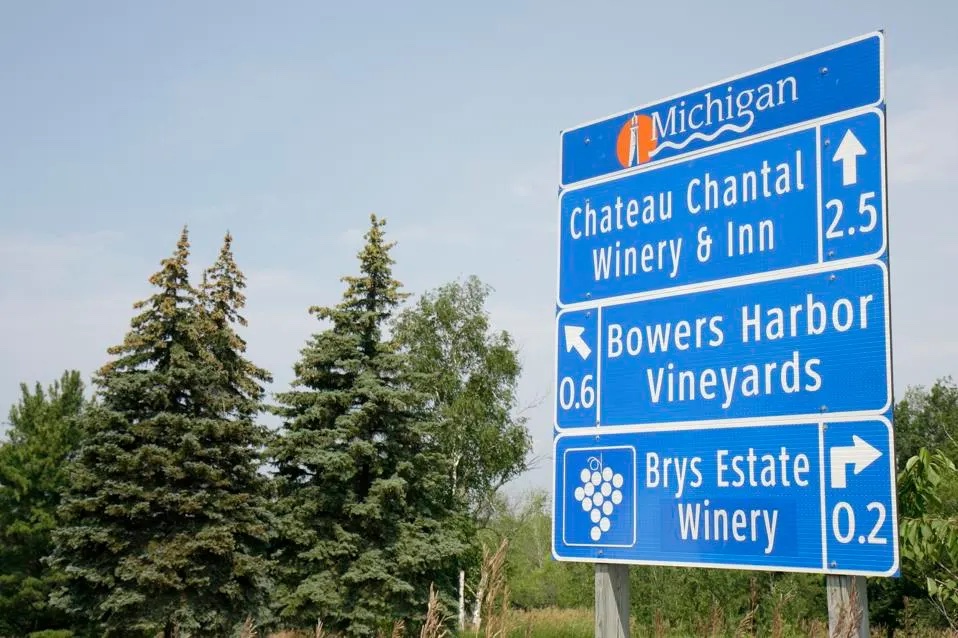 is produced in
the five American
Viticultural Areas (AVAs) of
Fennville, Lake Michigan Shore, Leelanau Peninsula,
Old Mission Peninsula and the Tip of Mitt. The Upper
Peninsular is also gaining in interest and number of
wineries.
is produced in
the five American
Viticultural Areas (AVAs) of
Fennville, Lake Michigan Shore, Leelanau Peninsula,
Old Mission Peninsula and the Tip of Mitt. The Upper
Peninsular is also gaining in interest and number of
wineries.
I was surprised to find that
while some wineries still use foxy native grapes
like Concord ice wines do well in the cold
north––overwhelmingly sweet wines up through the
1970s, but these days more are using
French-American hybrids like Vignoles and
Chambourcin and European varietals like Riesling,
which does
well in cold climates. Northern Michigan areas like
Traverse City, the Leelanau Peninsular, and the Old
Mission Peninsular with more temperate microclimates
do well with chardonnay and merlot. The warming of
the climate should be a boon to the industry in the
future.
Michiganders
are very proud of their wines, ubiquitous in wine
stores, groceries, and restaurants, and the vintners
seem to delight in giving their wines catchy, even wacky names, like Left
Foot Charley, Karma Vista, Fishtown White, Sex,
Detention, and Hotrod Cherry, along with Madonna,
made by Silvio and Joan Ciccone, who happen to be
the pop star’s mother and father.
What to look for?
My favorites after a week of drinking only Michigan
wines included the
bright, refreshing Bowers Harbor Vineyard Riesling
($15) from the Old Mission Peninsula (above).
Also
fine was Chateau Grand Traverse Dry Riesling ($13),
with a fresh, clean, briskness. The best red wine I
tried was also from Bowers Harbor, a pinot noir with
true varietal flavor reminiscent of some of the best
out of Oregon, if not quite up to French Burgundy.
By the way, Michigan law
permits shipping to “reciprocal states” only, so
best check with Fed-Ex if you can get receive them
where you live.
If so, try Folgarelli’s Wine Shop in Traverse
City (231-941-7651).
❖❖❖
ACQUIRED TASTES NO
ONE NEEDS TO ACQUIRE
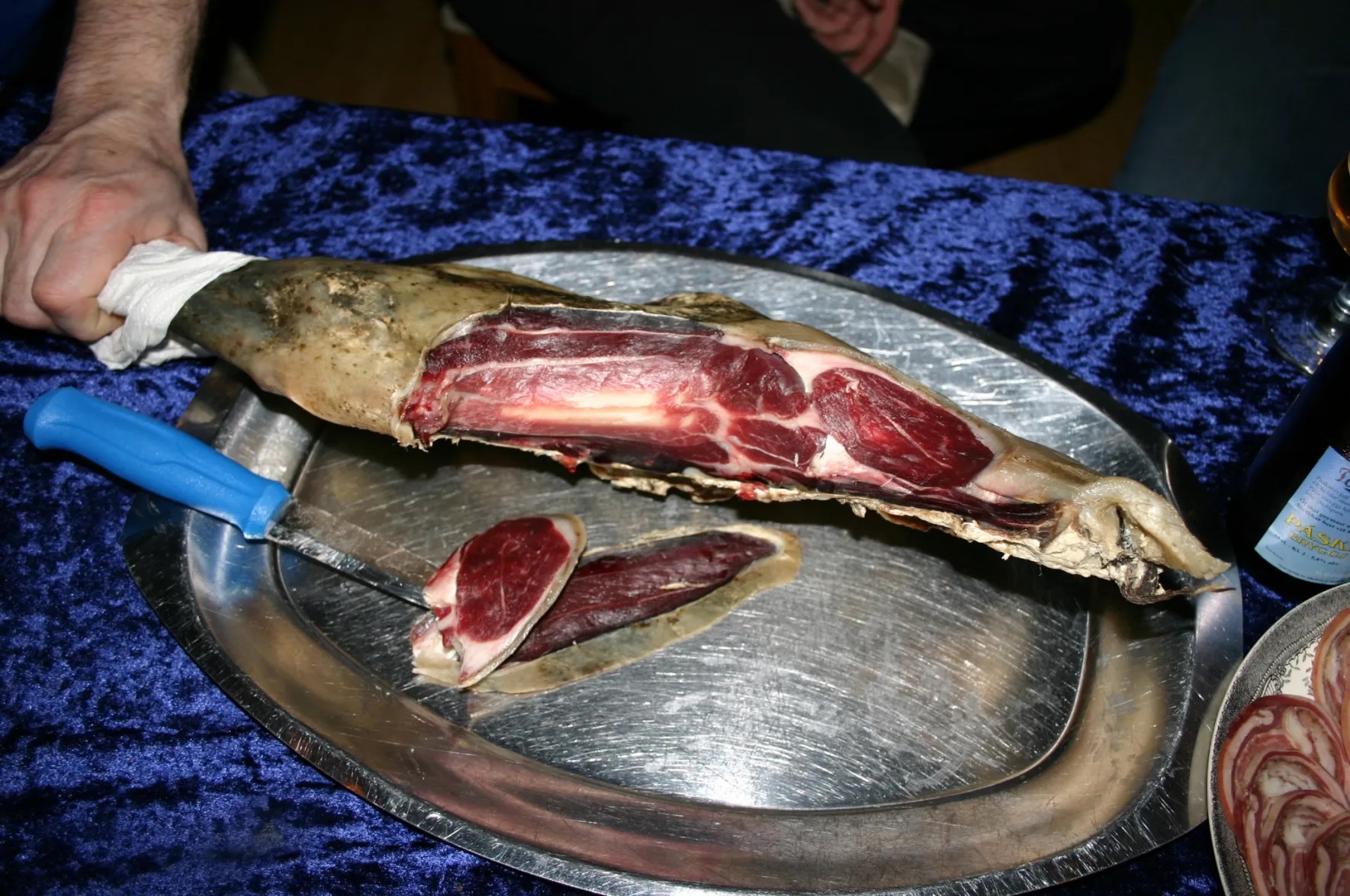
"To make skerpikjot, the signature dish of Faroese cooking, a freshly slaughtered lamb must be hung out to dry in the mineral-rich islands’ winds for so long that it starts to ferment. Then, reeking of death and coated with a fine layer of mould, the meat is ready to eat. It would be underselling it to describe skerpikjot as an acquired taste. While universally popular among Faroe Islanders, those from overseas may struggle to develop an appreciation."––"I tried mouldy lamb at the world’s most remote Michelin-star eatery at Paz in the Faroe Island." The London Times (7/25).
❖❖❖
Any of John Mariani's books below may be ordered from amazon.com.
 The Hound in Heaven
(21st Century Lion Books) is a novella, and
for anyone who loves dogs, Christmas, romance,
inspiration, even the supernatural, I hope you'll find
this to be a treasured favorite. The story
concerns how, after a New England teacher, his wife and
their two daughters adopt a stray puppy found in their
barn in northern Maine, their lives seem full of promise.
But when tragedy strikes, their wonderful dog Lazarus and
the spirit of Christmas are the only things that may bring
his master back from the edge of despair.
The Hound in Heaven
(21st Century Lion Books) is a novella, and
for anyone who loves dogs, Christmas, romance,
inspiration, even the supernatural, I hope you'll find
this to be a treasured favorite. The story
concerns how, after a New England teacher, his wife and
their two daughters adopt a stray puppy found in their
barn in northern Maine, their lives seem full of promise.
But when tragedy strikes, their wonderful dog Lazarus and
the spirit of Christmas are the only things that may bring
his master back from the edge of despair. WATCH THE VIDEO!
“What a huge surprise turn this story took! I was completely stunned! I truly enjoyed this book and its message.” – Actress Ali MacGraw
“He had me at Page One. The amount of heart, human insight, soul searching, and deft literary strength that John Mariani pours into this airtight novella is vertigo-inducing. Perhaps ‘wow’ would be the best comment.” – James Dalessandro, author of Bohemian Heart and 1906.
“John Mariani’s Hound in Heaven starts with a well-painted portrayal of an American family, along with the requisite dog. A surprise event flips the action of the novel and captures us for a voyage leading to a hopeful and heart-warming message. A page turning, one sitting read, it’s the perfect antidote for the winter and promotion of holiday celebration.” – Ann Pearlman, author of The Christmas Cookie Club and A Gift for my Sister.
“John Mariani’s concise, achingly beautiful novella pulls a literary rabbit out of a hat – a mash-up of the cosmic and the intimate, the tragic and the heart-warming – a Christmas tale for all ages, and all faiths. Read it to your children, read it to yourself… but read it. Early and often. Highly recommended.” – Jay Bonansinga, New York Times bestselling author of Pinkerton’s War, The Sinking of The Eastland, and The Walking Dead: The Road To Woodbury.
“Amazing things happen when you open your heart to an animal. The Hound in Heaven delivers a powerful story of healing that is forged in the spiritual relationship between a man and his best friend. The book brings a message of hope that can enrich our images of family, love, and loss.” – Dr. Barbara Royal, author of The Royal Treatment.
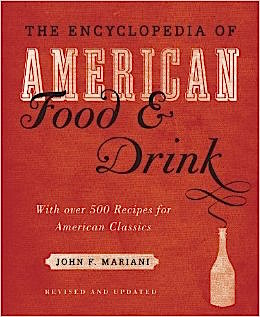 |
The Encyclopedia of American Food and Drink by John F. Mariani (Bloomsbury USA, $35) Modesty forbids me to praise my own new book, but let me proudly say that it is an extensive revision of the 4th edition that appeared more than a decade ago, before locavores, molecular cuisine, modernist cuisine, the Food Network and so much more, now included. Word origins have been completely updated, as have per capita consumption and production stats. Most important, for the first time since publication in the 1980s, the book includes more than 100 biographies of Americans who have changed the way we cook, eat and drink -- from Fannie Farmer and Julia Child to Robert Mondavi and Thomas Keller. "This book is amazing! It has entries for everything from `abalone' to `zwieback,' plus more than 500 recipes for classic American dishes and drinks."--Devra First, The Boston Globe. "Much needed in any kitchen library."--Bon Appetit. |
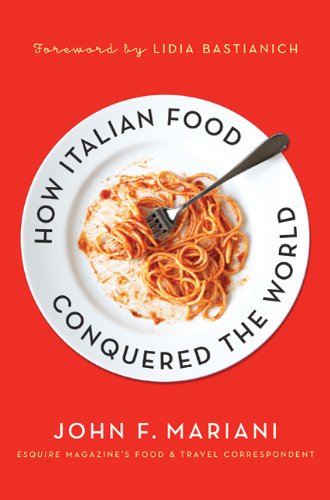
"Eating Italian will never be the same after reading John Mariani's entertaining and savory gastronomical history of the cuisine of Italy and how it won over appetites worldwide. . . . This book is such a tasteful narrative that it will literally make you hungry for Italian food and arouse your appetite for gastronomical history."--Don Oldenburg, USA Today. "Italian
restaurants--some good, some glitzy--far
outnumber their French rivals. Many of
these establishments are zestfully described
in How Italian Food Conquered the World, an
entertaining and fact-filled chronicle by
food-and-wine correspondent John F.
Mariani."--Aram Bakshian Jr., Wall Street
Journal.
"Equal parts
history, sociology, gastronomy, and just
plain fun, How Italian Food Conquered the
World tells the captivating and delicious
story of the (let's face it) everybody's
favorite cuisine with clarity, verve and
more than one surprise."--Colman Andrews,
editorial director of The Daily
Meal.com. "A fantastic and fascinating
read, covering everything from the influence
of Venice's spice trade to the impact of
Italian immigrants in America and the
evolution of alta cucina. This book will
serve as a terrific resource to anyone
interested in the real story of Italian
food."--Mary Ann Esposito, host of PBS-TV's
Ciao
Italia. "John Mariani has written the
definitive history of how Italians won their
way into our hearts, minds, and
stomachs. It's a story of pleasure over
pomp and taste over technique."--Danny Meyer,
owner of NYC restaurants Union Square
Cafe, The Modern, and Maialino.
|
 |
 |
 |
 |
 |
 |
MARIANI'S VIRTUAL GOURMET
NEWSLETTER is published weekly. Publisher: John Mariani. Editor: Walter Bagley. Contributing Writers: Christopher
Mariani, Misha Mariani, John A. Curtas, Gerry Dawes, Geoff Kalish.
Contributing
Photographer: Galina Dargery. Technical
Advisor: Gerry
McLoughlin.
If you wish to subscribe to this
newsletter, please click here: http://www.johnmariani.com/subscribe/index.html
© copyright John Mariani 2025