MARIANI’S
Virtual Gourmet
August 17, 2025
NEWSLETTER
Founded in 1996
ARCHIVE
%20SEE%20INDIA%20:%20AJANTA%20FRESCOES%20:%20CAVE%20TEMPLES.%201934.%20.jpg)
India Travel Poster 1934
THIS WEEK
SULMONA, ITALY
By John Mariani
NEW YORK CORNER
GRAND BRASSERIE
By John Mariani
HÔTEL ALLEMAGNE
CHAPTER TWENTY-THREE
By John Mariani
NOTES FROM THE WINE CELLAR
THE LAST ROSÉS OF SUMMER
MAKE FOR GOOD AUTUMN WINES
By John Mariani
A DAY TRIP FROM ROME:
SULMONA, ITALY
By John Mariani
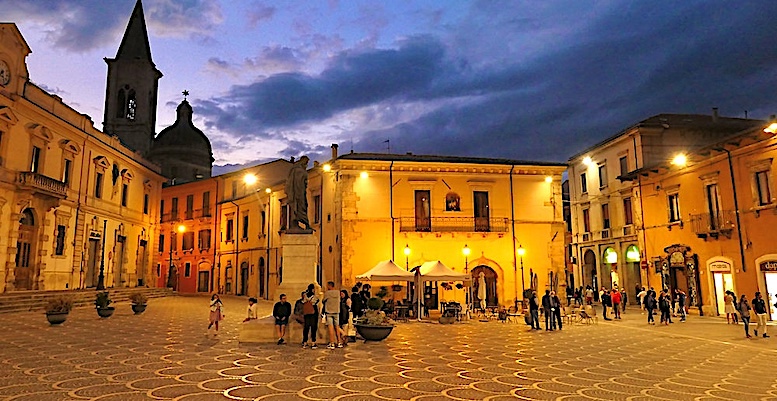
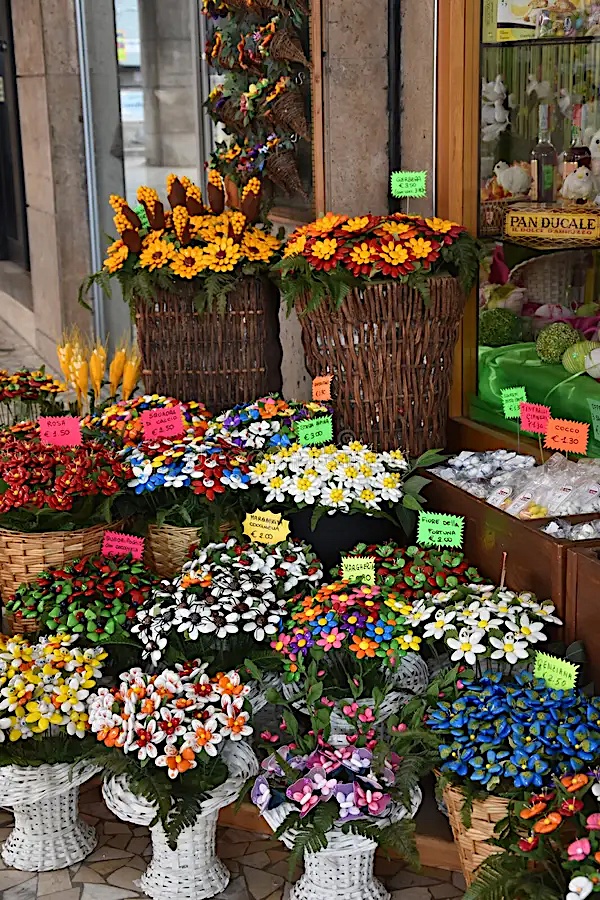
If you’ve ever attended an Italian
wedding you were probably given a netted bag
of confetti––white sugar-coated
almonds , as a parting gift. And chances are
they came from the town of Sulmona in
Italy’s Abruzzo region, and very probably
from Confetti Mario Pellino, which
has been producing them since 1783. 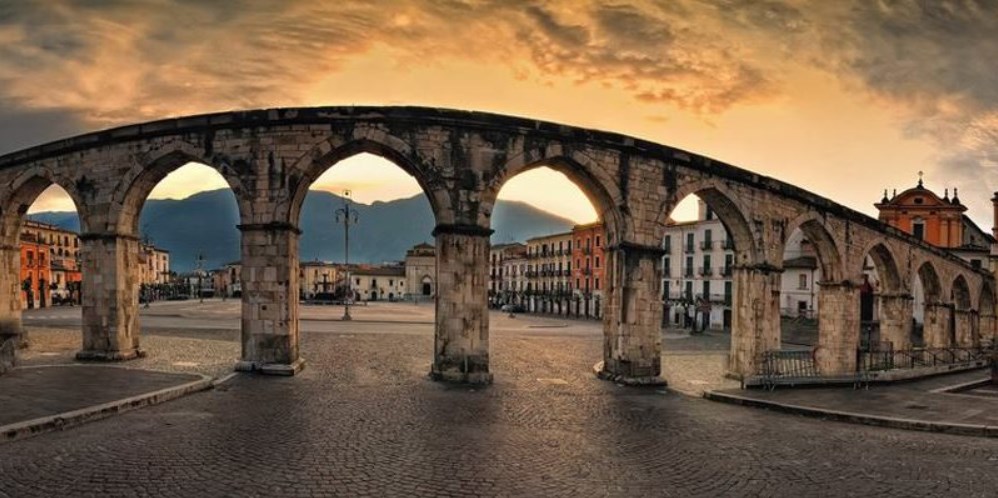
 Were
you ever to visit Sulmona, which is a small,
reclusive town two hours' drive from Rome,
there are several touristic attractions
outside of its Cathedral and the
medieval-Renaissance Palazzo Annunziata and
Church of Saint Annunziata, where you will
find dozens of shops selling confetti,
brightly colored and knitted into various
shapes of flowers and wreaths. There is also a
Piazza Garibaldi with a large baroque
fountain, where at Easter at the ceremony of
the Madonna che Scappa, a bronze
statue of the Virgin Mary is carried by the
remarkably well-preserved 12th
century Gothic aqueduct. Sulmona gave the
Catholic world a pope, Innocent VII in the 15th
century. Piazza XX Settembre is the location
of Sulmona’s foremost town’s historical
figures, the
Were
you ever to visit Sulmona, which is a small,
reclusive town two hours' drive from Rome,
there are several touristic attractions
outside of its Cathedral and the
medieval-Renaissance Palazzo Annunziata and
Church of Saint Annunziata, where you will
find dozens of shops selling confetti,
brightly colored and knitted into various
shapes of flowers and wreaths. There is also a
Piazza Garibaldi with a large baroque
fountain, where at Easter at the ceremony of
the Madonna che Scappa, a bronze
statue of the Virgin Mary is carried by the
remarkably well-preserved 12th
century Gothic aqueduct. Sulmona gave the
Catholic world a pope, Innocent VII in the 15th
century. Piazza XX Settembre is the location
of Sulmona’s foremost town’s historical
figures, the 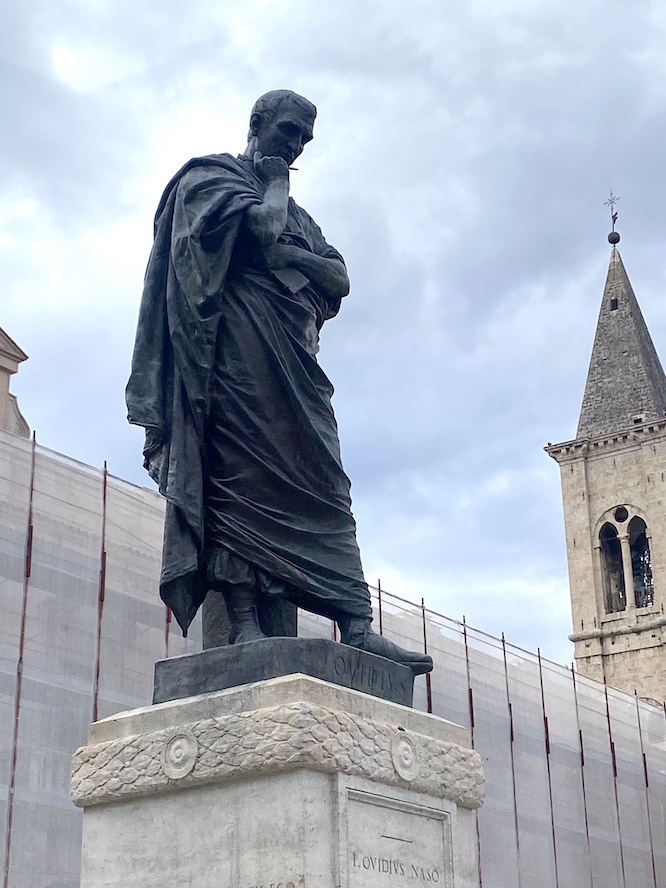 greatest
Roman poet Ovid, whose bronze statue stands
sternly atop a pedestal. As the author of the
witty Metamorphoses, he was a canny observer
of the goodness and follies of the Romans, and
wrote, ““I am
the poet of the poor, because I was poor
when I loved; since I could not give gifts,
I gave words.”
greatest
Roman poet Ovid, whose bronze statue stands
sternly atop a pedestal. As the author of the
witty Metamorphoses, he was a canny observer
of the goodness and follies of the Romans, and
wrote, ““I am
the poet of the poor, because I was poor
when I loved; since I could not give gifts,
I gave words.”
Located up a winding road, Sulmona itself is
fairly flat and easy to walk through, and
there are several very good restaurants that
feature the cooking of Abruzzo. Semina
Cucina Agricola, which is
committed to locality and seasonality within a
39 tasting menu of five courses. There’s a
lavish antipasto table at Ristorante
Hostaria del’Arco, and the pasta to have
is the tagliatelle with zucchini cream.
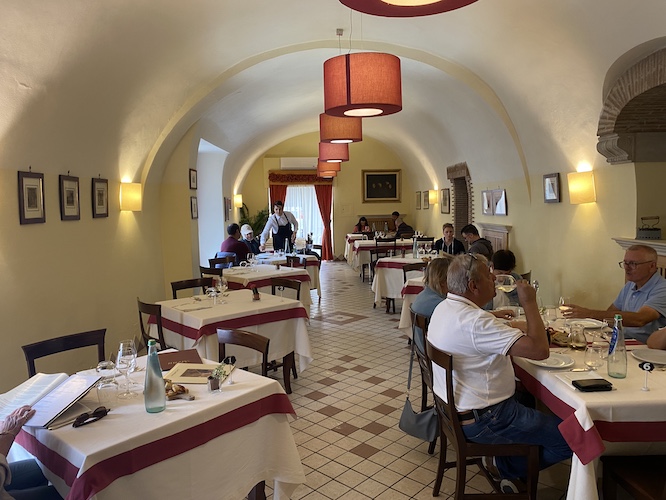 On
my last visit to the town I ate at the
charming, sunny Ristorante Clemente
Sulmona (Via Solimo 25), located
just inside the town’s ancient gate. Begin
with some local Abruzzese cheeses from Casari
e Pastori, like
Pecorino, caciocavallo and pampanella goat’s
cheese along with salami like salamella di
tratturo made form mutton and the
locally revered salsiciotto di Guilmi
of simply salt-cured pork, served
with puffy pizza-like
On
my last visit to the town I ate at the
charming, sunny Ristorante Clemente
Sulmona (Via Solimo 25), located
just inside the town’s ancient gate. Begin
with some local Abruzzese cheeses from Casari
e Pastori, like
Pecorino, caciocavallo and pampanella goat’s
cheese along with salami like salamella di
tratturo made form mutton and the
locally revered salsiciotto di Guilmi
of simply salt-cured pork, served
with puffy pizza-like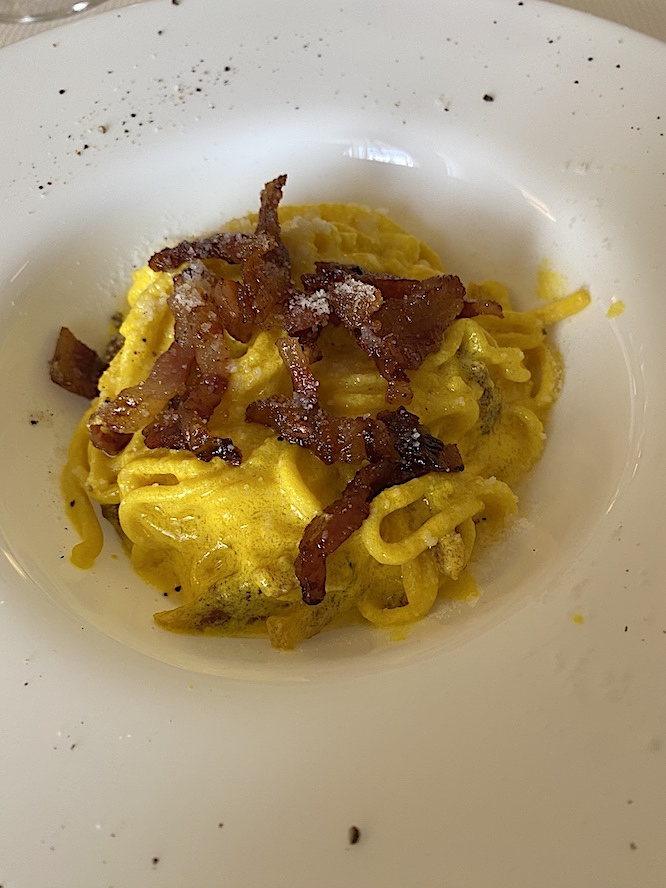 bread. Next came the Abruzzese specialty spaghetti
alla ghitarra, cut on a
guitar-string-like interment, served with
crispy pancetta bacon and local
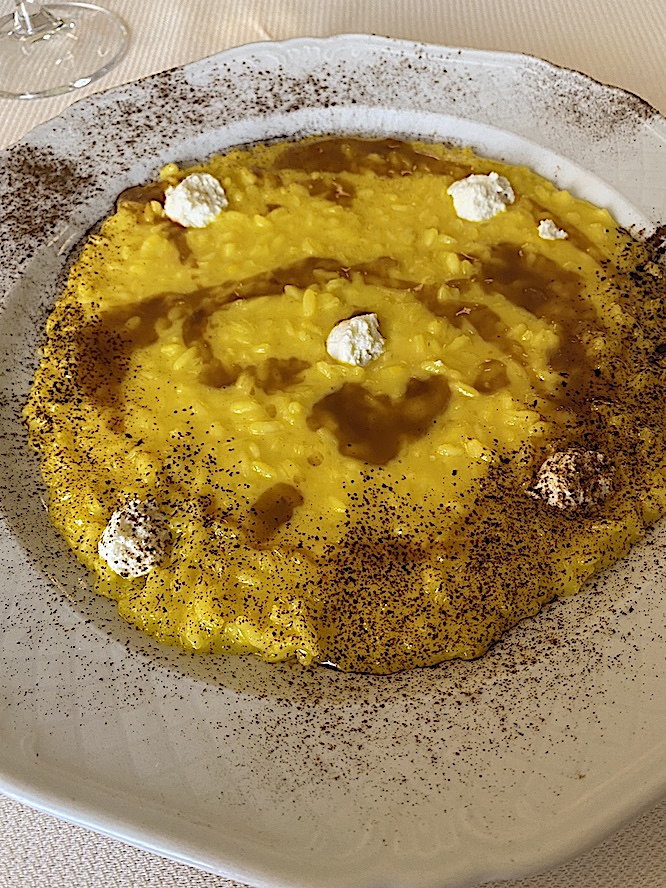
saffron. Risotto made from Canaroli rice also
had saffron with an addition of anise, along
with ricotta and salami-studded lamb ragù.
(Half portions are also available.) For
dessert the signature sweet here is pan
dell’Orso semi-freddo.
bread. Next came the Abruzzese specialty spaghetti
alla ghitarra, cut on a
guitar-string-like interment, served with
crispy pancetta bacon and local
saffron. Risotto made from Canaroli rice also
had saffron with an addition of anise, along
with ricotta and salami-studded lamb ragù.
(Half portions are also available.) For
dessert the signature sweet here is pan
dell’Orso semi-freddo.
 The wine list is especially good for
bottlings like Montepulciano d’Abruzzo––the
Faraie label is very good and Trebbiano
d’Abruzzo. The menu has English translations.
The wine list is especially good for
bottlings like Montepulciano d’Abruzzo––the
Faraie label is very good and Trebbiano
d’Abruzzo. The menu has English translations.
Ovid, by
the way, seems to have been something of a
vegetarian, writing, “I am
the poet of the poor, because I was poor
when I loved; since I could not give gifts,
I gave words.”
O
mortals, do not pollute your bodies with
food so impious [the flesh of animals]! You
have the fruits of the earth, you have
apples, bending down the branches with their
weight, and grapes swelling in ripeness on
the vines, you also have sweet herb.” And
not much of a drinker, saying, "There is more
refreshment and stimulation in a nap, even of
the briefest, than in all the alcohol ever
distilled", notes Ovid.
NEW YORK CORNER
Grand Central Terminal
By John Mariani
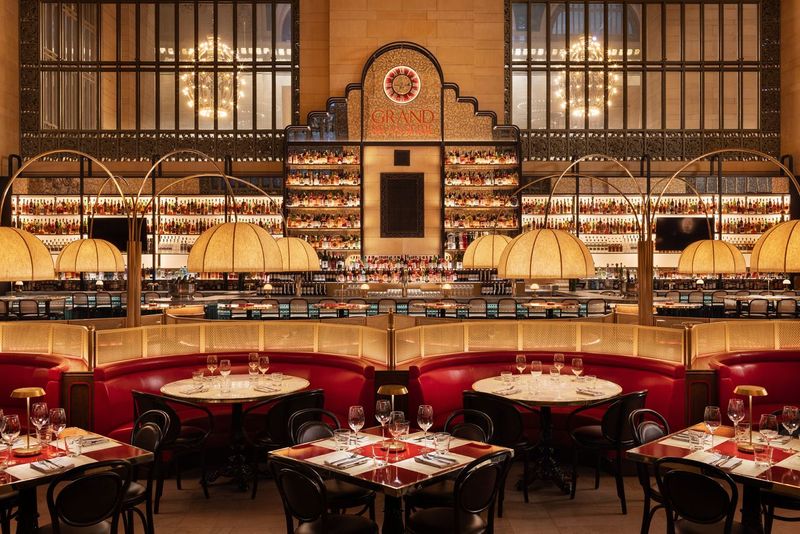
I am
very greedy when it comes to using two words:
“grand” and “unique.” Though the name of the
restaurant in this review is a form of
self-description, it truly is in every way
grand. And indeed, it is unique, meaning one
of a kind and nothing like it.
It could hardly be otherwise, located as it is
within the glorious cavern of what had once been
Grand Central Terminal’s once dismal waiting
room, called Vanderbilt Hall, facing East 42nd
Street. Opened in 1913 and stunningly restored
in 1998, the 6,000 square foot space with
55-foot ceilings and gold chandeliers, the room
is now divided into exhibition space and Grand
Brasserie, whose décor by the Rockwell Group
respects all the finest features of the Beaux
Arts original, so that it would fit equally well
into a Paris train station of this size, similar
to Le Train Bleu in the Gare de Lyon, though not
as flamboyant.
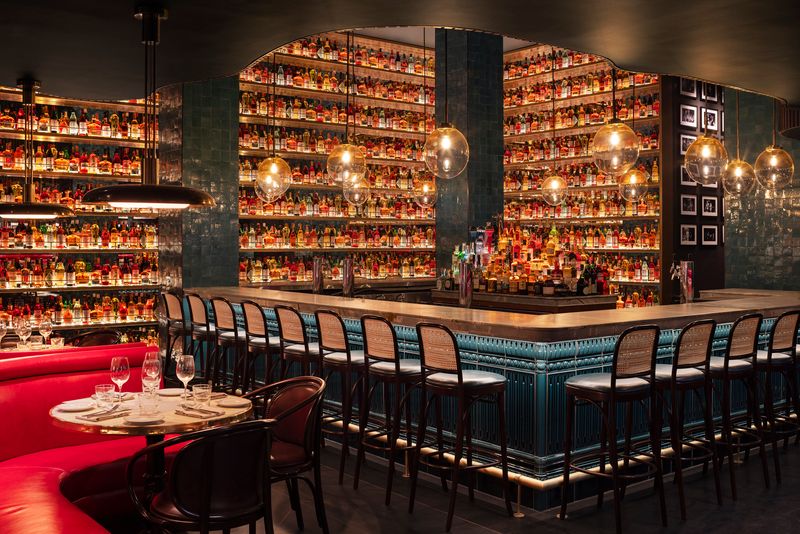 The
Grand Brasserie itself is split into a 300-seat
dining hall and an enclosed 100-seat Green Room
(formerly a New Nordic restaurant that quickly
went pffft!) with cherry red leather
banquettes and marble bar (left). Given
its height and expanses of marble, the dining
hall is very, very loud at dinner, the Green
Room less so, and by nine o’clock quite
comfortable. We sat in the latter, with white
marble tabletops, flattering lighting and green
walls filled up with historic black-and-white
photos.
The
Grand Brasserie itself is split into a 300-seat
dining hall and an enclosed 100-seat Green Room
(formerly a New Nordic restaurant that quickly
went pffft!) with cherry red leather
banquettes and marble bar (left). Given
its height and expanses of marble, the dining
hall is very, very loud at dinner, the Green
Room less so, and by nine o’clock quite
comfortable. We sat in the latter, with white
marble tabletops, flattering lighting and green
walls filled up with historic black-and-white
photos.
The service staff,
beginning at the host’s station, is as affable
as they come, and, as at any good Parisian
brasserie, the kitchen sets a brisk pace for
serving the dishes from its highly traditional
French menu.
For some reason,
French bistro/brasserie food has become
something of the rage in New York, with entries
like Le Veau d’Ȏr and Chez Fifi joining
established examples like Benôit and Bar Boulud.
The food is easy to love and familiarity breeds
contentment. It’s difficult not to love a menu
full of items like onion soup, trout amandine,
cassoulet and profiteroles. And it’s impossible
to resist the good crisp bread and butter
(though one small ramekin 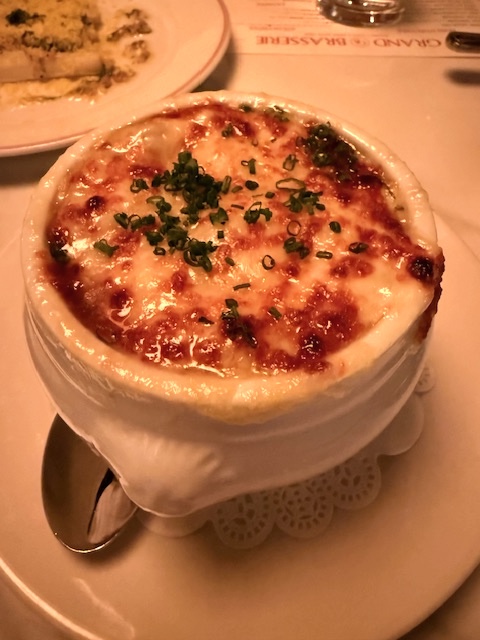 of butter was hardly enough for a table for four
people).
of butter was hardly enough for a table for four
people).
There is a formidable wine list, French
heavy, as well as a short list of regional wines
available the glass, carafe (very good idea) or
bottle.
Mark-up prices for
many bottles are actually below what you’ll find
at other restaurants.
There is a prix fixe dinner of three
courses for a very reasonable $65, though citing
seven dishes with supplements of $4 to $8 seems
a tad disingenuous. There’s also a three-course
pre-theater dinner for five dollars less, from 4
PM-6 PM.
Executive Chef Guillaume Thivet,
previously at Veronika at Fotografiska, Bouley,
Brasserie Les Halles and La Grande Bouchérie, is
a dyed-in-the-wool classicist who has been
making these dishes for decades, which is
obvious among the appetizers, like the paragon
of an onion soup gratinée with a coffee-dark
broth and a half-inch thick topping of bubbly 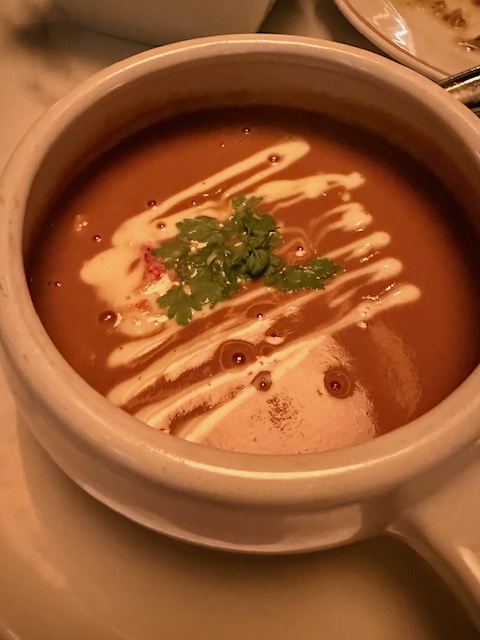 golden
Gruyère, all buoyed by sweet caramelized onions
(right). Its equal in the soup rankings
was a richly flavorful lobster bisque with an
abundance of lobster morsels (left).
Leeks vinaigrette were a good light starter, and
the smooth, silky foie gras mousse came with
buttery brioche. Of the two tartares, the beef,
laid out in a pancake-like circle, was perfect,
finely chopped with an good dose of subtle
seasonings. The tuna tartare used fish of high
quality but could have been dressed with a
little more zest.
golden
Gruyère, all buoyed by sweet caramelized onions
(right). Its equal in the soup rankings
was a richly flavorful lobster bisque with an
abundance of lobster morsels (left).
Leeks vinaigrette were a good light starter, and
the smooth, silky foie gras mousse came with
buttery brioche. Of the two tartares, the beef,
laid out in a pancake-like circle, was perfect,
finely chopped with an good dose of subtle
seasonings. The tuna tartare used fish of high
quality but could have been dressed with a
little more zest.
There is a section of dozen salads and
sandwiches true to
brasserie form, from a tangy salade
lyonnaise with frisée, lardons and poached
egg to a ham-and-cheese croque monsieur, even a
California French dip made with wagyu and a New
England lobster roll.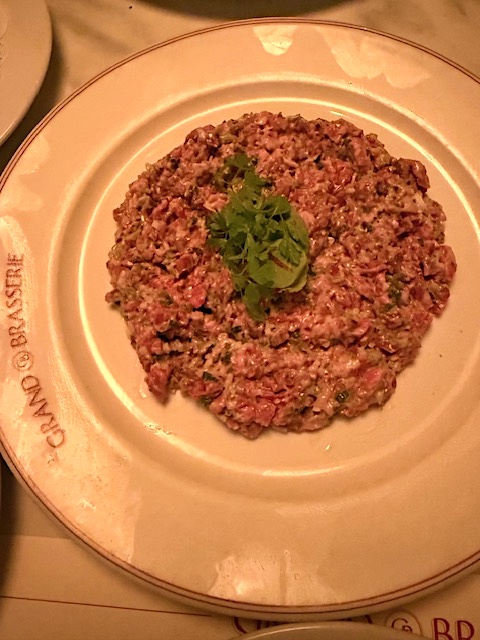
Among the main courses I
enjoyed the plump, crisp-skinned roast
chicken––which can feed two––and the trout
with buttered almonds and haricot verts. A
saddle of lamb might have had more of a
wine-rich reduction.
The steak frites section allows you to choose a
filet, a
bone-in strip at 14 ounces, an entrecôte at 14
ounces and a skirt steak. I ordered the strip
steak, which was good but not stellar. I think
the skirt steak, with its fatty chew might have
been a better option.
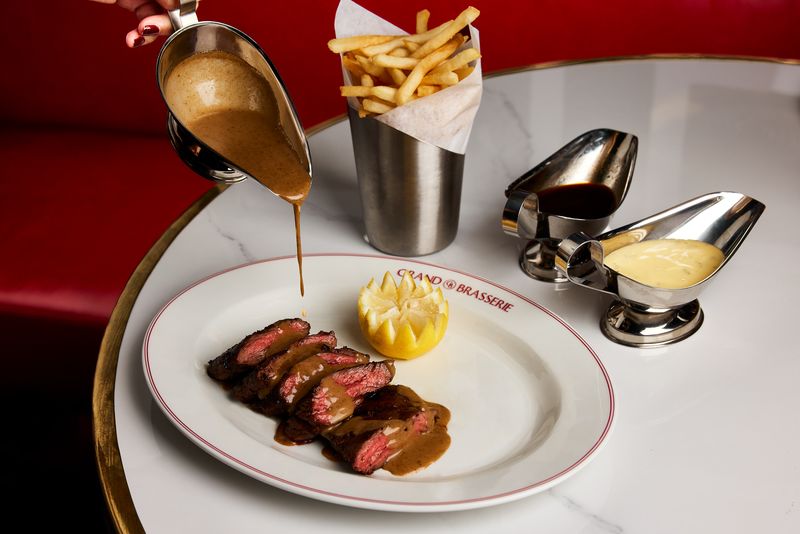 The
frites, by the way, are terrific, with plenty of
potato flavor and light crispiness.
The
frites, by the way, are terrific, with plenty of
potato flavor and light crispiness.
The kitchen really
excels with its desserts, including an always
welcome crème brûlée, an egg-shaped scoop of
dark chocolate mousse with crème Chantilly. The
profiteroles were big and fat with vanilla ice
cream and poured dark chocolate sauce. My
favorite of all was the tarte Tatin––the real
McCoy, for its being two-inches thick and dark
with caramel, not the skimpy flat tarte you so
often get.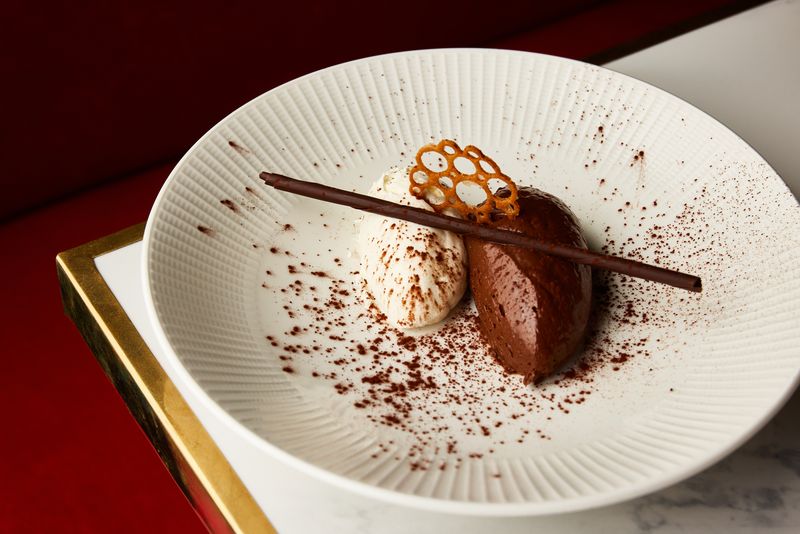
There are all sorts
of options, for brunch, pre-theater, lunch and
dinner, no matter what you feel like at any time
up until two AM, when the trains stop running––a
late night (and early morning) bonus you rarely
find anywhere else, especially at Manhattan’s
bistros and brasseries.
It also needs
mention that prices are lower than trendier
competitors around town. As noted, dinner here
is $65, while it’s $125 at Le Veau d’Or; at
Grand Brasserie you’ll pay $69 for a whole roast
chicken and $72 for Dover sole Meunière, while
at Chez Fifi they’ll run you, respectively, $78
for half a chicken and $148 for the sole.
And for all that
you also get a unique experience of dining in
one of America’s most wondrous public spaces,
and even catch a late train home after the
theater.
Coming
into Grand Central Terminal into the Great Hall
is always an awe-inspiring experience, then to
find this spectacular Brasserie in the next room
should take anyone’s breath away.
The
restaurant
is open from 5:30 am to 2 am, 7 days a
week, 365 days a year, operating at the same
hours as Grand Central Terminal.
HÔTEL ALLEMAGNE
By John Mariani
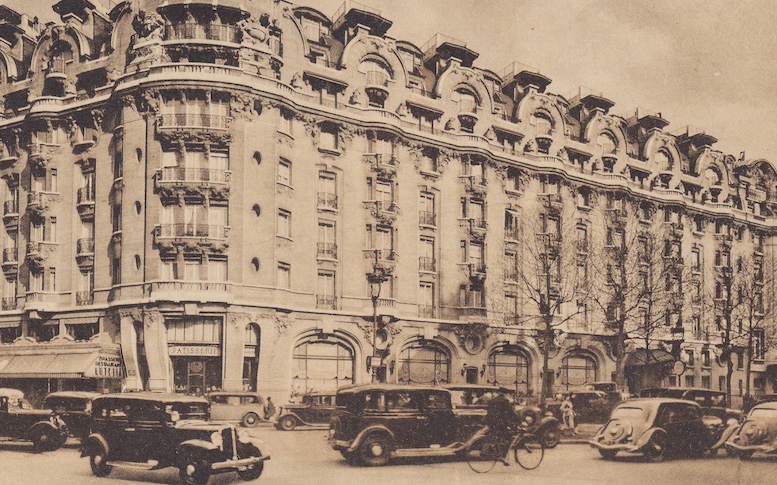
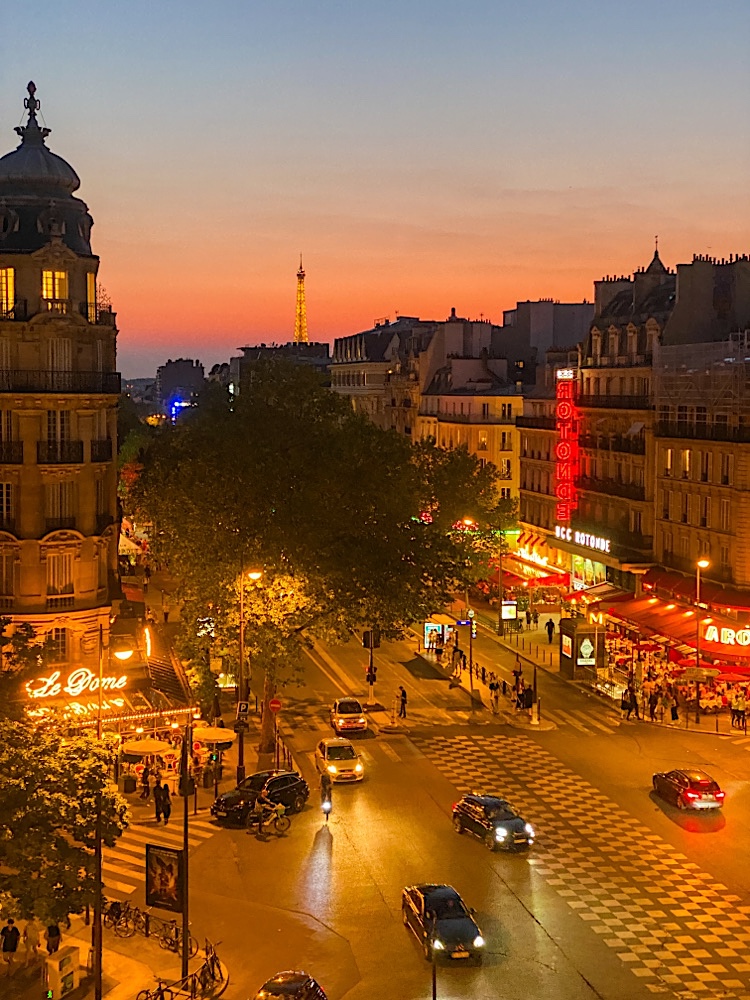
Yves
Collard’s apartment was in Montparnasse (below),
not far from where David and Katie had had
their first meal together in Paris. He was
tall, lanky sandy-haired and in his
thirties, with horn rimmed glasses. He
apparently lived with a woman in the
one-bedroom apartment, and it appeared she
had been the decorator.
Yves
spoke
impeccable English, as demanded by his job. He
also spoke some Spanish, Italian and, given
the Anastasia’s history, a smattering of
Russian. He was as gracious off-duty as he
needed to be on-duty, deferential to his
guests. Katie asked him to call her and David
by their first names, but he kept addressing
them as Madame and Monsieur.
 “I do not
know if I can help you,” he said. “I told
Catherine pretty much all I knew about that
night. It all happened very fast.”
“I do not
know if I can help you,” he said. “I told
Catherine pretty much all I knew about that
night. It all happened very fast.”
“But you did not
get infected, right?” asked Katie.
“No, Madame. I was lucky.”
“Did you have to help guests exit the
hotel?” asked David.
“Ah, oui, it was pandemonium
until the police and ambulances arrived.
People were very, very sick, mostly coughing
and trying to get some air.”
“And I think you told Catherine there
was nothing suspicious about any of the
clientele that day?”
“No, nothing I recall. We were not very
full, because the fashion shows had not yet
begun, so we did not have the number of guests
we would normally have had this week, if the
hotel was open. We are always fully booked a
year in advance for the shows.”
David thought to himself that that must
be the reason the perpetrator had acted the
week before, in case he would have failed to
get a room reservation during the shows, when
all the luxury hotels were booked solid. That
would also apply to both the Hôtel de la Reine
and the Prince de Carignan. He wondered how
all those people must have scrambled to find
rooms when three of the most desirable were
shut down; he also realized that the loss of
income during fashion week would have been
enormous. The prospects that the attacks were
very well-coordinated by someone or some group
were obvious.
“Do you know Messieurs Kōvar and
Bazarov, the two ambassadors,” asked Katie?
“Ah, oui, they are regular
guests. They almost always stay at the
Anastasia when they are in Paris.”
“What time did they check in?”
“I was not on duty, but the registry
showed Monsieur Kōvar checked in around noon
and Monsieur Bazarov around three. I
came on duty at seven.”
David took on the interview from there.
“Did you see either or both of them
when you came on duty?”
“Oui, I saw them in the lobby
when they came down to go to dinner. I believe
they were going together. There was a
reservation in our book that the concierge had
made for two people under Bazarov’s name at Le
Stresa; it’s a casual little Italian bistro
nearby.”
“And that was about seven, when you
came on duty?”
“Oui, I had just arrived.”
“So, you saw them come back soon
afterwards?”
“Oui, they were back by eight
o’clock, then they went to our bar to have a
drink. About fifteen minutes later they went
upstairs to their rooms.”
“Can you tell me what rooms Kōvar and
Bazarov were staying in?”
Yves looked at his laptop, which had
the hotel’s registry on it, and said, “Here it
is. Monsieur Kōvar was in Room 310, and
Monsieur Bazarov was in 316 down the hall.”
“I ask because Kōvar told us that he
got off at the third floor but Bazarov
continued to a higher one.”
Yves shook his head and said, “I do not
know, Monsieur. I was not watching the
elevator. But Bazarov did check out of the
hotel around nine-thirty.”
Katie and David looked at each other,
and she said, “Well, that’s odd. Isn’t it?”
“He said that he had unfortunately been
ordered to Brussels for an impromptu business
meeting and had a flight early the next
morning, but first he had to collect papers
and things at his embassy, so he would spend
the night there.”
Katie joined in, asking, “And as far as
you remember, there was no one suspicious
entering or leaving the hotel, maybe people
visiting guests?”
“There may have been one or two, but
they would have to come to see me to so that I
could call upstairs and get the guest to allow
them to come up to their room.”
“Nobody went up to Bazarov’s room?”
“It is possible someone can simply get
in the elevator and go up, but I do not recall
seeing anyone that night do so.”
“So, as far as you know, everybody was
upstairs asleep by, say, midnight?” asked
David.
“I think so. We usually make a notation
as to when or if a guest was in the room.”
“And is there another way to exit the
hotel without passing by you in the lobby?”
“Ah, oui, you could go out the
side door onto the Rue Daru.”
“And you saw no one else coming or
going from, say, eight till midnight?”
Yves rubbed his chin, then said, “Ah, I
forgot. There was a technician from T-Mobile
who came in around eight o’clock. He said he
was called to check into a problem in service
on the seventh floor and asked if he could
gain access to an empty room. I
told him we had several that night, and I
asked a security man to accompany him to go
up.”
“Can you tell me what room he used?”
“I believe it was. . . oui, it
was Room 702.”
“And that’s the highest floor?” Yves
said yes.
“And do you have security cameras in
all the hallways?”
“Oui, ever since 9/11, we
installed them. It took some time because it
is an old building.”
Katie asked when the technician came
down and if he said anything.
“He came down around nine or
nine-fifteen, I believe, and he came over and
asked me to sign a receipt for the service.”
“But he was the one who told you that
there was a problem with the Internet or some
technical problem. No one at the hotel on the
seventh floor called you to complain?”
Yves thought very hard and said, “No,
no one called me. But it is possible they
called the switchboard and asked for the
engineer.”
“Would there be a record of that?”
asked David. Yves said there should be, but it
would not be on his laptop.
“These are things I think we need to
find out, Yves. Can we get that information
quickly?”
“You mean you think this T-Mobile guy
was an imposter and he put the virus into the
air ducts?”
“If he got access to an air duct on a
higher floor, that’s the way it would have
been done.”
Yves looked blanched, thinking that he
may have been the one who let in a man who
could commit such a crime. He was always so
careful. It was his job to know and handle
everything while he was on duty.
“Well, let’s see what we can find out
about this T-Mobile guy. Can you call the
local office and see if they actually sent a
guy over?” Yves nodded, yes, yes, of course,
and looked up the T-Mobile office closest to
the Anastasia. After going through three
different personnel, he got the service agent
who sent technicians out on calls. Yves asked
about the night of the attack. A few moments
passed and the man spoke to Yves, who put the
call on speaker.
The man said, “Il
n'y a pas eu de demande de service,”
and, “Non, nous n'avons envoyé aucun
technicien à l'hôtel ce soir-là.”
Yves thanked the man and hung up. “No, they had no
request for service and sent no one to the
hotel.”
David was constructing a time line in
his head. “So, let me make sure I have this
correct: Kōvar and Bazarov come back from a
quick dinner about eight o’clock, then they
have a quick drink in your bar, then they both
go up in the elevator.”
“Oui, Monsieur.”
“Meanwhile, the T-Mobile guy arrives to
fix something on the seventh floor, and he
leaves about nine, nine-fifteen. Then Bazarov
comes down with his suitcase and checks out.”
“Oui, Monsieur.”
“How big a suitcase?”
“Oh, it was one those, how do you call
them? Suiters. You put in your suit and zip it
up and you can hang it in the closet.”
David turned to Katie and said, “A good
piece to carry a HAZMAT outfit in. Yves, what
was the T-Mobile guy carrying?”
“Just a small tool kit, as far as I
could see.”
“You think Bazarov helped plant the
virus?” Katie asked David.
“No, I think he gave the suiter with a
HAZMAT outfit in it to the fake T-Mobile guy,
the guy put it on, put the virus in an air
duct, put the HAZMAT outfit and his mask and
gloves into the suiter, waved goodbye to Yves
and left the hotel, and
then Bazarov took the suiter out of the
hotel.”
“Back to the Russian Embassy?”
“If that’s where he really went, yes.
They would know how to dispose of poisonous
material like that, especially if they knew he
was coming over with it.”
Katie and David could see the concierge
was deeply troubled by all he’d heard. Katie
said, “As far as I can see, Yves, you just
followed your protocol. How could you have any
idea this guy was going to plant a virus in the
hotel?”
Yves was not convinced his superiors
would see it that way, but said, “If there is
any possible way I can help you, please let me
know.”
“Well,” said David, “you’re going to
have to speak with the police about all this.
They want to catch this guy. He’s the last of
three, and they’ve got a pretty good case
against the other two. You can do nothing but
help them tremendously with the information
you gave us. You’ll come out of it a hero.
Meanwhile I need you to check those security
camera tapes of the seventh floor hallway. The
police will want to see them, too, I’m sure.”
“Whatever they need,” said Yves.
“I’m going to give you the phone number
for a Detective Borel we’ve been working with.
I suggest you call him and tell him everything
you told us, and he’ll take it from there.”
Yves was anxious to clear himself of
any wrong-doing as a professional and called
Borel as soon as the Americans left. Borel
asked him to come to the Sûreté headquarters
as soon as possible. Meanwhile the police
would contact the hotel manager and ask to see
the security video. Within a couple of hours,
the manager was able to transfer the videos to
the police headquarters, and Borel called
Katie and David in to watch them.
© John Mariani, 2024
❖❖❖
THE LAST ROSÉS OF SUMMER MAKE
FOR GOOD WINE IN AUTUMN
By John Mariani
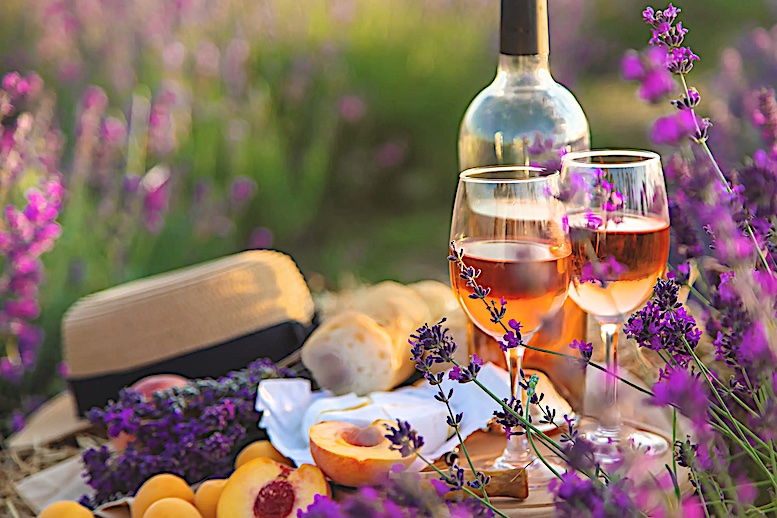
Having
dutifully written my annual rosé wine article at
the beginning of summer, it seems worthwhile to
end off with a few more examples of the genre that
make for wonderful drinking well into fall or
winter.
Many of the American rosés,
Italian and Pacific Rim I find are
often too sweet and some have a strange almost
fuchsia color that can be off-putting.
Of course, the rosés of France’s
Provence have long been a standard that others
either strive to meet 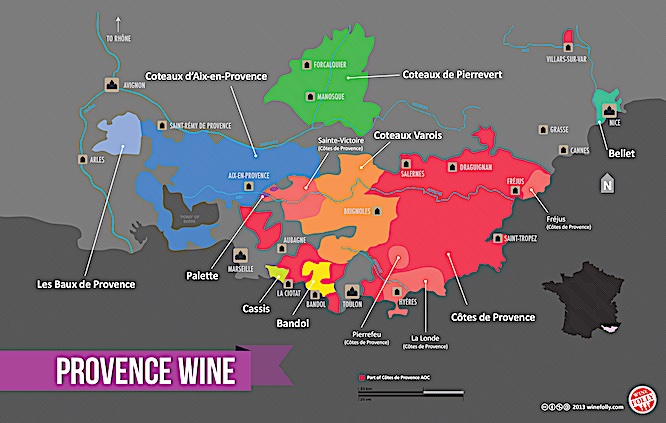 or go in
another, bolder direction. Provence rosés do tend to
be light, though their alcohol may reach 13.5% and
easy to drink as an apéritif before
dinner. But they are also fine accompaniments for
first and main courses, too.
or go in
another, bolder direction. Provence rosés do tend to
be light, though their alcohol may reach 13.5% and
easy to drink as an apéritif before
dinner. But they are also fine accompaniments for
first and main courses, too.
When I was in my salad days, the rosé of Domaine
Ott was my choice for dinner with a
sophisticated girl who merited a better wine than
Mateus. Founded in 1896 by
Alsatian engineer Marcel Ott and now owned and
managed by Champagne Louis Roederer, the estate’s
three vineyards are quite different from one another
in terms of terroir: Château Romassan are in the
Bandol appellation, Clos Mireille and Château de
Selle both Côtes de Provence.
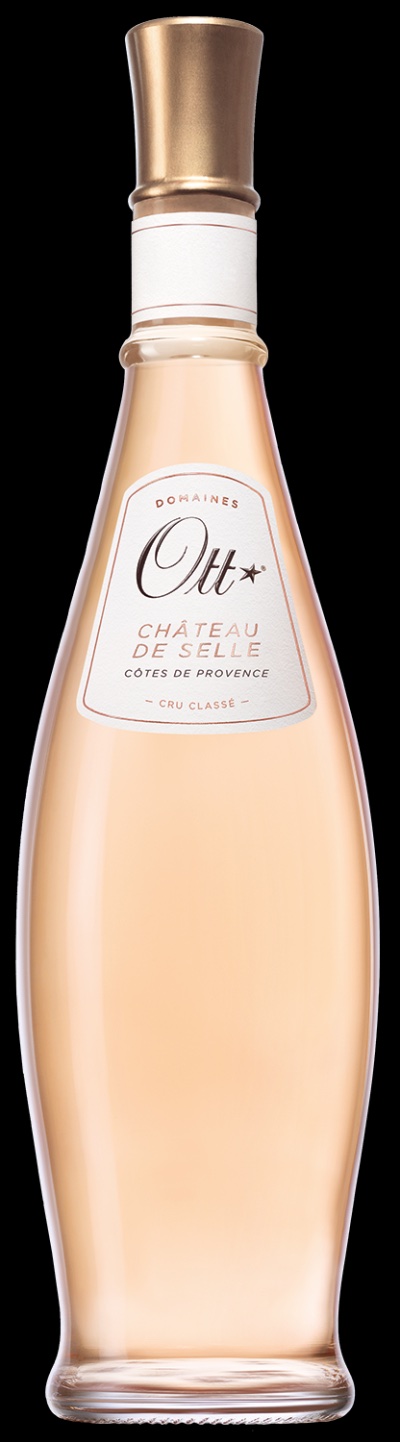 Château de Selle is
located inland from the Mediterranean Sea, on
limestone hillsides, planted in arid limestone
soil––the earth is actually mechanically tilled to
crush the rocks; yields from the 345-acre organic
(since 2022) estate are low. Mourvèdre is the
principal grape. The estate is considered their
flagship wine, with an array of soft ripe fruits on
the palate and a touch of saltiness from the sea,
making it a fine wine for shellfish and a good
bouillabaisse. The 2024 vintage sells for $65.
Château de Selle is
located inland from the Mediterranean Sea, on
limestone hillsides, planted in arid limestone
soil––the earth is actually mechanically tilled to
crush the rocks; yields from the 345-acre organic
(since 2022) estate are low. Mourvèdre is the
principal grape. The estate is considered their
flagship wine, with an array of soft ripe fruits on
the palate and a touch of saltiness from the sea,
making it a fine wine for shellfish and a good
bouillabaisse. The 2024 vintage sells for $65.
Château
Romassan 2024 ($69)
has a bigger
profile, reflecting the terroir of Bandol, a port
town located just to the west of Toulon, best known
for its red wines (although the majority of the
grapes grown are used for rosés). It has a very
pale, opalescent color and, served either more or
less cold, is brisk and silky. Ott acquired the
château in 1956 in the foothills of the village of Le Castellet. The soil
is actually quite poor––limestone, sandstone, and
marine upper cretaceous marls––and the vineyards
terraced, so the grapes have to struggle a bit to
prove their worth. But sea salt from the bay helps
the wine’s acidity and the Mourvèdre, Cinsault and Grenache
grapes are very selectively
picked and sorted by hand, then fermented and aged
in thermo-regulated stainless steel vats 4-6 months.
It is very refreshing, terrific with mild cheeses
and a fish like branzino or red mullet. Ott’s
website contends it will be just as good in 2029,
though this is not a wine to save but to savor.
2023
Étoile
Rosé 2023
($175) is a cuvée, that is, a blend of 85% Grenache
and 15% Mourvèdre from the finest parcels from Clos
Mireille and Château de Selle. It has considerable
depth––it should for $175, although I’ve
seen it on-line for less––and has more of a saline
character than Ott’s other rosés, owing to limestone
coils of Selle and
calcareous sandstone and sandy marl soils at
Romassan. It is peach-colored, has a citrus tang as
well as faintly sweet fruit notes. Here’s a rosé to
consider for bluefish and grilled chicken or seafood
risotto.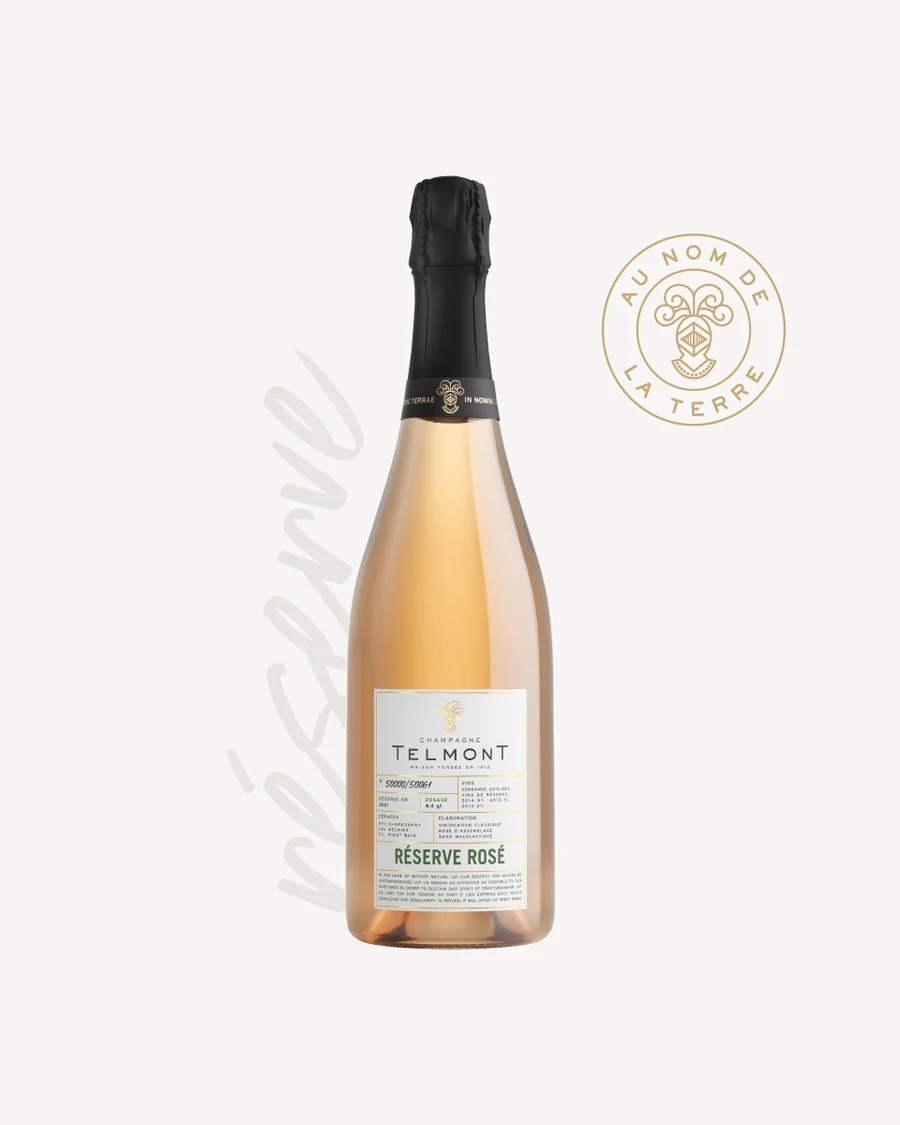
Sparkling rosés are increasingly popular,
not least Champagnes, and the Telmont Estate has
put a big push into being among the most
environmentally correct producers, aiming to convert
100% of its cultivated
areas and its partners’ to organic agriculture by
2031. In addition they are going after the small
details, like using recycled glass and green
bottles, not using cardboard gift boxes and
shipping all wines to the U.S. aboard wind-powered
Neoline ships.
Telmont’s 60 acres
are located in Damery, Épernay, established in 1912
and now a fourth generation estate making eight
crus, since 1999 under Bertrand Lhôpital. (Actor Leo
DiCaprio is an investor.) Its Reserve Rosé ($87) is
a blend of grapes from four different harvest, made
from 87% Chardonnay and 13% Meunier. Oddly, for a
rosé there is no Pinot Noir in the blend, though
Meunier is a red grape. It has a lovely rosy color,
rich flavor and fruitedness but is quite dry on the
palate and finish. Its finesse makes it fit for sole
meunière, lobster and crab and aged cheeses.
❖❖❖
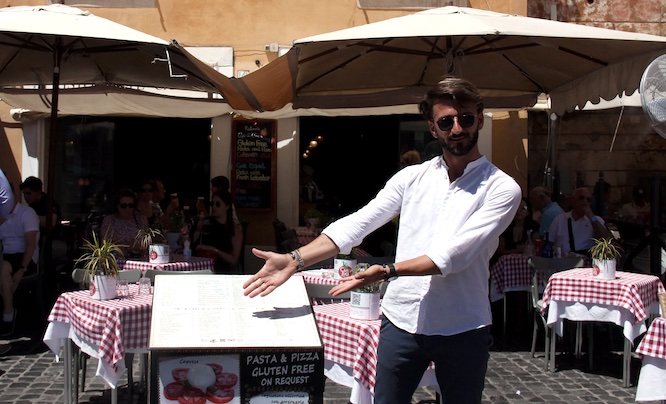 THEY
ALSO SELL FAKE ROLEXES
THEY
ALSO SELL FAKE ROLEXES
In its attempt to reduce the negative impact of
over-tourism, the Tuscan town
of Lucca has banned the buttadentro from the
historic center to preserve the city’s calm and
quality of life. A buttadentro (meaning
“throwers in”) is a
restaurant hawker who identifies well-heeled
visitors and to use his wit and persistence to
lure them into the restaurant. The rule will be enforced
by the police, and repeat offenders face a
three-day ban on placing tables outdoors.
❖❖❖
Any of John Mariani's books below may be ordered from amazon.com.
 The Hound in Heaven
(21st Century Lion Books) is a novella, and
for anyone who loves dogs, Christmas, romance,
inspiration, even the supernatural, I hope you'll find
this to be a treasured favorite. The story
concerns how, after a New England teacher, his wife and
their two daughters adopt a stray puppy found in their
barn in northern Maine, their lives seem full of promise.
But when tragedy strikes, their wonderful dog Lazarus and
the spirit of Christmas are the only things that may bring
his master back from the edge of despair.
The Hound in Heaven
(21st Century Lion Books) is a novella, and
for anyone who loves dogs, Christmas, romance,
inspiration, even the supernatural, I hope you'll find
this to be a treasured favorite. The story
concerns how, after a New England teacher, his wife and
their two daughters adopt a stray puppy found in their
barn in northern Maine, their lives seem full of promise.
But when tragedy strikes, their wonderful dog Lazarus and
the spirit of Christmas are the only things that may bring
his master back from the edge of despair. WATCH THE VIDEO!
“What a huge surprise turn this story took! I was completely stunned! I truly enjoyed this book and its message.” – Actress Ali MacGraw
“He had me at Page One. The amount of heart, human insight, soul searching, and deft literary strength that John Mariani pours into this airtight novella is vertigo-inducing. Perhaps ‘wow’ would be the best comment.” – James Dalessandro, author of Bohemian Heart and 1906.
“John Mariani’s Hound in Heaven starts with a well-painted portrayal of an American family, along with the requisite dog. A surprise event flips the action of the novel and captures us for a voyage leading to a hopeful and heart-warming message. A page turning, one sitting read, it’s the perfect antidote for the winter and promotion of holiday celebration.” – Ann Pearlman, author of The Christmas Cookie Club and A Gift for my Sister.
“John Mariani’s concise, achingly beautiful novella pulls a literary rabbit out of a hat – a mash-up of the cosmic and the intimate, the tragic and the heart-warming – a Christmas tale for all ages, and all faiths. Read it to your children, read it to yourself… but read it. Early and often. Highly recommended.” – Jay Bonansinga, New York Times bestselling author of Pinkerton’s War, The Sinking of The Eastland, and The Walking Dead: The Road To Woodbury.
“Amazing things happen when you open your heart to an animal. The Hound in Heaven delivers a powerful story of healing that is forged in the spiritual relationship between a man and his best friend. The book brings a message of hope that can enrich our images of family, love, and loss.” – Dr. Barbara Royal, author of The Royal Treatment.
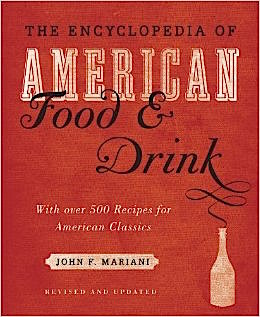 |
The Encyclopedia of American Food and Drink by John F. Mariani (Bloomsbury USA, $35) Modesty forbids me to praise my own new book, but let me proudly say that it is an extensive revision of the 4th edition that appeared more than a decade ago, before locavores, molecular cuisine, modernist cuisine, the Food Network and so much more, now included. Word origins have been completely updated, as have per capita consumption and production stats. Most important, for the first time since publication in the 1980s, the book includes more than 100 biographies of Americans who have changed the way we cook, eat and drink -- from Fannie Farmer and Julia Child to Robert Mondavi and Thomas Keller. "This book is amazing! It has entries for everything from `abalone' to `zwieback,' plus more than 500 recipes for classic American dishes and drinks."--Devra First, The Boston Globe. "Much needed in any kitchen library."--Bon Appetit. |
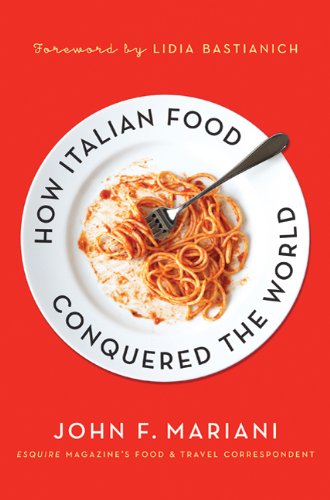
"Eating Italian will never be the same after reading John Mariani's entertaining and savory gastronomical history of the cuisine of Italy and how it won over appetites worldwide. . . . This book is such a tasteful narrative that it will literally make you hungry for Italian food and arouse your appetite for gastronomical history."--Don Oldenburg, USA Today. "Italian
restaurants--some good, some glitzy--far
outnumber their French rivals. Many of
these establishments are zestfully described
in How Italian Food Conquered the World, an
entertaining and fact-filled chronicle by
food-and-wine correspondent John F.
Mariani."--Aram Bakshian Jr., Wall Street
Journal.
"Equal parts
history, sociology, gastronomy, and just
plain fun, How Italian Food Conquered the
World tells the captivating and delicious
story of the (let's face it) everybody's
favorite cuisine with clarity, verve and
more than one surprise."--Colman Andrews,
editorial director of The Daily
Meal.com. "A fantastic and fascinating
read, covering everything from the influence
of Venice's spice trade to the impact of
Italian immigrants in America and the
evolution of alta cucina. This book will
serve as a terrific resource to anyone
interested in the real story of Italian
food."--Mary Ann Esposito, host of PBS-TV's
Ciao
Italia. "John Mariani has written the
definitive history of how Italians won their
way into our hearts, minds, and
stomachs. It's a story of pleasure over
pomp and taste over technique."--Danny Meyer,
owner of NYC restaurants Union Square
Cafe, The Modern, and Maialino.
|
 |
 |
 |
 |
 |
 |
MARIANI'S VIRTUAL GOURMET
NEWSLETTER is published weekly. Publisher: John Mariani. Editor: Walter Bagley. Contributing Writers: Christopher
Mariani, Misha Mariani, John A. Curtas, Gerry Dawes, Geoff Kalish.
Contributing
Photographer: Galina Dargery. Technical
Advisor: Gerry
McLoughlin.
If you wish to subscribe to this
newsletter, please click here: http://www.johnmariani.com/subscribe/index.html
© copyright John Mariani 2025