MARIANI’S
Virtual Gourmet
AUGUST 30,
2025
NEWSLETTER
THIS WEEK
SANTANDER
By John Mariani
NEW YORK CORNER
O MANDARIN
By John Mariani
HÔTEL ALLEMAGNE
CHAPTER TWENTY-FIVE
By John Mariani
NOTES FROM THE WINE CELLAR
SUPER TUSCAN WINES 2025
by Geoff Kalish
By John Mariani
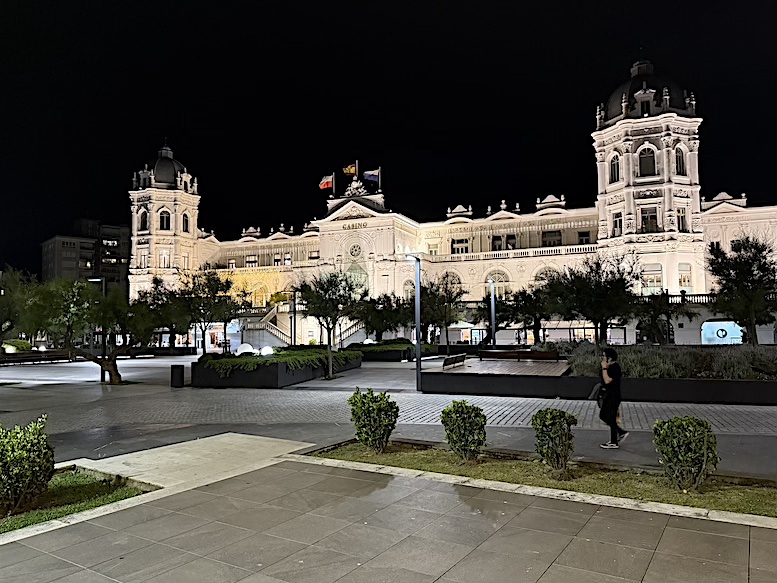
The Casino in Santander
My friend had preceded me by three
days when I arrived in Santander, a city in
northern Spain about which I knew nothing
but the bank of the same name. My
friend, a surgeon, was there to give a talk
to medical students, and I was to join him
for a day or two before heading south to
Madrid.
 When
I asked what he thought of the city, he said,
“It’s wonderfully quiet, spacious and has a
sense of peacefulness about it. I think I
could retire here.” Which struck me as a very
strange notion on his part because he’d spent
his entire career in land-locked, sand-locked
Tucson, Arizona, which Santander is nothing
like.
When
I asked what he thought of the city, he said,
“It’s wonderfully quiet, spacious and has a
sense of peacefulness about it. I think I
could retire here.” Which struck me as a very
strange notion on his part because he’d spent
his entire career in land-locked, sand-locked
Tucson, Arizona, which Santander is nothing
like.
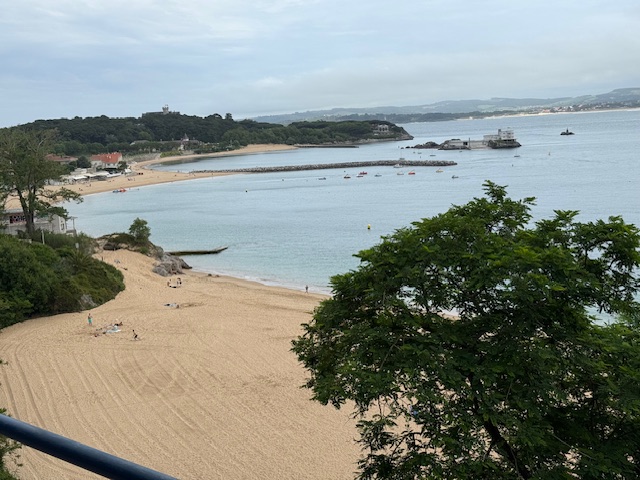
After two days in the city I knew what
my friend was feeling, for it is
a wide-open city of long, winding boulevards
along the Bay of Santander on La Magdalena
Peninsula leading to the Cantabria Sea. It is
the capital city of Cantabria with a modest
population .jpg) of
under 200,000. Sadly, much of the city dating
back to the 9th Century suffered a
devastating 1941 fire that burned for two days
and consumed much of the old medieval town,
including the cathedral. As a result, the city
was restored along modern lines after World
War II, so that the curving Paseo de Pereda
and Avenida de la Reina sweep the shore and
beach of El Sardinero, one of the loveliest in
Spain. Above it La Magdalena Royal Palace
(right), a mix of turrets,
balconies and timbered accents, was
the summer residence of the king and his
family, located near the elegant and majestic
Hotel Real.
of
under 200,000. Sadly, much of the city dating
back to the 9th Century suffered a
devastating 1941 fire that burned for two days
and consumed much of the old medieval town,
including the cathedral. As a result, the city
was restored along modern lines after World
War II, so that the curving Paseo de Pereda
and Avenida de la Reina sweep the shore and
beach of El Sardinero, one of the loveliest in
Spain. Above it La Magdalena Royal Palace
(right), a mix of turrets,
balconies and timbered accents, was
the summer residence of the king and his
family, located near the elegant and majestic
Hotel Real.
The rebuilding of the 12th
century Our Lady of the Assumption
Cathedral after
the Great Fire took twelve years, but today it
has the sheen of freshness, in the Gothic style
with overlapping floors, crypt and an annex of
cloisters.
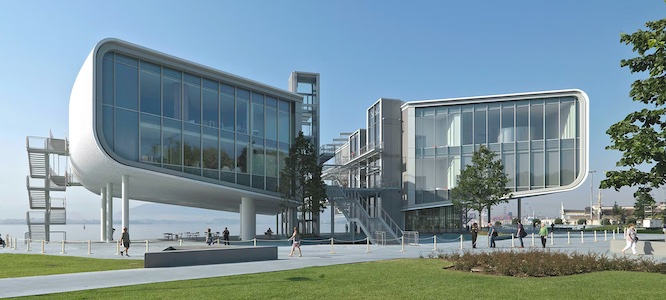 Fortunately
much of the old city has been reclaimed, and
its weaving up-and-down streets are ideal for
finding what’s behind the next corner. The Centro
Botin (below), by architect Renzo
Piano, opened
in 2017, is
a complex within the vast Pereda Gardens
devoted to art, music and theater, which has
given the city a high reputation for Spanish
and international culture.
Fortunately
much of the old city has been reclaimed, and
its weaving up-and-down streets are ideal for
finding what’s behind the next corner. The Centro
Botin (below), by architect Renzo
Piano, opened
in 2017, is
a complex within the vast Pereda Gardens
devoted to art, music and theater, which has
given the city a high reputation for Spanish
and international culture.
(By the way,
Banco Santander's corporate headquarters,
located for a century in the Pereda Building
in Santander, is currently being transformed
into a cultural and leisure space; the bank is
now headquartered in Boadilla del Monte,
Madrid.)
I stayed at the Grand Hotel
Sardinero overlooking the beach (below),
itself an 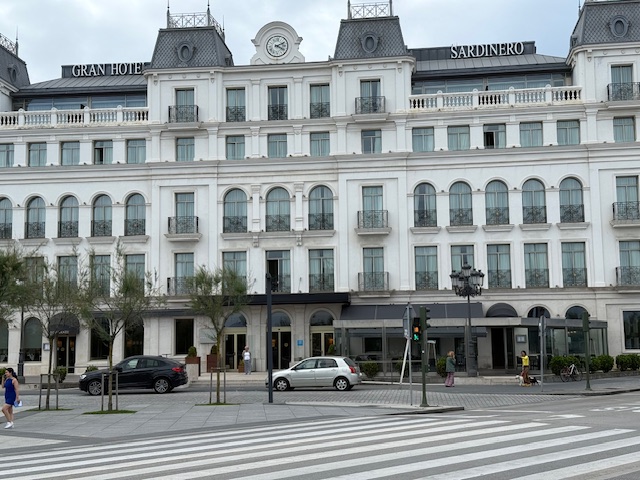 historic
building
now thoroughly modernized. The standard rooms
are fairly basic in décor but have good
bathrooms, air-conditioning and easy access to
the Internet. The breakfast buffet is
satisfying if nothing special. The front desk
staff can be helpful when they do not claim
being too busy to be so. Currently rooms begin
at a very reasonable €71.
historic
building
now thoroughly modernized. The standard rooms
are fairly basic in décor but have good
bathrooms, air-conditioning and easy access to
the Internet. The breakfast buffet is
satisfying if nothing special. The front desk
staff can be helpful when they do not claim
being too busy to be so. Currently rooms begin
at a very reasonable €71.
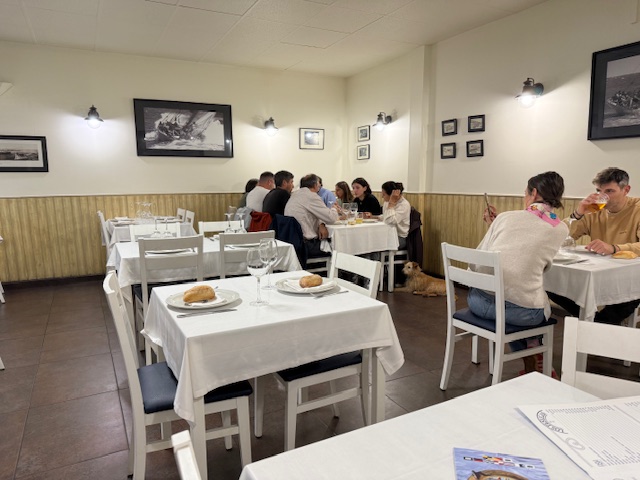 Being a
seashore town, Santander gets its pick of
fresh seafood. Restaurante
Los Peñucas (C.
Marqués de la Ensenada, 35; 942-22-9445) is
very popular with the local people who come
with their families to this expansive
inside-and-out restaurant located where the
fishermen bring in their catch each day (left).
The décor is minimal, the lighting bright,
the noise level remarkably moderate. You
pass the open kitchen on your way in, seeing
a brigade of cooks steaming, roasting and
grilling seafood just brought in from the
docks, which the day I visited included a
splendid fat rodaballo
(turbot). There are two pages of
starters, including plump white asparagus in
season,
and 24 seafood items, sold by the
kilogram, as well as a three-course plus
glass of wine menu of the day at €20. Langoustines
cooked on the plancha griddle were
meaty and seared for a smoky flavor. The
turbot was silky with its own fat, filleted
at the table and served with fried potatoes
and salad. The wine list is serviceable,
stressing bottlings from Ribera del Duero,
averaging €15. Tax and service are included.
Being a
seashore town, Santander gets its pick of
fresh seafood. Restaurante
Los Peñucas (C.
Marqués de la Ensenada, 35; 942-22-9445) is
very popular with the local people who come
with their families to this expansive
inside-and-out restaurant located where the
fishermen bring in their catch each day (left).
The décor is minimal, the lighting bright,
the noise level remarkably moderate. You
pass the open kitchen on your way in, seeing
a brigade of cooks steaming, roasting and
grilling seafood just brought in from the
docks, which the day I visited included a
splendid fat rodaballo
(turbot). There are two pages of
starters, including plump white asparagus in
season,
and 24 seafood items, sold by the
kilogram, as well as a three-course plus
glass of wine menu of the day at €20. Langoustines
cooked on the plancha griddle were
meaty and seared for a smoky flavor. The
turbot was silky with its own fat, filleted
at the table and served with fried potatoes
and salad. The wine list is serviceable,
stressing bottlings from Ribera del Duero,
averaging €15. Tax and service are included.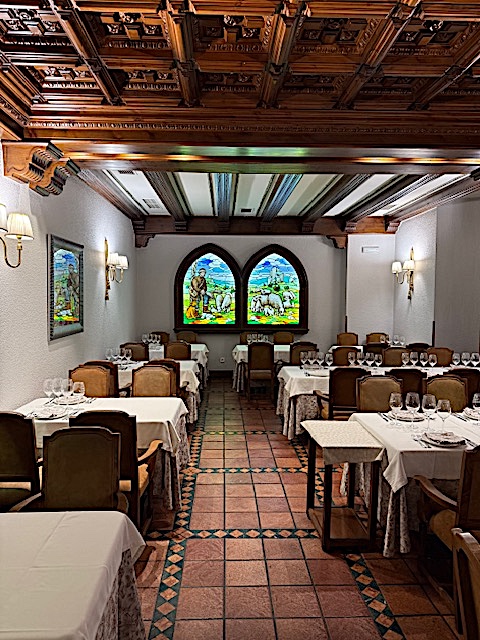
The next day I was ready for roast
suckling pig and baby lamb, which are the
stars of Spanish cuisine, so we went into
the old part of town to Asador
Lechazo Aranda (15 Terúan;
942-21-48-23), whose specialties include
dishes roasted in a brick oven fired with
aromatic wood. It’s open every day and its two
main dining rooms start to fill up after one
PM. Aranda has a long history in Santander as
one of its best––though not
expensive––restaurants, known for its stained
glass ceiling and Castilian décor, with lovely
lighting from sconces on old brick walls.
We
started off with cod and potato croquetas
and both a quarter of the suckling pig (€56),
which came out sizzling, its aroma perfuming
the room, its flesh glistening with melting
fat and crackling skin. Practice has obviously
made this preparation perfect here, and
nothing is made in advance. We did our best to
finish the pig, accompanied by cold Mahon
beer, but it was futile. We’d need at least
another person to polish it off. We saved the
baby lamb for next time.
NEW YORK CORNER
361 North Central Avenue
Hartsdale, NY
914 437 9168
By John Mariani
The 1970s was a revolutionary era for
Chinese restaurants in America when
Chinese-American fare was pushed to the
sidelines by the fiery, spicy, sweet and sour
cooking of Sichuan and Hunan provinces. Suddenly
restaurants with those names in them––Sichuan
Pavilion, Hunan Village––were popping up in
strip malls, not least along the eight-mile
stretch of Central Avenue in Westchester County,
New York.
The problem was that most
lapsed into sameness, replacing chow mein and egg
foo young with fried dumplings and General Tso’s
chicken. Now, pretty much everywhere, Chinese
restaurants in America are an amalgam of Chinese
and Japanese concepts, often with sushi counters
alongside a kitchen driven my wok-fried beef,
chicken and seafood. To find more regional food
you had to ferret it out in cities’ Chinatowns.
 O
Mandarin in Hartsdale (there’s another in
Hicksville, Long Island) has transcended those
clichés by featuring the cuisine of its name, led by Chef
Eric Gao and owners Gen
Lee
and Peter Liu, who already had a following at
their Euro-Asian Bistro in Port Chester.
O
Mandarin in Hartsdale (there’s another in
Hicksville, Long Island) has transcended those
clichés by featuring the cuisine of its name, led by Chef
Eric Gao and owners Gen
Lee
and Peter Liu, who already had a following at
their Euro-Asian Bistro in Port Chester.
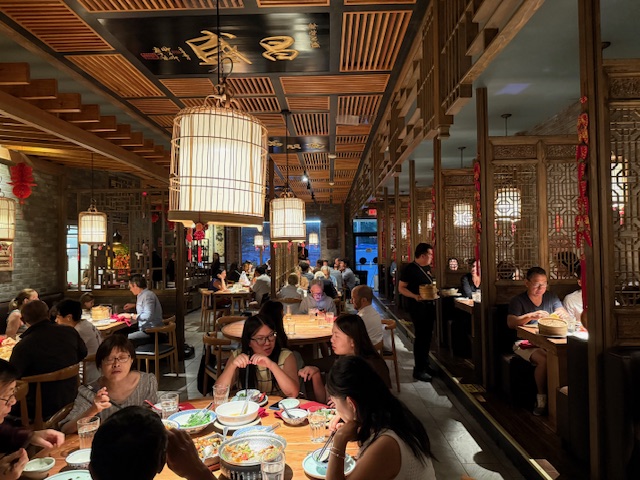
Since opening in 2017, O Mandarin has
rarely had an empty table, and there is a very
large Chinese clientele, which is not often the
case in suburban Chinese restaurants. Reservations
are essential weekdays and weekends, and there is
a nightly bustle in the big dining room set with
Chinese woodwork and hanging lamps that put you in
mind of finer dining rooms in Chinatown. The
booths are coveted, and there’s a cozy smaller
room to the rear. The noise level is remarkably
moderate.
It
is a fast-paced evening, which the waiters and
kitchen keep to, so dishes may come out in more
profusion than you imagined. They serve wine and
beer but no liquor.
The
menu
is unnecessarily long––which seems to be a given
in Chinese restaurants everywhere––and will appeal
to those who still wish to order wonton soup, chao
mein and kung pao chicken. But the real interest
here is in the Mandarin dishes––a whole page of
them, as well as
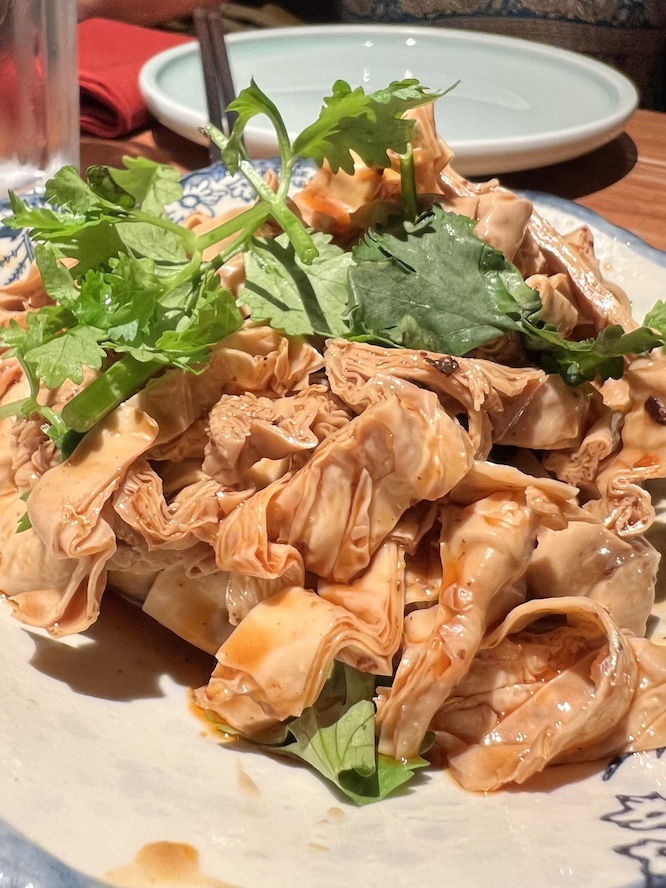
Chef’s Signature items, from slippery but
crisp thousand layer tofu flavored with pork belly
(left), Chinese celery and 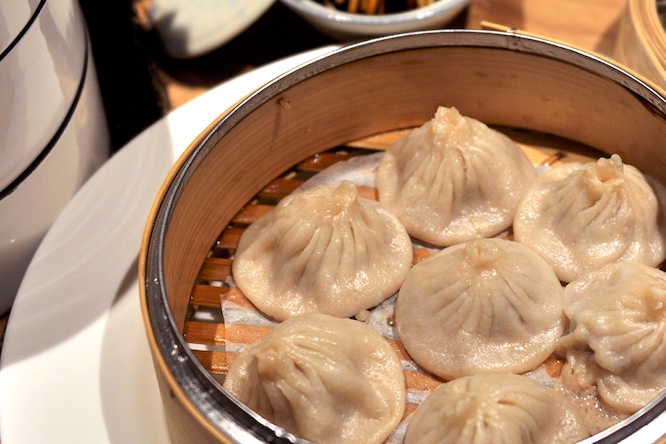 chili pepper to crispy
whole fish with a black bean sauce and complex
braised beef brisket in a clay pot, and succulent
twice cooked pork belly to “Toothpick lamb” and
spicy fermented beans and minced pork. Dan Dan
noodles, a Sichuan dish, is a rich mélange of thin
Chinese spaghetti with a sweet-salty balance, a
little vinegar and chili oil.
chili pepper to crispy
whole fish with a black bean sauce and complex
braised beef brisket in a clay pot, and succulent
twice cooked pork belly to “Toothpick lamb” and
spicy fermented beans and minced pork. Dan Dan
noodles, a Sichuan dish, is a rich mélange of thin
Chinese spaghetti with a sweet-salty balance, a
little vinegar and chili oil.
 Mandarin, which
includes Beijing cuisine, is most famous for its
dumplings, especially the soup dumplings that are
delicate casings enclosing minced pork and ginger
and red hot broth that spurts out when bitten into
and floods the palate with flavors. Soong dishes
are a snack item in China, composed of minced,
seasoned chicken or shrimp and served in a crisp
iceberg lettuce leaf, which makes for a refreshing
first course.
Mandarin, which
includes Beijing cuisine, is most famous for its
dumplings, especially the soup dumplings that are
delicate casings enclosing minced pork and ginger
and red hot broth that spurts out when bitten into
and floods the palate with flavors. Soong dishes
are a snack item in China, composed of minced,
seasoned chicken or shrimp and served in a crisp
iceberg lettuce leaf, which makes for a refreshing
first course.
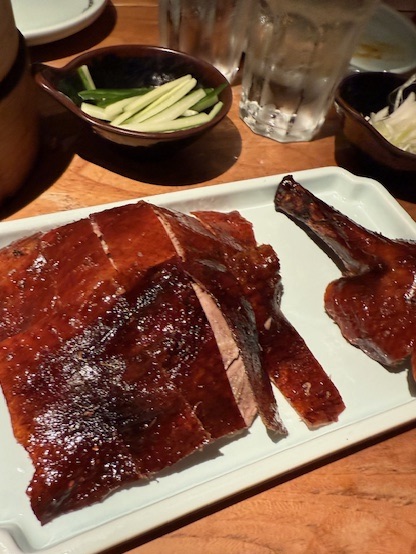
Peking
duck
is also a Mandarin dish, and here it comes with
the thinnest possible, translucent pancakes in
which to fold the roasted duck meat, paper thin
skin scallion shreds and cucumber and brushed with
hoisin sweet sauce. It’s available as half ($52)
or a full duck ($95). The rarely
encountered scallion bubble pancake is a kind of Indian
puffed poori bread served with a red curry dip.
Despite the menu being so
inclusive, on my visits I found only a few dishes
suffered from blandness or a lack of interest in
the kitchen But if you choose with some
discretion, leaning to the Mandarin and Sichuan
dishes, you will find O Mandarin a very fine
diversion from the pan-Asian restaurants that
dominate in the New York area.
Open daily for lunch and
dinner.
HÔTEL ALLEMAGNE
By John Mariani
Borel checked into Bazarov’s
background and found he was most likely KGB.
He came out of the Russian Army and worked
in intelligence, with postings in Istanbul,
Beirut and Brussels before the liaison work
in Paris, where he reported to the chief
Ambassador, who in turn reported to the new
Russian President, Vladimir Putin.
 Putin’s
name
had come up while Katie and David were on
stories that took them to Taipei and Moscow
when he was considered a rising star under
President Boris Yeltsin (left). For
sixteen years he had been a foreign
intelligence officer with the KGB, eventually
attaining the rank of Lieutenant Colonel
before resigning for a fledgling career in
politics that brought him to the attention of
the foundering Yeltsin, who made Putin Prime
Minister in 1999. With Yeltsin’s resignation
in 2000, Putin became President. That was two
years ago, and since then he had begun to
exert an iron-fisted control over his
deputies. It was Putin who appointed Bazarov
as junior ambassador to Paris.
Putin’s
name
had come up while Katie and David were on
stories that took them to Taipei and Moscow
when he was considered a rising star under
President Boris Yeltsin (left). For
sixteen years he had been a foreign
intelligence officer with the KGB, eventually
attaining the rank of Lieutenant Colonel
before resigning for a fledgling career in
politics that brought him to the attention of
the foundering Yeltsin, who made Putin Prime
Minister in 1999. With Yeltsin’s resignation
in 2000, Putin became President. That was two
years ago, and since then he had begun to
exert an iron-fisted control over his
deputies. It was Putin who appointed Bazarov
as junior ambassador to Paris.
Borel tracked all of Bazarov’s travel
over the past two years, showing he spent
about half his time in Moscow, half in Paris,
with trips throughout European capitals for
conferences and meetings. Reports said that he
was a stalwart supporter of Putin and might
someday replace the current ambassador in
Paris.
Borel also believed Bazarov was still
in Paris, saying that he had no reason to
leave unless he suspected he was the focus of
an investigation. He must have assumed he had
covered his tracks successfully, and, as Borel
noted, going up to the seventh floor and being
let into someone’s room was not a crime. The
HAZMAT suit had obviously been disposed of by
the embassy staff, and apparently Bazarov had
taken a flight to Brussels the next morning,
as he had told the concierge, although the
police found that he had purchased the ticket
days before, not on short notice as he’d told
Yves Collard.
Inquiries had been made at T-Mobile
about any possibility someone fitting the
description of the man posing as a technician
actually worked at the company, but the
response was negative. A T-Mobile shirt and a
fake work order would have been easy enough to
come by or create.
Borel was in contact with David, who
assumed there were no fingerprints in Room 702
but inquired about strands of hair, but
nothing had been found. The
fumigation of the building had begun
immediately after the incident, so it was
difficult to prove that the virus was
introduced through the air duct in Room 702.
Borel admitted he had no leads at all. No one
had seen the technician, aside from Yves
Collard and Bazarov.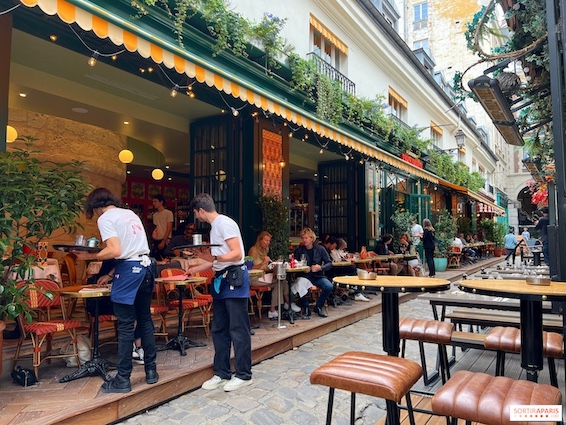
Then someone did. Yves was sitting at
Brasserie de Prés on Boulevard Saint-Germain (right)
finishing his lunch when he saw a man sitting
down at another brasserie across the street.
It was the technician—the man’s face had been
in Yves’s head for days—dressed in jeans and a
sweater. Yves positioned himself in his chair
so as not to be recognized, looking at the
bistro’s window reflection to watch the man,
who had just been brought a menu by the
waiter. Clearly the man was going to be
staying put for some time. Yves dialed the
number Borel had given him and told him what
he saw, and Borel told him to keep his eye on
him and that police would be there
immediately. Yves then called David’s number
and told him what was happening. David asked
for the address and said he and Katie would
try to get to the scene without alerting the
man.
Minutes seemed to creep by agonizingly
slowly. The man was nibbling on bread and
sipping from his water glass. Then, without
horns blaring, a police van pulled up to the
brasserie, hiding the man from Yves’s view,
but within seconds he could see the police had
him in handcuffs and were placing him in the
back of the van. Within ten seconds the van
was gone, leaving behind two policemen at the
brasserie to quell the commotion. The owner
came out and the police began calming him down
then asked him questions about the man.
A police car came to a quick stop and
Borel got out, first speaking with the two
policemen then crossing the street to where
Yves sat, telling him this was a wonderful
coincidence. A few minutes later Katie and
David arrived by taxi, hailing Borel and Yves.
“This is fantastic news!” said Katie.
“I just looked over and there he was,”
said Yves. “I could not believe my eyes.”
David well knew that much of the time
sheer coincidence was the biggest factor in
locating suspects, like their running a stop
light.
“And you
don’t think he was waiting there for someone?”
asked David.
“I don’t know, but by the time the
police arrived he had ordered his meal, so I
don’t think so. If someone else was to meet
him, I’m sure he did not approach the table
after seeing him arrested.”
Borel asked Yves to go over every
detail, however small: Which direction did the
man come from? Did he arrive by taxi or come
out of the Métro? Did he seem to know the
waiter? Do you think he might have recognized
you? Then he asked Yves to come to the station
to make a formal statement, asking Katie and
David if they’d like to go along.
By the time they arrived at the station
Borel was receiving preliminary information on
the man: His driver’s license gave his name as
Charles Massot, 31 years of age, address 322
Rue de Pessac. A business card showed he was,
in fact, a technician, but did not work for
T-Mobile.
Massot
had been removed from the van after being read
his rights and taken to an interview room with
a one-way mirror, with Katie and David on the
see-through side. The man’s handcuffs were
removed. Borel entered the room and said, “You
are in a good deal of trouble, Monsieur
Massot.” (Katie translated as best she could
for David.)
“Why am I here?” asked Massot blankly.
“I’m sure you know, but you are under
arrest for introducing a virus into the air
duct system of the Hôtel Anastasia on the
night of April 3 that made many, many people
very, very ill. Do you have anything to say?”
Massot continued to look stoic but not
belligerent.
“I’m sure you want to know why we know
you are the perpetrator,” said Borel, “and I
assume you are not going to say anything
without a lawyer, but here’s what we know.”
Reading from a folder, Borel went into
considerable detail about the events of the
night of April 3, saying that Massot need not
deny he was the fake T-Mobile technician
because the video was very clear about that.
“We also know that you were involved
with a Russian
ambassador named Ilya Bazarov, who came to
Room 702, which you had entered at 8:05 and
Monsieur Bazarov joining you a few minutes
later. At 9:07 you left the hotel and Monsieur
Bazarov checked out at 9:15.”
The man stayed silent, his hands flat
on the table.
“Now,” said Borel, “we will have you
arraigned on charges, which may include murder
if any of the victims dies from the virus. As
I’m sure you know, because of diplomatic
immunity, it may be difficult for us to arrest
Monsieur Bazarov the way we arrested you, and
he may even leave the country without our
permission and we shall never see him again.
Which would be very disappointing, because
then everything would collapse on your head
and your head alone, Monsieur Massot. I’m sure
you’ll want to tell your lawyer that. But for
now, we are finished. We’ll speak again soon.”
From what Katie and David could see,
Borel’s abrupt leaving the room appeared to
shake Massot’s demeanor. He took his hands off
the table, leaned back in his chair and closed
his eyes. Then the door opened and two
officers came in to put Massot’s handcuffs
back on, leading him out to a cell.
“The strong, silent type,” said Katie.
“He’d been prepped, in case he was
arrested,” said David. “But Bazarov probably
didn’t mention the diplomatic immunity part to
him. Now Massot’s brain is going to start
assessing his prospects. If he tells his
lawyer the truth, the lawyer may try to cut a
deal. Like I said, over here you’re guilty
until you prove your innocence. Makes it
easier to get a conviction. As they say around
here, why bother to arrest an innocent
person?”
© John Mariani, 2024
❖❖❖
SUPER
TUSCAN
WINES 2025
by Geoff Kalish
.jpg)
While sounding
high and mighty, “Super Tuscan” is not an official
wine category and includes any red made in Italy’s
central region that’s not classified as Chianti –
which legally requires
at least 70% Sangiovese and no more than 10% of juice
from white grapes. In fact, the blend of grapes in
many of these wines is more like that found in a red
from Bordeaux than one from Italy – with Cabernet
Sauvignon, Cabernet Franc and Merlot usually the
dominant varietals. And, of note, many of these
renegade Italian wines contain at least a bit of
Sangiovese and are aged in French oak barrels (not
typical for wine labeled as Chianti). Also, as would
be expected, the rather ubiquitous cherry fruit taste
of Chianti is supplanted by a range of flavors from
dark cherry to plum and raspberry, many with earthy
spice and long, lingering finishes that make them
excellent options to mate with a range of fare – from
grilled salmon to squid ink pasta to steak, pork and
lamb. Moreover, many of these wines not only age
gracefully over a number of years but are superior in
old age (15 – 25 years from bottling). However,
unfortunately, some of the best command prices that
definitely dent the wallet.
So, as a guide to consumers, from
some recent tastings, the following are my top choices
with some suggestions for food pairings.
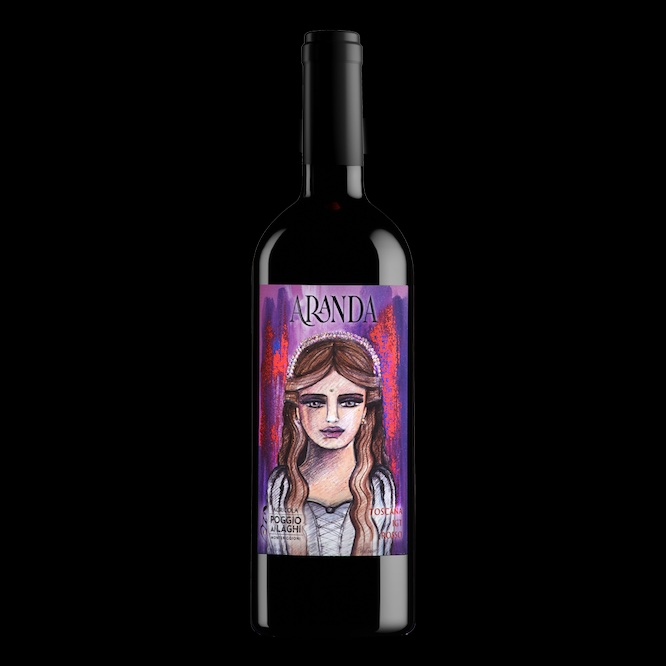 2023
Poggio
Laghi Aranda ($52)
2023
Poggio
Laghi Aranda ($52)
Featuring
a
beautiful label created by local artist Maria Chiara
Viviana, this elegant wine was made from a blend of
Sangiovese, Cabernet Franc, Cabernet Sauvignon and
Merlot grapes harvested from a vineyard situated on a
plateau between two lakes near the medieval town of
Monteriggioni. Following fermentation it was aged for
18 months in large oak barrels and shows a bouquet and
easy drinking flavor of ripe plums and cherries with a
touch of vanilla in its long, memorable finish. It
marries harmoniously with foie gras, grilled chicken,
swordfish and soft cheeses.
2021
Castello
di Romitorio ($25)
Ready
to drink now, but probably better in 4-5 years this
wine was made from a blend of Syrah and Petit Verdot
grapes grown in Montalcino, not far from Siena. It has
a fragrant bouquet and full-bodied taste of blackberry
and red currants with notes of spice and herbs in its
finish, perfect to pair with grilled lamb, pork and
veal.
1998
Castello
di Romitorio
($36)
After
“breathing”
for an hour in a large decanter, this wine showed rich
flavors of blueberry and cassis with undertones of
chocolate and dark cherry. It was made from a blend of
Sangiovese, Cabernet Sauvignon and Canaiolo grown in
soil featuring a mix of clay and sand. Try it with
brisket of beef, grilled ribs and pasta with spicy red
sauce.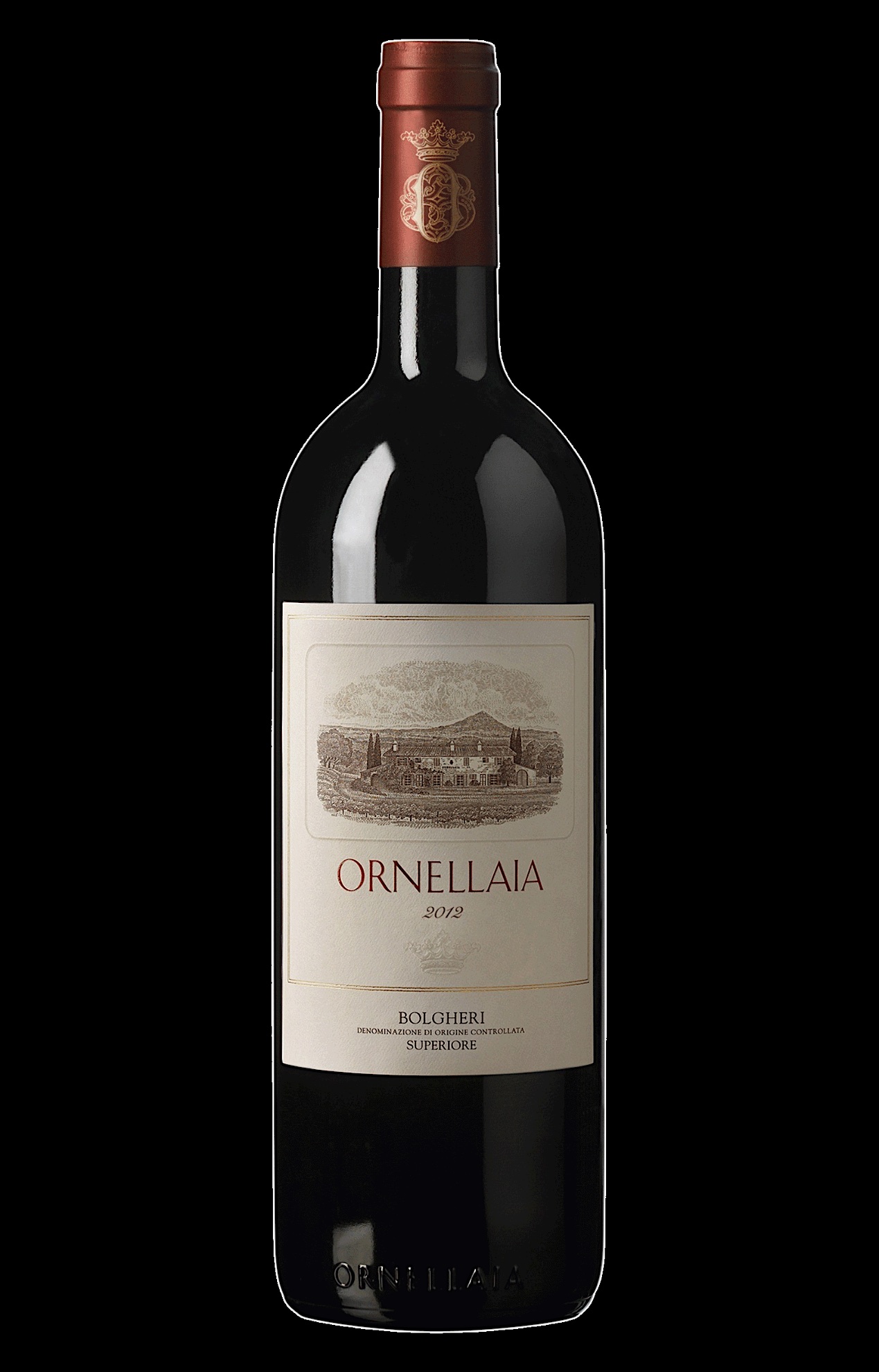
2012
Ornellaia
($200)
One
of the most highly praised wines in the world,
considered by many critics as on a par with France’s
Château Lafite and Haut-Brion, this lush red is
perfect to accompany celebratory meals. It’s
a blend of Cabernet Sauvignon, Cabernet
Franc, Merlot and Petit Verdot from Italy’s coastal
Mediterranean Bolgheri region and shows a fragrant
bouquet and taste of blackcurrant and cherry with a
touch of cranberry with earthy spice in its smooth,
memorable finish. Serve it with hearty main course
items like veal Marsala, rack of lamb, and duck
breast. The current 2022 vintage costs $310.
2018
Borgonero ($24)
This
full-bodied
blend of Sangiovese (40%), Cabernet Sauvignon (20%),
Syrah (20%) and Merlot (20%) that was aged in French
oak barrels after fermentation hails from the Borgo
Scopeto winery located near Siena. It has a bouquet
and taste of blackberries and ripe plums with strong
notes of vanilla in its finish and mates well with
roast chicken, scampi and pasta with pesto.
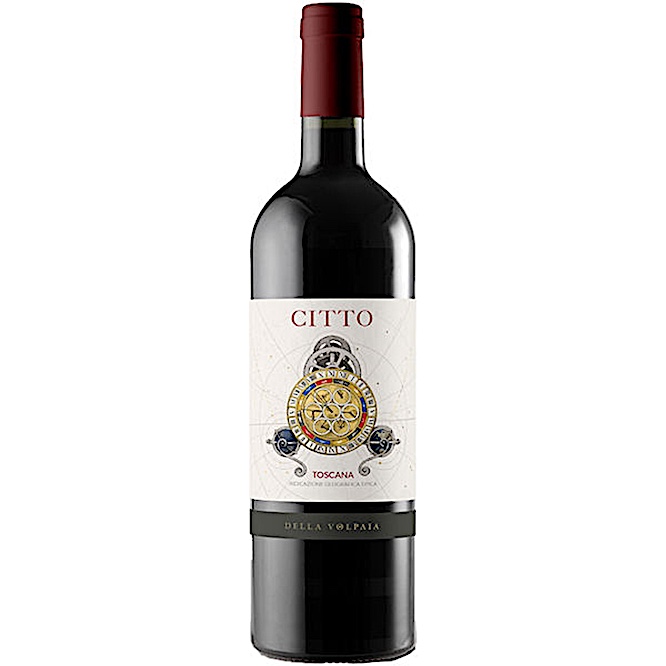 2023 Castello di Volpaia
Citto ($18)
2023 Castello di Volpaia
Citto ($18)
Better
known
for its production of top-flight Chianti Classicos,
Castello di Volpaia also produces this organic blend
of Sangiovese and Cabernet Sauvignon, that was
fermented in stainless steel. It shows a bouquet and
easy-drinking taste of ripe cherry and strawberry with
a smooth finish. It mates well with soft shell crabs,
sushi and pasta with meat sauce.
2021
Talaini
Al Passo ($27)
This
full-bodied
wine was made from a blend of equal parts of
Sangiovese, Cabernet Sauvignon and Merlot grown in
soil rich with limestone in the Castelnuovo Berardenga
commune area of southern Tuscany. Following
fermentation, the wine was aged in oak for over a year
and has a fragrant bouquet and taste of ripe cherries
and hints of strawberry in its earthy
finish. It mates well with calamari and
grilled salmon as well as grilled duck breast and
steak.
❖❖❖
 FOOD
WRITING 101: ANTICLIMAX OF THE WEEK
FOOD
WRITING 101: ANTICLIMAX OF THE WEEK
"The Tigerforest was
enormous with neat black stripes that looked as if
they’ve been painted out. He prowled along with
dusty path, slinging between a handful of vehicles,
then spun his head around and gave a Steely stare to
remind us who was in charge. My heart hammered. My
stomach lurched. I grew up seeing cheaters and
leopards in South Africa but nothing could’ve
prepared me for the primal power of this creature.
After a few minutes, he sorted back into the
bush."--Mary Holland, "Tigertail," Conde Nast
Traveler (8/2025).
❖❖❖
Any of John Mariani's books below may be ordered from amazon.com.
 The Hound in Heaven
(21st Century Lion Books) is a novella, and
for anyone who loves dogs, Christmas, romance,
inspiration, even the supernatural, I hope you'll find
this to be a treasured favorite. The story
concerns how, after a New England teacher, his wife and
their two daughters adopt a stray puppy found in their
barn in northern Maine, their lives seem full of promise.
But when tragedy strikes, their wonderful dog Lazarus and
the spirit of Christmas are the only things that may bring
his master back from the edge of despair.
The Hound in Heaven
(21st Century Lion Books) is a novella, and
for anyone who loves dogs, Christmas, romance,
inspiration, even the supernatural, I hope you'll find
this to be a treasured favorite. The story
concerns how, after a New England teacher, his wife and
their two daughters adopt a stray puppy found in their
barn in northern Maine, their lives seem full of promise.
But when tragedy strikes, their wonderful dog Lazarus and
the spirit of Christmas are the only things that may bring
his master back from the edge of despair. WATCH THE VIDEO!
“What a huge surprise turn this story took! I was completely stunned! I truly enjoyed this book and its message.” – Actress Ali MacGraw
“He had me at Page One. The amount of heart, human insight, soul searching, and deft literary strength that John Mariani pours into this airtight novella is vertigo-inducing. Perhaps ‘wow’ would be the best comment.” – James Dalessandro, author of Bohemian Heart and 1906.
“John Mariani’s Hound in Heaven starts with a well-painted portrayal of an American family, along with the requisite dog. A surprise event flips the action of the novel and captures us for a voyage leading to a hopeful and heart-warming message. A page turning, one sitting read, it’s the perfect antidote for the winter and promotion of holiday celebration.” – Ann Pearlman, author of The Christmas Cookie Club and A Gift for my Sister.
“John Mariani’s concise, achingly beautiful novella pulls a literary rabbit out of a hat – a mash-up of the cosmic and the intimate, the tragic and the heart-warming – a Christmas tale for all ages, and all faiths. Read it to your children, read it to yourself… but read it. Early and often. Highly recommended.” – Jay Bonansinga, New York Times bestselling author of Pinkerton’s War, The Sinking of The Eastland, and The Walking Dead: The Road To Woodbury.
“Amazing things happen when you open your heart to an animal. The Hound in Heaven delivers a powerful story of healing that is forged in the spiritual relationship between a man and his best friend. The book brings a message of hope that can enrich our images of family, love, and loss.” – Dr. Barbara Royal, author of The Royal Treatment.
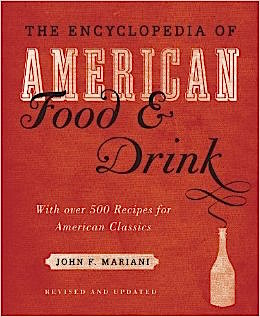 |
The Encyclopedia of American Food and Drink by John F. Mariani (Bloomsbury USA, $35) Modesty forbids me to praise my own new book, but let me proudly say that it is an extensive revision of the 4th edition that appeared more than a decade ago, before locavores, molecular cuisine, modernist cuisine, the Food Network and so much more, now included. Word origins have been completely updated, as have per capita consumption and production stats. Most important, for the first time since publication in the 1980s, the book includes more than 100 biographies of Americans who have changed the way we cook, eat and drink -- from Fannie Farmer and Julia Child to Robert Mondavi and Thomas Keller. "This book is amazing! It has entries for everything from `abalone' to `zwieback,' plus more than 500 recipes for classic American dishes and drinks."--Devra First, The Boston Globe. "Much needed in any kitchen library."--Bon Appetit. |
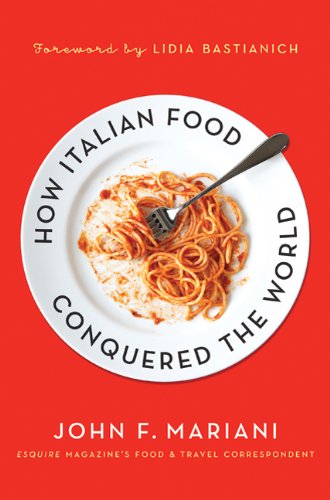
"Eating Italian will never be the same after reading John Mariani's entertaining and savory gastronomical history of the cuisine of Italy and how it won over appetites worldwide. . . . This book is such a tasteful narrative that it will literally make you hungry for Italian food and arouse your appetite for gastronomical history."--Don Oldenburg, USA Today. "Italian
restaurants--some good, some glitzy--far
outnumber their French rivals. Many of
these establishments are zestfully described
in How Italian Food Conquered the World, an
entertaining and fact-filled chronicle by
food-and-wine correspondent John F.
Mariani."--Aram Bakshian Jr., Wall Street
Journal.
"Equal parts
history, sociology, gastronomy, and just
plain fun, How Italian Food Conquered the
World tells the captivating and delicious
story of the (let's face it) everybody's
favorite cuisine with clarity, verve and
more than one surprise."--Colman Andrews,
editorial director of The Daily
Meal.com. "A fantastic and fascinating
read, covering everything from the influence
of Venice's spice trade to the impact of
Italian immigrants in America and the
evolution of alta cucina. This book will
serve as a terrific resource to anyone
interested in the real story of Italian
food."--Mary Ann Esposito, host of PBS-TV's
Ciao
Italia. "John Mariani has written the
definitive history of how Italians won their
way into our hearts, minds, and
stomachs. It's a story of pleasure over
pomp and taste over technique."--Danny Meyer,
owner of NYC restaurants Union Square
Cafe, The Modern, and Maialino.
|
 |
 |
 |
 |
 |
 |
MARIANI'S VIRTUAL GOURMET
NEWSLETTER is published weekly. Publisher: John Mariani. Editor: Walter Bagley. Contributing Writers: Christopher
Mariani, Misha Mariani, John A. Curtas, Gerry Dawes, Geoff Kalish.
Contributing
Photographer: Galina Dargery. Technical
Advisor: Gerry
McLoughlin.
If you wish to subscribe to this
newsletter, please click here: http://www.johnmariani.com/subscribe/index.html
© copyright John Mariani 2025