MARIANI’S
Virtual Gourmet
September
21, 2025
NEWSLETTER
Founded in 1996
ARCHIVE
THIS WEEK
MONOPOLI
ON THE ADRIATIC
By
John Mariani
NEW
YORK CORNER
PALERMO GRAMERCY
ARGENTINIAN BISTRO
By John Mariani
HÔTEL ALLEMAGNE
CHAPTER TWENTY-EIGHT
By John Mariani
NOTES FROM THE WINE
CELLAR
FAMIGLIA
DE CHERCHIO IS WORKING
TO BRING THE WINES OF ABRUZZO
TO GLOBAL ATTENTION
By John Mariani
❖❖❖
CITY ON THE ADRIATIC
By John Mariani
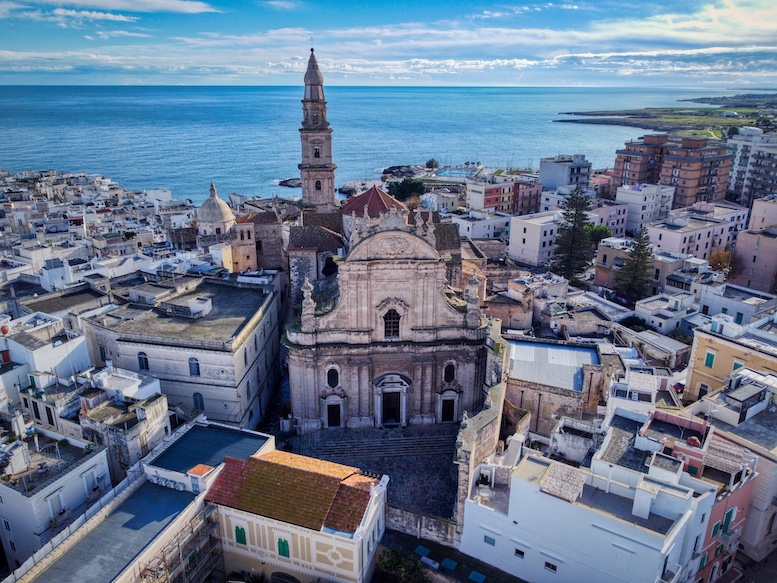
Italy’s Puglia has, with
considerable justification, become one of
the most desirable destinations in
southern Italy, not only for its beautiful
baroque cities like Bari, Lecce and
Otranto but for its smaller towns fitted
snugly above the Adriatic that include
Polignano a Mare, Mola and Monopoli––all
of them now popular as travel destinations
but none, as yet, overrun by tourists.
 Monopoli is
south of Bari by only 25 miles and takes its
name, which means “only city,” from its
having survived the sixth century
destructive invasion of Puglia by the
Ostrogoths. As
did much of southern Italy, Monopoli had
successive overseers that included the
Byzantines, Normans, Venetians and Spanish
before becoming part of the new Kingdom of
Italy as of 1860.
Monopoli is
south of Bari by only 25 miles and takes its
name, which means “only city,” from its
having survived the sixth century
destructive invasion of Puglia by the
Ostrogoths. As
did much of southern Italy, Monopoli had
successive overseers that included the
Byzantines, Normans, Venetians and Spanish
before becoming part of the new Kingdom of
Italy as of 1860.
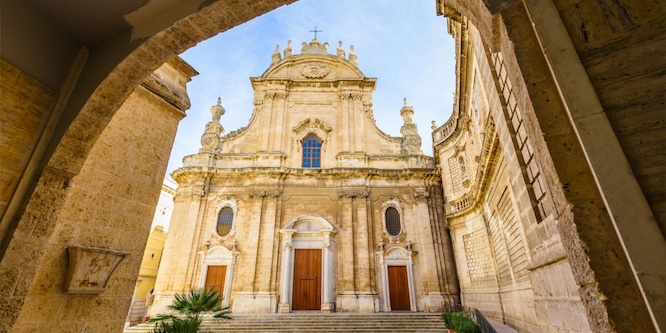
Although Ostuni claims the sobriquet
of “the white city,” Monopoli, too, well
deserves the name, given its sun-and-sea
washed brightness, reflecting the light off the
chianche limestone and
marble buildings that include the 18th
century Cathedral Maria Santissima della
Madia (above) and clock tower.
You can walk around the sweep of the
Lungomare walls that surround the old town
(“Paese Vecchio”) and gaze down on
the ancient harbor, where all the fishing
boats (“u vozz”), all painted blue,
bob in the water and creak against the
docks. 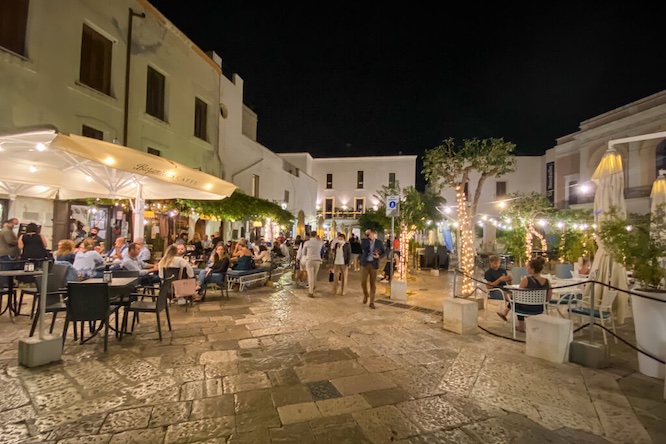
Inside the walls the Piazza
Giuseppe Garibaldi (right) is a
peaceful square whose surrounding buildings
with their green shutters echo the various
architectural styles of the city’s history.
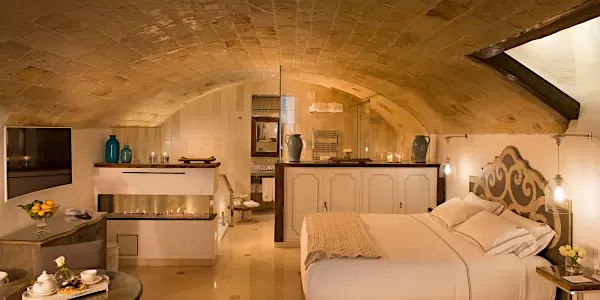 The
best
hotel in town is the rustic-chic Don
Ferrante (Via San Vito 27),
with 17 rooms carved out of a central
fortress on the cliffs, with arched stone
walls, white-and-beige furnishings, a
swimming pool and a splendid terrace bar and
restaurant overlooking the sea.
The
best
hotel in town is the rustic-chic Don
Ferrante (Via San Vito 27),
with 17 rooms carved out of a central
fortress on the cliffs, with arched stone
walls, white-and-beige furnishings, a
swimming pool and a splendid terrace bar and
restaurant overlooking the sea.
Shopping in town is
leisurely, with a few local boutiques. Dida
& Camilo (Piazza Manzoni 13),
opened in 2017, features fashions, bags and
accessories that are very much evocative of
the culture of the Mediterranean and
Monopoli’s place in the sun.
Seafood, of course,
dominates the restaurant menus here, and the
very popular, ebullient, always busy,
30-year old Osteria Perricci (Via
Orazio Comes 1) near the port (below)
is a terrific place to find the best of the
day’s catch. It is a bright, airy trattoria
done in white and blue colors. It has a
substantial menu, though a small wine list,
and serving portions are all generous. My
wife and I thoroughly 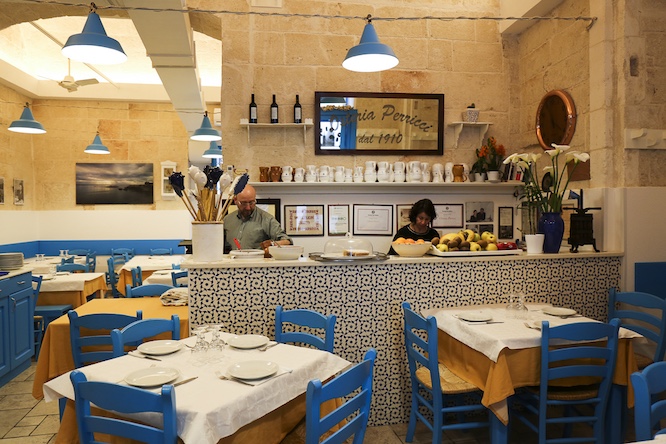 enjoyed
a starter of mixed fried seafood of mullet,
calamari, small shrimp and octopus, as well
as spaghetti with fat langoustines in a
tomato broth (below). The menu also
recommends cavatelli pasta with
various seafood, and lightly fried meatballs
of hake.
enjoyed
a starter of mixed fried seafood of mullet,
calamari, small shrimp and octopus, as well
as spaghetti with fat langoustines in a
tomato broth (below). The menu also
recommends cavatelli pasta with
various seafood, and lightly fried meatballs
of hake.
Radimare (Via Beato Pier
Giorgio Frassati 5A) is not much on
décor but chef Domenico Ungaro deftly
balances what is fresh and simple with
creativity and stylishness, including an
array of crudi that induces red
shrimp and a carpaccio of amberjack, as well
as a risotto of red mullet with parsley and
seared lemon.
❖❖❖
NEW YORK CORNER
PALERMO GRAMERCY
ARGENTINIAN BISTRO
53 Irving Place
917-905-2441
By John Mariani
The
proliferation of Brazilian steakhouses, led
largely by the worldwide Fogo de Chão chain,
with 60 locations, shows how winning the
formula is when you give people huge amounts
of food and hunks of meats sliced dramatically
at the dining table from skewers. It’s a lot
of fun, if wholly formulaic.
 The
new
Palermo Argentinian Bistro is a more refined
variation of the non-Brazilian style,
offering a wider selection of dishes and less
fireworks in the dining room. (There is a branch
on West 46th Street.)
The
new
Palermo Argentinian Bistro is a more refined
variation of the non-Brazilian style,
offering a wider selection of dishes and less
fireworks in the dining room. (There is a branch
on West 46th Street.)
Owner Orhan Cakir and
Executive Chef and Partner Carlos Barroz
and Managing Partner Victor Medina have
impressive combined experience in Latin-American
food service, and Barroz’s family in Argentina
were restaurateurs, where he learned butchery
from his grandfather.
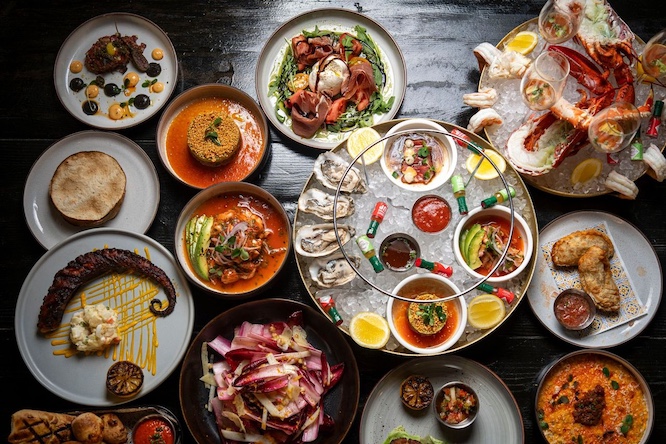
The appetizers hold as much
interest as the meats, however, starting with
two kinds of empanadas (below)––one
with
corn, butternut
squash,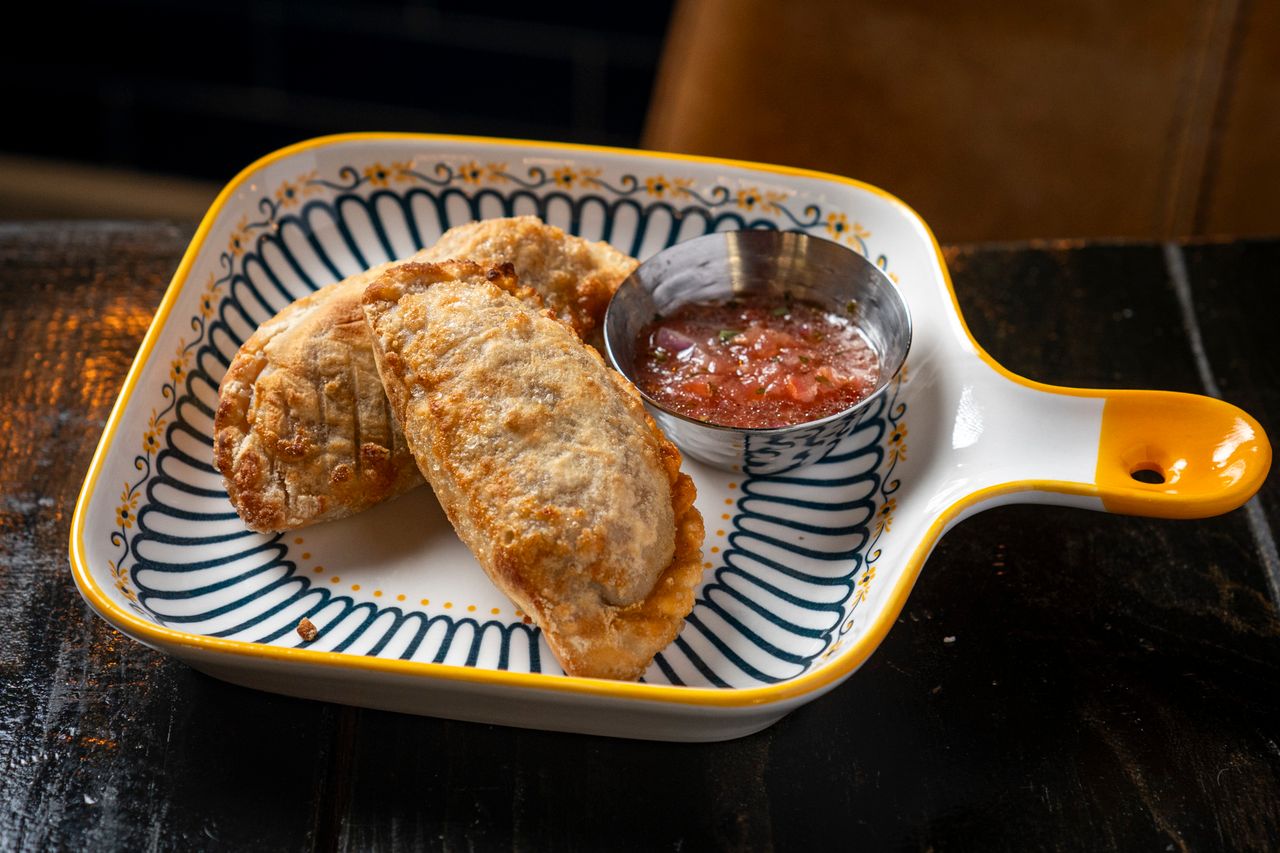 red pepper,
Gouda cheese and a Bolivian sauce of chilies,
tomatoes and onion sauce called llajua;
or beef with hard boiled eggs, olives,
scallions, cumin, encased
in crispy, flakey pastry. Lamb shanks are
braised in Malbec till they can be shredded and
made into croquettes with provoleta
cheese and a yogurt mint sauce. A simple endive
salad is here heightened with pears,
caramelized, walnuts, croutons, Grana Padano
cheese and a Chardonnay vinaigrette. The tangy
ceviche rojo is a plate if
octopus, shrimp, whitefish, cilantro, red onion
and jalapeños, with crispy tostadas, meant for
sharing. Each night there is also a selection of
East and West oysters with a yuzu
vinaigrette.
red pepper,
Gouda cheese and a Bolivian sauce of chilies,
tomatoes and onion sauce called llajua;
or beef with hard boiled eggs, olives,
scallions, cumin, encased
in crispy, flakey pastry. Lamb shanks are
braised in Malbec till they can be shredded and
made into croquettes with provoleta
cheese and a yogurt mint sauce. A simple endive
salad is here heightened with pears,
caramelized, walnuts, croutons, Grana Padano
cheese and a Chardonnay vinaigrette. The tangy
ceviche rojo is a plate if
octopus, shrimp, whitefish, cilantro, red onion
and jalapeños, with crispy tostadas, meant for
sharing. Each night there is also a selection of
East and West oysters with a yuzu
vinaigrette.
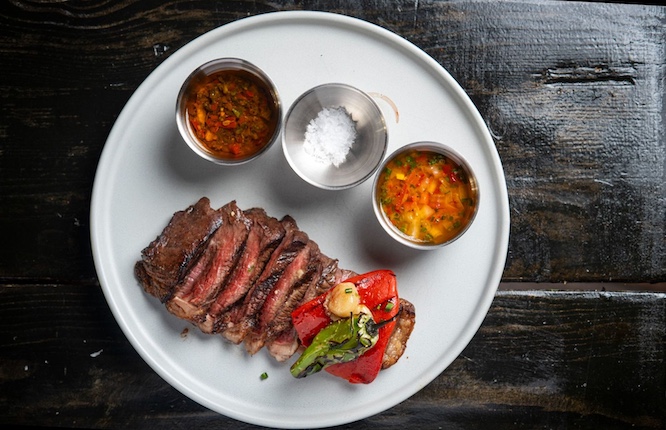 Skip the
section of “Entrees” that lists a burger, and
concentrate on the grill items, for within that
category a table of two or even four should
order the parrillada ($165), which gives
you a taste of pretty much all the grill items,
including skirt
steak, sirloin, short ribs, sweetbreads,
chicken, chorizo, morcilla, chimichurri, salsa
criolla, green salad and
mashed potatoes. Since each of these meat
items requires careful cooking each on its own,
it can be risky to have them all plated at once.
But At Palermo each had its own temperature,
done-ness and juiciness, admirably distinct from
one another.
Skip the
section of “Entrees” that lists a burger, and
concentrate on the grill items, for within that
category a table of two or even four should
order the parrillada ($165), which gives
you a taste of pretty much all the grill items,
including skirt
steak, sirloin, short ribs, sweetbreads,
chicken, chorizo, morcilla, chimichurri, salsa
criolla, green salad and
mashed potatoes. Since each of these meat
items requires careful cooking each on its own,
it can be risky to have them all plated at once.
But At Palermo each had its own temperature,
done-ness and juiciness, admirably distinct from
one another.
The desserts are fine if you
crave something sweet at the end. The banana
crêpe is the one to order.
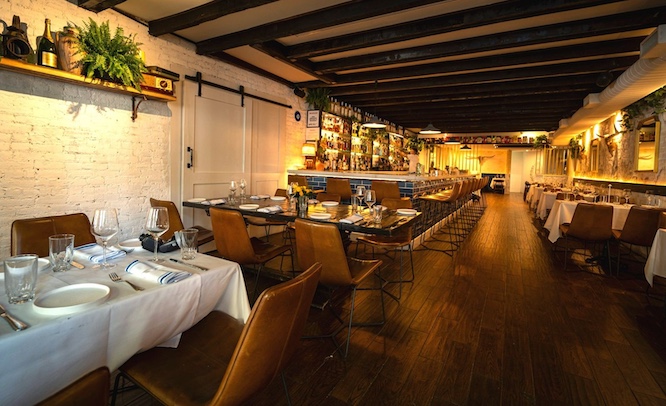
Palermo’s
colorful bar dining area, with sea blue tiled
bar with timbered ceiling, leads
to a softly lighted, brick-walled room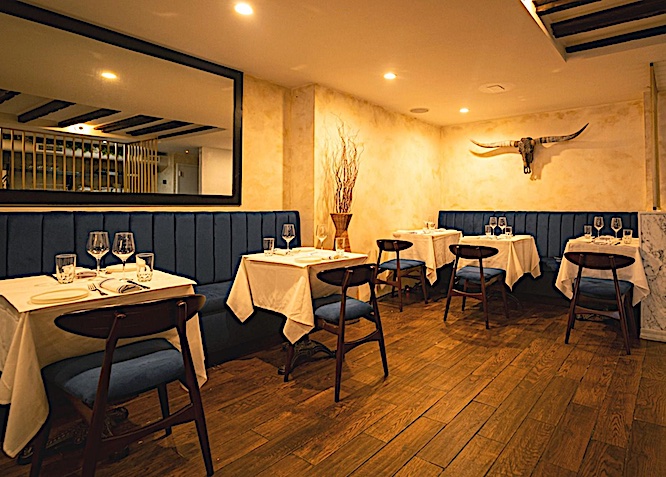 with
bull’s horns, a large wall mirror that opens the
space up, chandeliers, wooden floors and
well-set clothed tables, and it’s quieter than
the bar upfront.
with
bull’s horns, a large wall mirror that opens the
space up, chandeliers, wooden floors and
well-set clothed tables, and it’s quieter than
the bar upfront.
There are about three dozen wines, most
of which are from Argentine vineyards of note,
with labels like Catena Alta Malbec, Zuccardi
Concreto and El Esteco Don David Reserve.
Until it gets colder,
dining outdoors has all the charm of the
landmarked Gramercy Park neighborhood, right
down the block from where Washington Irving
lived and Pete’s Tavern, where O. Henry penned
his beloved story “Gift of the Magi.”
Palermo
Argentinian
Bistro offers an alternative to the huge, brash
steakhouses elsewhere and concentrates on good
ingredients from first-rate sources. With a fine
bottle of Argentine wine, it fits right into its neighborhood
with its own hospitable welcome and good hearty
food.
HÔTEL ALLEMAGNE
By John Mariani
CHAPTER TWENTY-EIGHT
The news of the capture
of the three men alleged to be behind the
hotel crimes was well reported in the Paris
newspapers, and all tried and failed to get a
comment from the Russian Embassy. Catherine
did a spot outside the Hôtel Anastasia,
interviewing Yves and what he’d seen the night
of the event, which her producer loved. Katie
had her notebooks and recorded interviews
packed. David was just happy to have a few
more days with Katie in the City of Lights,
finally getting to see the Louvre and
Versailles.
There had been no word on
Bazarov or his whereabouts, but he had not
left Paris, probably barricaded in the
Embassy until his superiors figured out
what to do with him. In their eyes Bazarov
had succeeded in his mission but failed in
his method, and he feared he would be
shipped back to Moscow, demoted at the
very least and possibly dropped from the
diplomatic corps entirely. All the publicity had
seriously hurt the Russians’ image as
among the most civilized corps in Paris.
After considerable debate, the
diplomatic staff decided that complete
silence on the allegations against Bazarov
was hurting more than helping. A simple
one-line response had not been enough to
quell further inquiry, so it was decided
that Bazarov should give one brief
interview to deny and refute the
allegations against him. Giving an
interview to the principal Paris papers, Le
Monde or Le Figaro, would
have found little traction
internationally, so, with the approval of
Moscow, it was decided that CNN
International would be the best way to get
their denial out to the world. CNN leapt
at the chance to do the interview,
assigning their Paris correspondent,
Catherine Newcombe. The date was set
within a day of the request.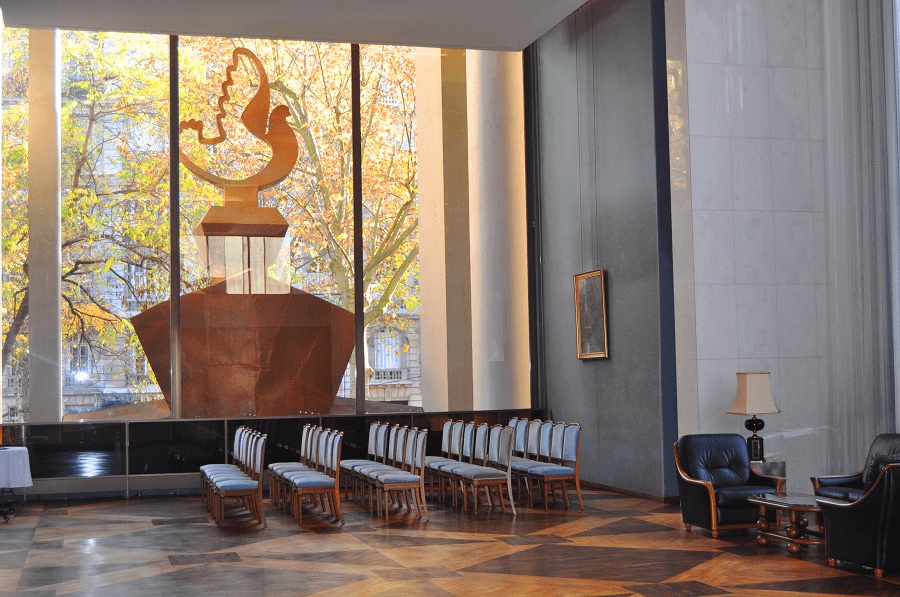
Catherine was, of course,
thrilled at the assignment and quickly
assembled her video and sound crew. The
interview was to take place at the Russian
Embassy in the morning so that the spot
could go to BREAKING NEWS as soon as it
was assembled. Catherine
and her crew arrived early and were
ushered into a large, well-decorated
reception room (above), where three
embassy staff were waiting. Precisely at
the appointed time, the door opened and
Bazarov, dressed in a gray suit but
without a necktie, came in and introduced
himself to Catherine in French.
“You are American?” asked.
“Perhaps for your audience we should speak
English.” Catherine said that she’d hoped
that would be the case.
Her crew set up their equipment
promptly, placing light screens and doing
sound checks. Bazarov sat opposite
Catherine and asked her about her
background and her time as a journalist in
Paris. His demeanor was friendly but
formal, and Catherine felt he was under a
great deal of stress.
Catherine asked how much time they
would have. Bazarov turned to the Russians
in the room and one of them said they had
fifteen minutes. The final preparations
for the set-up would take about five
minutes.
 “So, Madame,” said Bazarov,
“perhaps when this whole charade is over,
you and I can do a proper interview about
a more congenial subject, perhaps about
France’s love of Russian caviar and
Russia’s love of French Champagne. Have
you ever visited the caviar production
facilities in Russia? Perhaps I could
arrange for such a story. Do you like
caviar?”
“So, Madame,” said Bazarov,
“perhaps when this whole charade is over,
you and I can do a proper interview about
a more congenial subject, perhaps about
France’s love of Russian caviar and
Russia’s love of French Champagne. Have
you ever visited the caviar production
facilities in Russia? Perhaps I could
arrange for such a story. Do you like
caviar?”
Catherine knew Bazarov was
trying to charm her, and she went along
with it, believing it would make for a
more comfortable interview all around. She
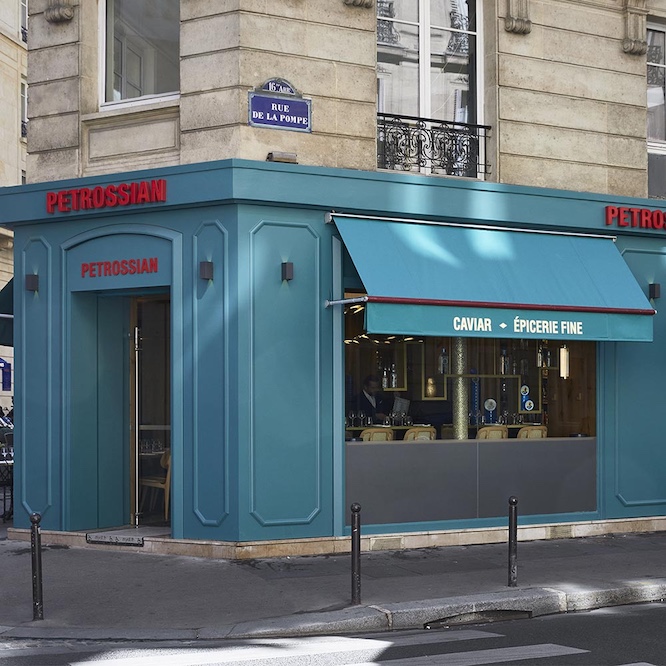
said, “I love caviar. I buy it in Paris at
Petrossian on the Boulevard de
Courcelles.”
“Ah, yes, Petrossian is very
dependable. Here in the embassy, however,
we get some very special caviar sent to us
from time to time. I
shall let you know when the next shipment
comes in.”
“It would make a good story,”
said Catherine, hoping her crew would
hurry up.
“So, you are a connoisseur of good
food?” asked the ambassador. “Where do you
like to eat in Paris?”
Catherine reeled off a few names,
particularly of out-of-the-way bistros she
favored, like her friend Jacques Dornay’s.
“Well,” said Bazarov, “you seem to know
more than I do. Most of my meals in Paris are
diplomatic dinners at embassies and trade
shows.” Then he leaned in a little closer and
asked, “Tell me this, I was once in Montréal
and I and I had this—what shall I say?—odd
variation on frites. It was fried
potatoes with crumbled cheese and gravy. I
must admit I found it delicious. Do you know
of this dish and if any bistro in Paris serves
it?”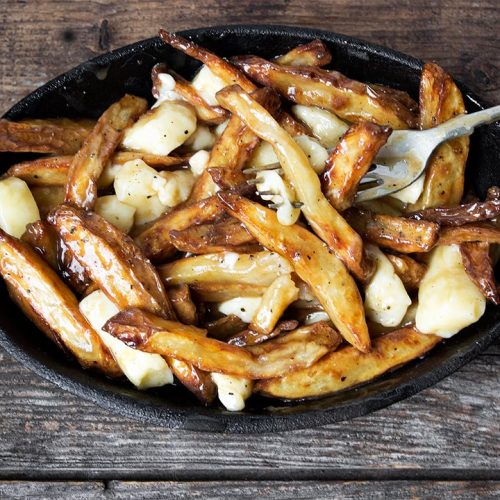
Catherine knew what he was talking
about. “You mean poutine? Yes, the
French Canadians do many different kinds. I
also find it a guilty pleasure when I go to
Canada.”
“Ah, yes!” said Bazarov. “Poutine!
That’s what it was. Poutine.”
“Yes, you can find it here in Paris.
There are several Canadian restaurants in the
city. Probably the best of them is The Moose
on Rue des Quatre Vents. It’s lots of fun.”
Bazarov clapped his hands
and said, “Thank you. I’m glad you know about
this poutine. You will have to take me
to The Moose sometime soon.”
Catherine was a bit nonplussed by
Bazarov’s intense interest in a
French-Canadian dish of messy frites,
then, just as her crew said they were ready,
the interview began.
Bazarov spoke amiably, not
belligerently, saying that he was greatly
offended by these ridiculous allegations about
his being involved in the hotel events. How,
he asked, could he know these three different
individuals from three different places—a
Parisian, a Syrian and a Marseille criminal?
It did not make any sense.
Catherine countered that in the case
of the Hôtel Anastasia he is seen on video
entering the room where the technician was
working. Bazarov said he did go to the
seventh floor to see a friend he knew was in
Paris but he was not there, and the
technician had opened the door and they
chatted for a few minutes about his work. That
was all there was to it.
“So, why would these three different
men say you had been in contact with them
about the virus insertion?” asked Catherine.
“I
have no idea, except that they are trying to
tie Russia into this ridiculous plot. Now, I
will say that our own investigation indicates
that a sample of the virus may have been
stolen from our laboratory in Kiev. Who might
have gotten hold of it and what they intended
to do with it, I cannot say, but it is being
rigorously investigated. But, Madame, here is
the question the world needs to ask: Why would
Russia have any interest in harming people in
order to put three Paris hotels out of
business for a while? It makes no sense at
all.”
Time
was running short, and Catherine kept her
questions brief and pointed, but Bazarov kept
waving his hand to say such a plot was
completely incomprehensible and defied all
logic. Then one of the Russians signaled that
the interview was over, and Bazarov
immediately stood up and removed the
microphone from his lapel.
He
extended his hand to Catherine and said, “I
hope I have been able to show your viewers
that this whole idea of Russia’s complicity in
this unfortunate incident simply makes no
sense whatsoever. I know you will consider all
that I have said and make an honest report.
And—may I call you Catherine, Madame?—We’ll
have a good a laugh about all this over some
caviar and we can discuss your going to the
production site in Russia. Oh, and please
remember what I said about the poutine!”
The
video crew packed up quickly and they were
shown out of the embassy.
Catherine’s
mind was racing.
© John Mariani, 2024
❖❖❖
THE WINES OF ABRUZZO TO GLOBAL ATTENTION
PART ONE
By John Mariani
Unlike the vaunted wines of
Tuscany and Piedmont, and, increasingly, Sicily
and Puglia, the wines of Abruzzo––the region of
Italy east of Rome all the way to the
Adriatic––has not enjoyed renown among the
country’s better offerings. Tradition bound by
generations of small farmers who made wines in
bulk, little of it exported, Abruzzo lagged behind
in technology and investment. One vintner intent
on changing that image on the global market is
Federico De Cerchio, the fourth generation scion
of an estate that dates back to 1910 when his
great-grandfather Vincenzo set off for Naples in
his dogcart, on his way to finalize negotiations
for the purchase of a plot of about twenty
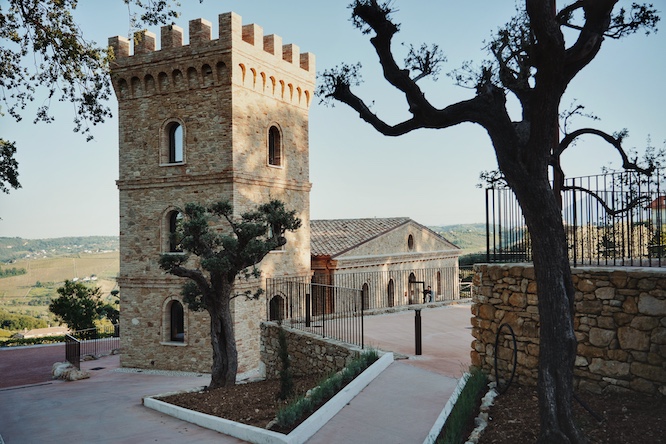
hectares of land, set around a lookout tower in
Abruzzo called Torre Zambra. There he planted the
region’s traditional grapes, Trebbiano d’Abruzzo
and Montepulciano d’Abruzzo. World War II
destroyed the estate, but was restored by his
son-in-law Laurentino De Cerchio in 1947. In 1961,
the first “Torre Zambra” vintage was bottled, at a
time when the region was known for undistinguished
jug wines.
After graduating from Karlstad
Business School in Sweden in 2012, the 25-year-old
Federico took over the family’s wineries,
eventually buying them outright and investing
heavily to produce wines now poised to garner the
respect the region’s wines have yet to achieve.
In
comparison to the wines of Tuscany, Piedmont,
Sicily and recently Umbria, the wines of
Abruzzo are mostly unknown to the global wine
lover. Why do you think this has been true?
I don’t think the wines
of Abruzzo are unknown to the world, but they
certainly aren’t considered “sexy” compared to the
regions you mentioned. This is because Abruzzo
wines have always been very affordable, and in the
mind of the general consumer, low prices often
equal low quality. Historically, our region has
had a large volume of wine production, with many
small growers and, consequently, many
cooperatives. The surplus of production has forced
local cooperatives to push prices down in order to
sell their wines and, as a result, retail prices
remain low. This system doesn’t make Abruzzo wines
particularly appealing.
However, things are
changing as vineyard surface area is being
reduced. Most of the winegrowers are over 60, and
my generation—and the ones that follow—are less
willing to work in the vineyards. As a result, in
the next 15 to 20 years, vineyard area will shrink
and, with less production, the wines of Abruzzo
will become more premium. In my view, this process
will generate much more interest in our region.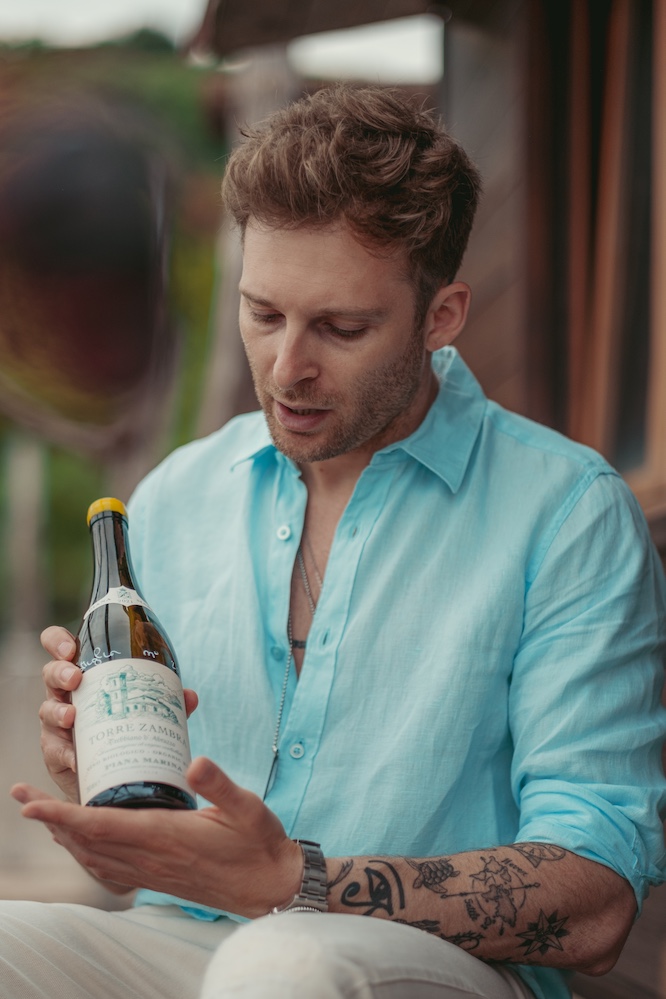
Trebbiano
d’Abruzzo and Montepulciano d’Abruzzo are the
wines you are concentrating on. How are you
making them of a higher quality to distinguish
them in the market?
Well, we are also
working a lot on our Pecorino, a grape varietal I
truly love. I believe that the key to success
nowadays is drinkability. There are many good
wines on the market, but as my father used to say,
“A successful wine is the one that invites you to
have one more glass.” We’ve been working hard
toward that goal, and I think we’ve achieved it in
different ways with our reds compared to our
whites and rosés.
In our reds, we reached
it by being very traditional in our winemaking
process—balancing non-invasive, traditional aging,
letting the wines rest in concrete vats (an
ancient method in Abruzzo) and using wood
carefully, favoring large barrels and seasoned oak
instead of the [smaller] classic barrique. With
our whites and rosés, it’s a different story: here
we’ve heavily invested in technology, implementing
cryomaceration and strictly controlling
fermentation temperatures to extract as much
complexity and aroma as possible. It has taken
years of fine-tuning, but this approach has
brought us to where we are today.

Your
family has long made wine but you do not come
from a wealthy family, though you have been
trained in business and finance. How did you
gain investor interest in your family’s
winery?
Nowadays I am the sole
owner of the Famiglia De Cerchio wine group, the
holding company that owns Torre Zambra along with
other boutique estates in central and southern
Italy. However, my career as an entrepreneur began
in 2012, when I graduated in Business and
Administration from Karlstad Business School in
Sweden. I returned to Italy full of enthusiasm—a
25-year-old freshly graduated and eager to take my
family’s wineries to the moon. But after working
with my father for about eight hours, let’s just
say we quickly realized we were not meant to work
together.
Even as a student, I had
always wanted to build something on my own, and
that was the beginning of my entrepreneurial
journey. To cut a long story short, I leveraged
both my family background and my knowledge of the
wine market to launch one of the first wine
e-commerce platforms in Italy, called Wineowine. I
started the venture with a friend of mine, an IT
engineer. Of course, we needed funds, and after
more than a year and a half of knocking on doors
without success, we were finally accepted into the
LUISS Business School acceleration
program—essentially a startup incubator created by
LUISS University, one of the most prestigious
Italian business schools, based in Rome. They gave
us €60,000 in seed funding and the opportunity to
join their six-month program.
Over the years,
we raised more than €2 million from investors,
including venture capital firms and angel
investors. In 2018, the company was sold. Thanks
to the proceeds of that sale—together with a large
loan I am still repaying—I was able to take over
the family wineries and become their 100%
owner.
Why
was it necessary to buy your family’s winery
estate from your father?
Being
the owner of a winery is not just an honor, it’s a
lifelong commitment. On paper, running a winery
may seem fun, but trust me—not everyone would be
willing to give what it really takes if they knew
in advance the amount of work and sacrifices
required, both personally and professionally, to
make it succeed. Let’s just say I was the one in
the family with the passion and determination to
carry on what my family has been doing since 1910.
Have
Abruzzo’s vintners and communes done much to
promote Abruzzo’s wines? What are you doing
that's different?
There is a genuine
effort, but I believe there is a lack of
entrepreneurial skills on the wine scene—not only
in Abruzzo, but in Italy as a whole. We have
outstanding producers making some of the best
wines in the world, yet the challenge lies in how
we market them. At Torre Zambra, we have worked
hard to strike the right balance between staying
true to our terroir and appealing to consumers’
tastes. Our labels are designed to be visually
striking and eye-catching, and we actively use
social media to engage our community, making them
feel part of our brand story.
❖❖❖
"You're probably bored by my prostate cancer by now. I know I am."––Tony Page, Times of London (8/25).
❖❖❖
Any of John Mariani's books below may be ordered from amazon.com.
 The Hound in Heaven
(21st Century Lion Books) is a novella, and
for anyone who loves dogs, Christmas, romance,
inspiration, even the supernatural, I hope you'll find
this to be a treasured favorite. The story
concerns how, after a New England teacher, his wife and
their two daughters adopt a stray puppy found in their
barn in northern Maine, their lives seem full of promise.
But when tragedy strikes, their wonderful dog Lazarus and
the spirit of Christmas are the only things that may bring
his master back from the edge of despair.
The Hound in Heaven
(21st Century Lion Books) is a novella, and
for anyone who loves dogs, Christmas, romance,
inspiration, even the supernatural, I hope you'll find
this to be a treasured favorite. The story
concerns how, after a New England teacher, his wife and
their two daughters adopt a stray puppy found in their
barn in northern Maine, their lives seem full of promise.
But when tragedy strikes, their wonderful dog Lazarus and
the spirit of Christmas are the only things that may bring
his master back from the edge of despair. WATCH THE VIDEO!
“What a huge surprise turn this story took! I was completely stunned! I truly enjoyed this book and its message.” – Actress Ali MacGraw
“He had me at Page One. The amount of heart, human insight, soul searching, and deft literary strength that John Mariani pours into this airtight novella is vertigo-inducing. Perhaps ‘wow’ would be the best comment.” – James Dalessandro, author of Bohemian Heart and 1906.
“John Mariani’s Hound in Heaven starts with a well-painted portrayal of an American family, along with the requisite dog. A surprise event flips the action of the novel and captures us for a voyage leading to a hopeful and heart-warming message. A page turning, one sitting read, it’s the perfect antidote for the winter and promotion of holiday celebration.” – Ann Pearlman, author of The Christmas Cookie Club and A Gift for my Sister.
“John Mariani’s concise, achingly beautiful novella pulls a literary rabbit out of a hat – a mash-up of the cosmic and the intimate, the tragic and the heart-warming – a Christmas tale for all ages, and all faiths. Read it to your children, read it to yourself… but read it. Early and often. Highly recommended.” – Jay Bonansinga, New York Times bestselling author of Pinkerton’s War, The Sinking of The Eastland, and The Walking Dead: The Road To Woodbury.
“Amazing things happen when you open your heart to an animal. The Hound in Heaven delivers a powerful story of healing that is forged in the spiritual relationship between a man and his best friend. The book brings a message of hope that can enrich our images of family, love, and loss.” – Dr. Barbara Royal, author of The Royal Treatment.
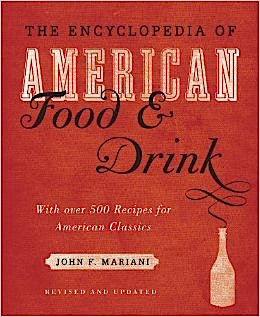 |
The Encyclopedia of American Food and Drink by John F. Mariani (Bloomsbury USA, $35) Modesty forbids me to praise my own new book, but let me proudly say that it is an extensive revision of the 4th edition that appeared more than a decade ago, before locavores, molecular cuisine, modernist cuisine, the Food Network and so much more, now included. Word origins have been completely updated, as have per capita consumption and production stats. Most important, for the first time since publication in the 1980s, the book includes more than 100 biographies of Americans who have changed the way we cook, eat and drink -- from Fannie Farmer and Julia Child to Robert Mondavi and Thomas Keller. "This book is amazing! It has entries for everything from `abalone' to `zwieback,' plus more than 500 recipes for classic American dishes and drinks."--Devra First, The Boston Globe. "Much needed in any kitchen library."--Bon Appetit. |
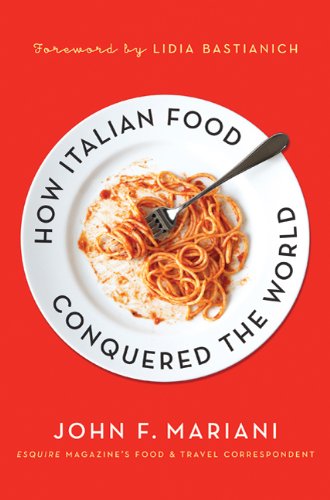
"Eating Italian will never be the same after reading John Mariani's entertaining and savory gastronomical history of the cuisine of Italy and how it won over appetites worldwide. . . . This book is such a tasteful narrative that it will literally make you hungry for Italian food and arouse your appetite for gastronomical history."--Don Oldenburg, USA Today. "Italian
restaurants--some good, some glitzy--far
outnumber their French rivals. Many of
these establishments are zestfully described
in How Italian Food Conquered the World, an
entertaining and fact-filled chronicle by
food-and-wine correspondent John F.
Mariani."--Aram Bakshian Jr., Wall Street
Journal.
"Equal parts
history, sociology, gastronomy, and just
plain fun, How Italian Food Conquered the
World tells the captivating and delicious
story of the (let's face it) everybody's
favorite cuisine with clarity, verve and
more than one surprise."--Colman Andrews,
editorial director of The Daily
Meal.com. "A fantastic and fascinating
read, covering everything from the influence
of Venice's spice trade to the impact of
Italian immigrants in America and the
evolution of alta cucina. This book will
serve as a terrific resource to anyone
interested in the real story of Italian
food."--Mary Ann Esposito, host of PBS-TV's
Ciao
Italia. "John Mariani has written the
definitive history of how Italians won their
way into our hearts, minds, and
stomachs. It's a story of pleasure over
pomp and taste over technique."--Danny Meyer,
owner of NYC restaurants Union Square
Cafe, The Modern, and Maialino.
|
 |
 |
 |
 |
 |
 |
MARIANI'S VIRTUAL GOURMET
NEWSLETTER is published weekly. Publisher: John Mariani. Editor: Walter Bagley. Contributing Writers: Christopher
Mariani, Misha Mariani, John A. Curtas, Gerry Dawes, Geoff Kalish.
Contributing
Photographer: Galina Dargery. Technical
Advisor: Gerry
McLoughlin.
If you wish to subscribe to this
newsletter, please click here: http://www.johnmariani.com/subscribe/index.html
© copyright John Mariani 2025