MARIANI’S
Virtual
Gourmet
November 9,
2025
NEWSLETTER
THIS WEEK
ÁVILA
City of Stones and Saints
By John Mariani
NEW YORK CORNER
ESSENTIAL BY CHISTOPHE BELLANCA
By John Mariani
HÔTEL ALLEMAGNE
CHAPTER THIRTY-FIVE
By John Mariani
❖❖❖
City of Stones and Saints
By John Mariani
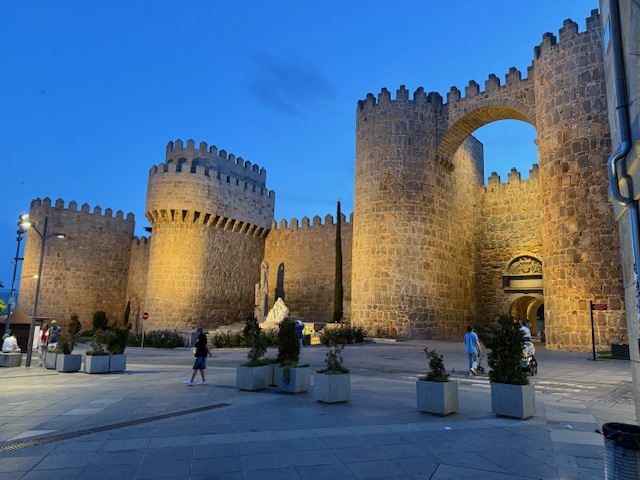
The mere sound of the word “Ávila” has
the soul of Spain in it, and for centuries, this
has remained one of the country’s most beautiful
and religious small cities, especially since the
beloved Saint Teresa was born here. As one
of the Catholic Church’s greatest saints, the
Carmelite nun wrote ecstatically about her
transfixed relation to Jesus, which spawned many
followers of
mysticism in the 16th century.
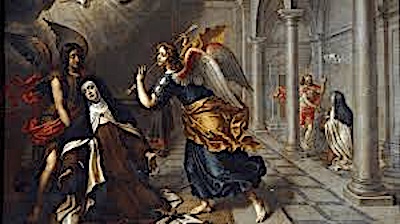 She was quite
literally a saint of many parts, so venerated that
when she died, her body (said to be found
incorruptible) was dismembered for relics, so that
Rome got her right foot and jaw, Lisbon her hand,
Rona her eye and left hand, Alba de Tormes her
left hand and heart, Paris a single finger
She was quite
literally a saint of many parts, so venerated that
when she died, her body (said to be found
incorruptible) was dismembered for relics, so that
Rome got her right foot and jaw, Lisbon her hand,
Rona her eye and left hand, Alba de Tormes her
left hand and heart, Paris a single finger 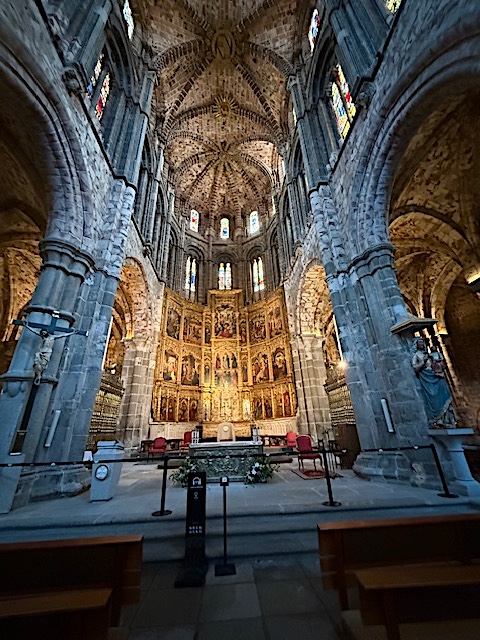 and Sanlúcar
de Barrameda another.
and Sanlúcar
de Barrameda another.
Ávila’s Cathedral, begun in the 12th
century and completed in 1350, has a splendid,
filigreed grandeur, while the cloistered Monastery
of St. Thomas, built in 1482 and located outside
the city walls, is exemplary for its Isabelline
architecture that combines both Gothic and Moorish
elements.
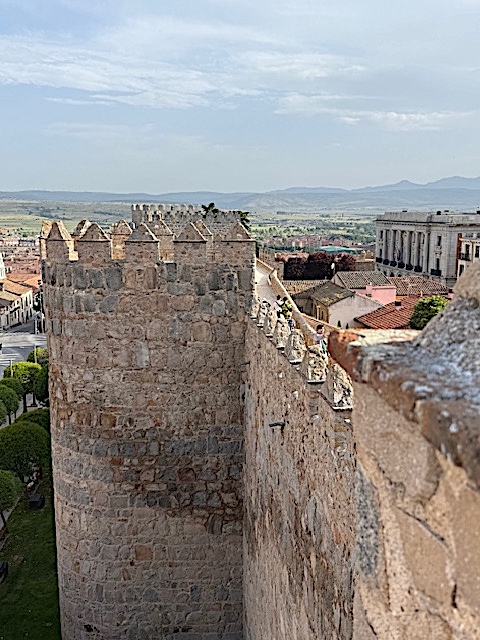 But
Ávila is most famous for its extraordinary 2.5
kilometer wall, nine-feet thick walls, with 87
look-out turrets, that wraps around the entire. The defensive
edifice took from the 11th to the
14th century to finish, and
afterwards this oft-conquered city was never again
threatened.
But
Ávila is most famous for its extraordinary 2.5
kilometer wall, nine-feet thick walls, with 87
look-out turrets, that wraps around the entire. The defensive
edifice took from the 11th to the
14th century to finish, and
afterwards this oft-conquered city was never again
threatened.
You can walk about half its length, starting at
the Puerto del Puente and, after a trek over rough
stones, exit at El Alcázar at the center of the
beautifully restored old town, a UNESCO World
Heritage site. At twilight the wall takes on an
amber glow.
Just outside the wall is the beautiful
Los Parador de Ávila (Marques de Canales
de Chozas 2; 920-211-340), near the
Basilica of St. Vincent, one of series of historic
hotel properties that once might have been a
monastery, palace or fortress. The Ávila hotel was
once the Piedras Albas Palace across from a pine
tree garden (right). Rooms are large,
elegantly restored with traditional wallpapers and
fabrics, stone and wood, some with canopied beds,
all very quiet. The unexceptional restaurant
mostly serves as a guest’s dining room.
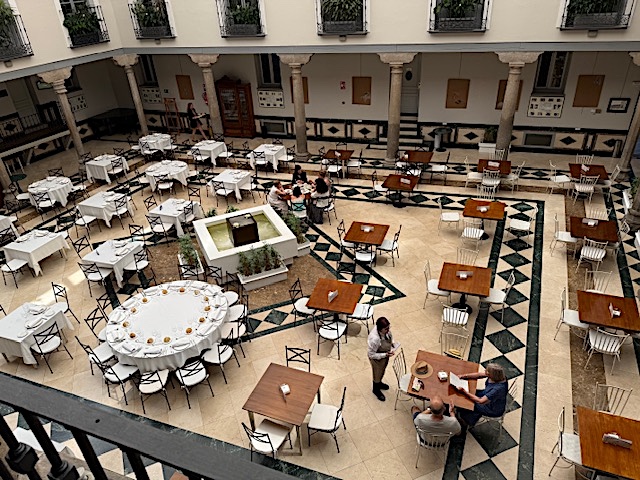 On my latest
visit to Ávila I stayed just steps from the wall’s
gate at the expansive, multi-storied Palacios
de los Veláda across from the Plaza de la
Cathedral, with a magnificent central courtyard,
within which its restaurant is set. The hotel is
much finer than the restaurant, however, whose
menu I found dull and whose service staff I could
hardly find at all.
On my latest
visit to Ávila I stayed just steps from the wall’s
gate at the expansive, multi-storied Palacios
de los Veláda across from the Plaza de la
Cathedral, with a magnificent central courtyard,
within which its restaurant is set. The hotel is
much finer than the restaurant, however, whose
menu I found dull and whose service staff I could
hardly find at all.
Ávila is, however, full of
good restaurantes, and on one street,
Calle Figones, there are several asadors specializing
in suckling pig and baby lamb. We ate at Asador
Las Cubas at lunch in the spacious,
well-lighted dining room, with tiled pillars. They
specialize in leg of baby lamb, among the
best I’ve had in Spain. Also
very good were gambas in olive oil
and garlic that came to the table sizzling in a
black skillet.
Rincón de Jabugo (Calle San Seguindo 28)
is a very popular place near the Cathedral, where
the mere cutting of the glorious jamón
Iberico is a nightly demo of Spanish
dexterity. Up front is a tavern for
tapas, in the rear is for full meals that might
begin with sardines in olive oil; a potato tortilla with
boletus and muscullus mushrooms foraged that
morning; a massive chuleton of
beef cooked very rare and served on a sizzling
platter; and a lovely cinnamon-flavored rice
pudding. 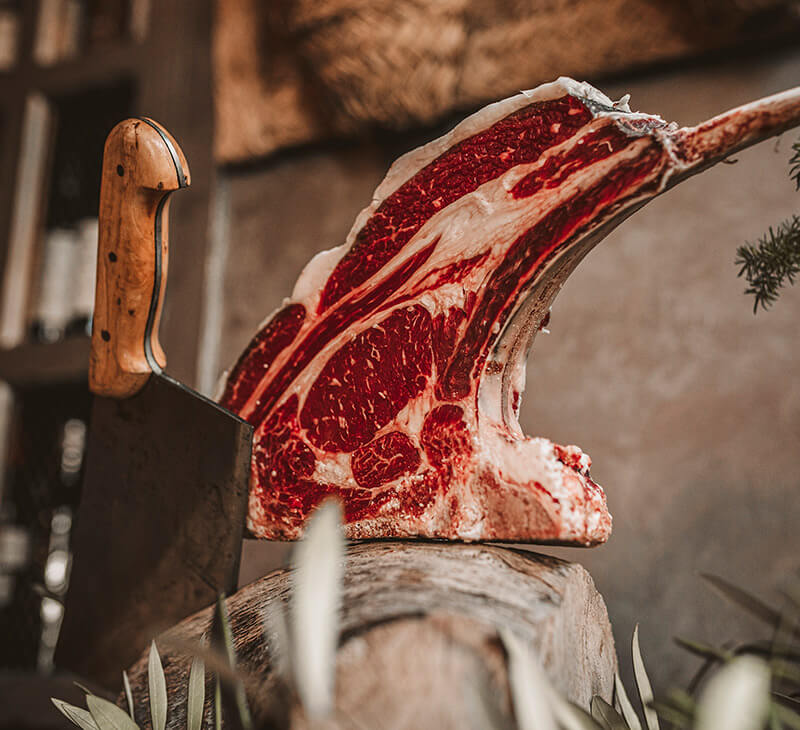
New to me was La Lumbre (Calle de
Tomas Luis de Victoria) on a quiet street
near the Plaza
del Mercado Chico. It has a fanciful, very
colorful interior
and a long menu, but the specialty here is
beef––nine cuts––which you can see ageing in a
glass cabinet. The ribeye we had was very good,
with fine marbling and deep, rich flavor. There
are also several seafood dishes, including bacalao
(cod) in a basil sauce, and to start have
their gazpacho of the season or the Castillian
bean soup.
In the morning
sit outside and have strong coffee and croissant
or churros fritters with melted hot chocolate to
fortify you for the scaling of the wall.
❖❖❖
NEW YORK CORNER
103 West 77th Street
646-478-7928
By
John Mariani
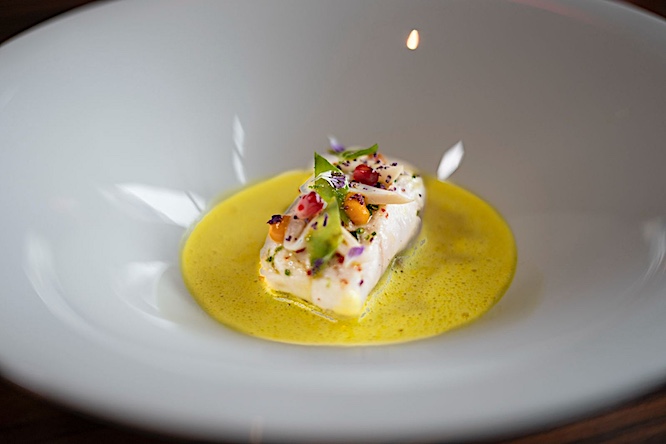
Black Sea Bass
Cuisine is to food what a fountain
pen is to a pencil, and finesse is to
substance what novelty is to style. Both are
useful, but the current food media’s attempt
to equate all restaurant food as being
equally admirable is like saying college
football is no different from the NFL or a
grunge band from the Chicago Symphony
Orchestra.
 The
differences are manifest at Essential by
Christophe, a three year-old French restaurant
that has proven itself a hit among
cognoscenti, despite being ignored by the New
York media, except for Steve Cuozzo of the Post,
who declared it the “best new French
restaurant in decades.” I concur, “new’ being
the correct word, for equally superb older
French restaurants in the city like Daniel,
Jean-Georges, Le Bernardin and Gabriel
Kreuther are in the same firmament.
The
differences are manifest at Essential by
Christophe, a three year-old French restaurant
that has proven itself a hit among
cognoscenti, despite being ignored by the New
York media, except for Steve Cuozzo of the Post,
who declared it the “best new French
restaurant in decades.” I concur, “new’ being
the correct word, for equally superb older
French restaurants in the city like Daniel,
Jean-Georges, Le Bernardin and Gabriel
Kreuther are in the same firmament.
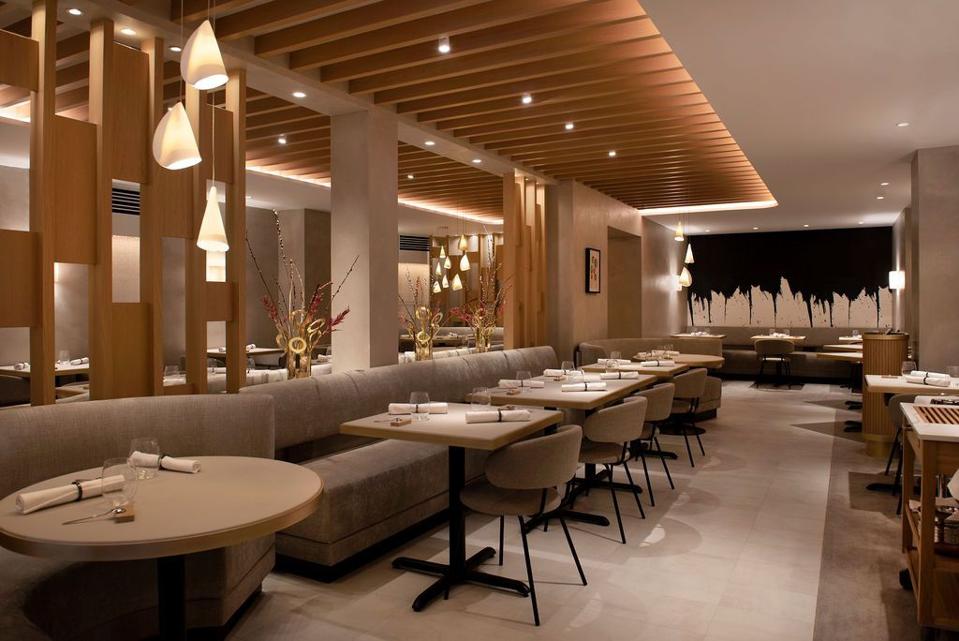
But being new––I’ll call it EC––it sets a
decorous standard for modern restaurants in
which Parisian interior designer Caroline
Egasse aimed both for comfort and
sophistication: In addition to muted colors of
black and beige,
there are touches of brass, porcelain tiles
and Élitis wallpapers, with a counterpoint of
a bold blue vinyl and silk mural; the tables
are made of beautiful treated leather; the
lighting casts a softness over a split dining
 room
where everyone can see everyone; The food is
set on Bernardaud china. Everyone from
hostesses to waiters is dressed in black,
never the most appealing color for staff
members.
room
where everyone can see everyone; The food is
set on Bernardaud china. Everyone from
hostesses to waiters is dressed in black,
never the most appealing color for staff
members.
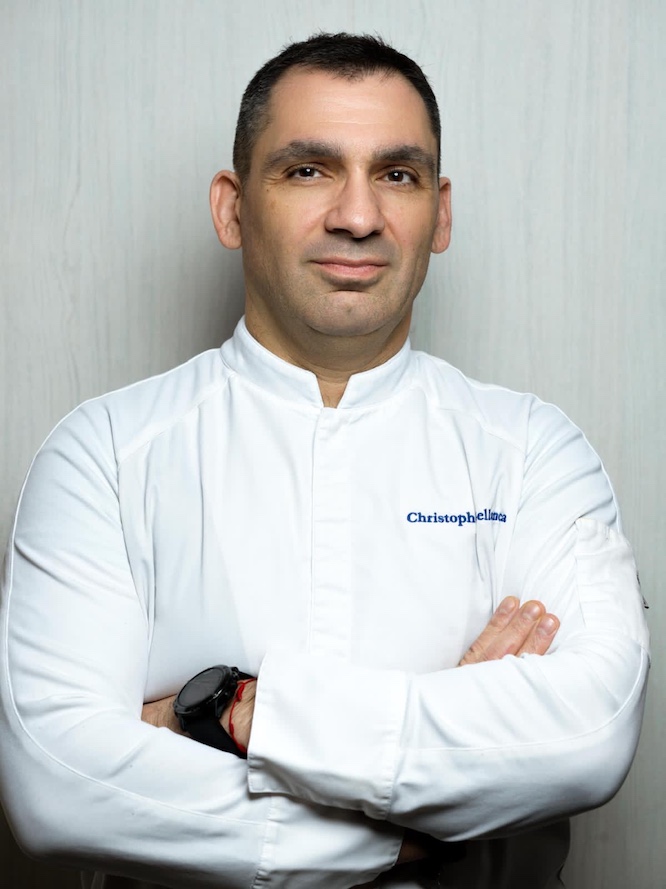
I have followed Christophe
Bellanca’s ever rising career since he was
chef at L’Orangerie in Los Angeles back in the
1990s, followed by time at Le Cirque before
joining Joël Robuchon in opening L’Atelier.
Now he cooks unfettered, and while he is
proudly French (born in Ardèche), he does not
build his menu solely upon French cuisine, as
is true of Jean-Georges Vongerichten and Eric
Ripert.
 There
are three- ($175) and four-course ($205) menus
(with wine pairings available), which is lower
than most other French restaurants at this
level. Cocktails
run
$18-$24, with 21 wines by the glass $19-$110
(this last for Château d’Yquem) and three pages
of half-bottles. By the bottle wines are very
expensive, with only two whites on the list
under $100 and the cheapest red $120. If you’re
feeling frisky or Emiratical, there’s a Château
Margaux 1900 for $30,000.
There
are three- ($175) and four-course ($205) menus
(with wine pairings available), which is lower
than most other French restaurants at this
level. Cocktails
run
$18-$24, with 21 wines by the glass $19-$110
(this last for Château d’Yquem) and three pages
of half-bottles. By the bottle wines are very
expensive, with only two whites on the list
under $100 and the cheapest red $120. If you’re
feeling frisky or Emiratical, there’s a Château
Margaux 1900 for $30,000.
We went for the
four courses, beginning with a complementary
mushrooms cappuccino. 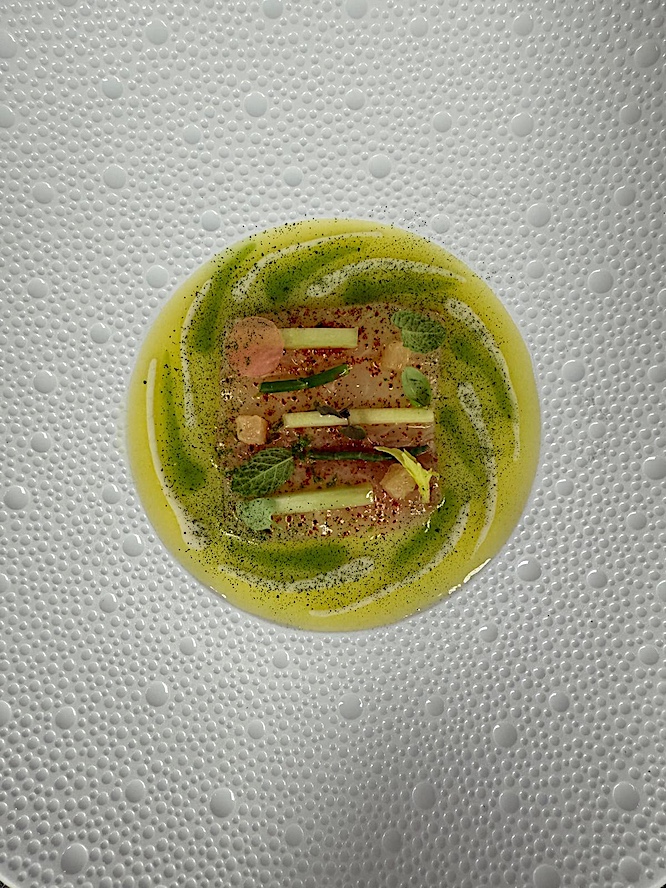 The
came silky sashimi of Japanese sea bream
named madai, (left) simply
dressed with cucumber, lemon
verbena
as an acid and
ajo blanco for spark. Wild red
crab was unexpectedly but delightfully
paired with creamy foie gras in a
flavorful bouillon corsé made
with the crab shells and Thai spices.
The
came silky sashimi of Japanese sea bream
named madai, (left) simply
dressed with cucumber, lemon
verbena
as an acid and
ajo blanco for spark. Wild red
crab was unexpectedly but delightfully
paired with creamy foie gras in a
flavorful bouillon corsé made
with the crab shells and Thai spices.
Among the second courses we opted for a
lightly grilled red mullet perked up by a piperade
and
sauced with a bouillabaisse-style
reduction. Granted it was a second course
but serving only one scallop, lightly smoked
and
gold caviar in a drizzle of Champagne
hazelnut sauce was skimpy.
 Third courses are a bit more generous and
richer, like the braised
black bass with artichoke
and razor clams, and sided with a fine
spicy ginger condiment and turmeric shoyu.
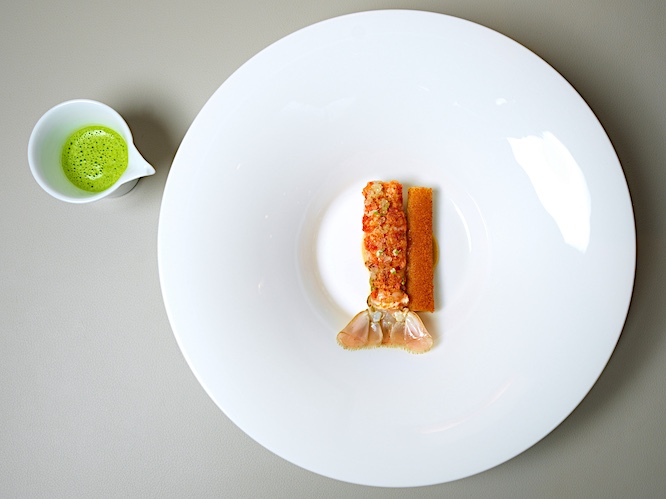
A plump langoustine was slightly cooked
and accompanied by
stuffed ziti pasta with a green curry (right),
while lobster came braised and served with served
kuri squash and kampot pepper sauce. The
heftiest dish of all is the succulent cap of
wagyu beef (below) with rosa
bianca eggplant and sweet-and-sour gremolata,
though I can’t say the Gekkeikan sake
reduction did much for the dish. Kudos for
Bellanca not tacking on a surplus for this
dish!
Third courses are a bit more generous and
richer, like the braised
black bass with artichoke
and razor clams, and sided with a fine
spicy ginger condiment and turmeric shoyu.
A plump langoustine was slightly cooked
and accompanied by
stuffed ziti pasta with a green curry (right),
while lobster came braised and served with served
kuri squash and kampot pepper sauce. The
heftiest dish of all is the succulent cap of
wagyu beef (below) with rosa
bianca eggplant and sweet-and-sour gremolata,
though I can’t say the Gekkeikan sake
reduction did much for the dish. Kudos for
Bellanca not tacking on a surplus for this
dish!
What he does tack on to each dish listing
are obtrusive little icons indicating
“vegetarian and/or gluten free,” which one
expects in a hospital, not at a fine dining
restaurant.
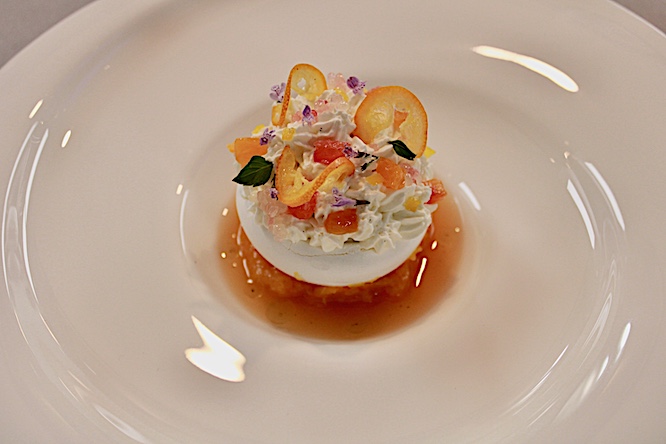
Desserts
approach the sublime, like the warmTart
“Tout Chocolat”; Le Vacherin (right)
with clementine marmalade, bergamot and lime
sorbet; and an airy
soufflé of orange marmalade and green
cardamom ice cream.
You
can
see from these descriptions that Bellanca is
not toeing a strictly French line, but it’s
also obvious that French technique and
finesse are the underpinnings of everything
on the menu, whether it’s Chinese, Japanese
or Italian. Indeed this kind of cuisine is
exemplary of the evolution of French cuisine
and a rebuke of those who still insist that
it is staid and stuck in the past. You will
find such cuisine in France now, and the
essential element of all Bellanca’s food is
that enhancement, not mere novelty, is key.
Open
nightly
for dinner.
HÔTEL ALLEMAGNE
By John Mariani
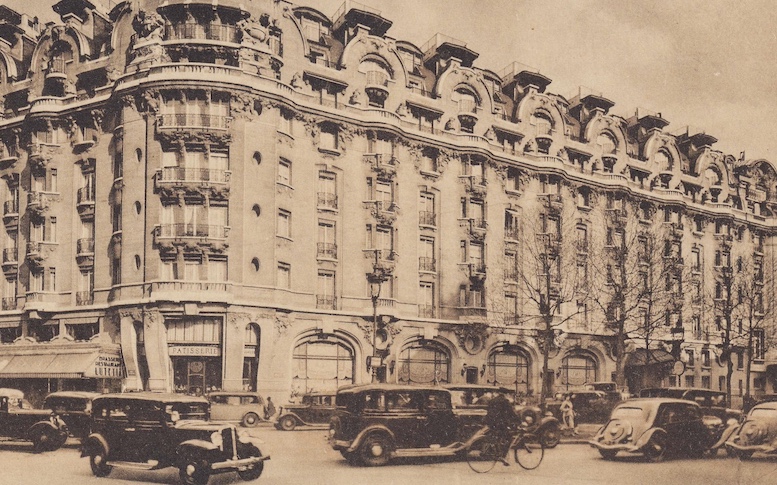
“Louise
was a bright girl everyone said was quite
attractive and could achieve much in her
life, even though her being Jewish and a
female were handicaps before the war. Of
course, she was only a young girl in the
1930s, but by 1939 German Jews were pouring
into Paris for refuge. Most of them lived in
the 4th, 11th, 18th
and 20th Arrondissements when the
Germans captured Paris in 1940. They did a
census and found there were about 150,000
Jews in Paris; almost half of them were
foreigners.
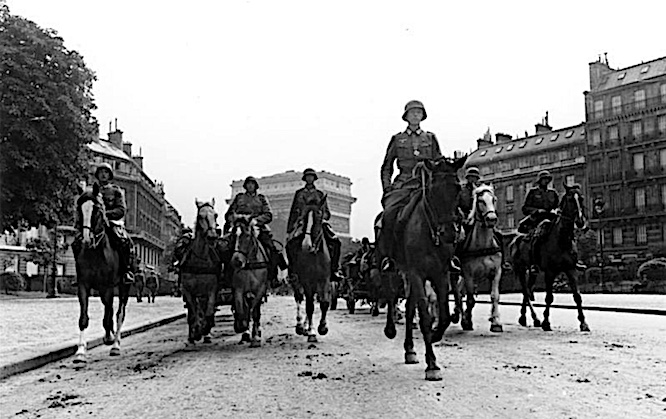 “In
October that year the Nazis bombed seven
synagogues in Paris, and
they put an SS
Police official in charge of taking
over Jewish businesses. I remember they even
put a
gate and a sign on the children’s playgrounds
saying ‘Interdit aux Juifs’—‘forbidden
to Jews’—the one Louise and I had played in
since we were born. Then the Nazis began
arrests, 10,000 in Paris, but many families
were able to get to the unoccupied zone south
of Paris. The foreigners were deported, with
the full assistance of the French police, and
few of them ever returned.
“In
October that year the Nazis bombed seven
synagogues in Paris, and
they put an SS
Police official in charge of taking
over Jewish businesses. I remember they even
put a
gate and a sign on the children’s playgrounds
saying ‘Interdit aux Juifs’—‘forbidden
to Jews’—the one Louise and I had played in
since we were born. Then the Nazis began
arrests, 10,000 in Paris, but many families
were able to get to the unoccupied zone south
of Paris. The foreigners were deported, with
the full assistance of the French police, and
few of them ever returned. 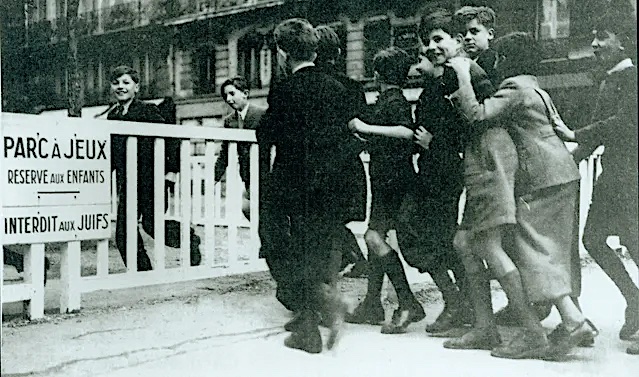
“By 1942—Louise and I were fourteen—all
Jews had to wear the yellow Star of David. A
year later only 60,000 Jews remained in the
city, but those who could get out went to
neutral countries like Spain, Portugal or
Switzerland.
Many others joined Jewish resistance
groups, some of them Zionists, others
Communists.
“Louise’s
family was not able to escape. Her family was
eventually arrested and sent to a work camp in
Poland, but Louise had been protected by, of
all people, the fashion designer
Coco Chanel, who had a very amiable
relationship with the Nazis. She despised
Jews, although she found many of the Jewish
artists and writers worthwhile to be around.
She knew them all—Modigliani, Chagall,
Soutine, everybody. They lent a cachet to her
brand, and Chanel was passionately devoted to
keeping her name in the international market.
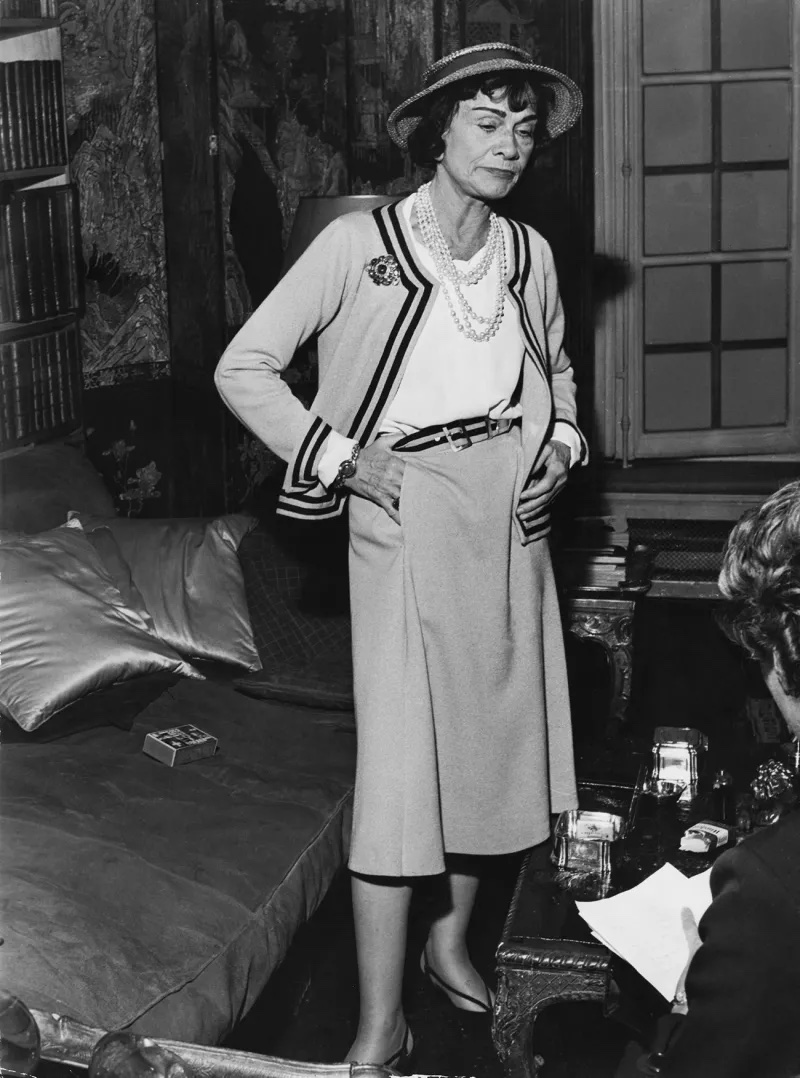 “Chanel
had always kept an apartment at The Ritz,
which was neutral ground because it was owned
by the Swiss. And the German officers took
over all the grand hotels, including half of
The Ritz (below)—the other half, where
Chanel lived on the Rue Cambon side, was for
French civilians and foreigners—and they even
paid for their rooms and food, although with a
heavy discount. Hermann Goering took the whole
first floor for his headquarter. He ordered a
jeweled baton from Cartier and doused himself
with French perfume. In
Paris the Nazis tried to act as civilized
human beings to show the French they were not
such
“Chanel
had always kept an apartment at The Ritz,
which was neutral ground because it was owned
by the Swiss. And the German officers took
over all the grand hotels, including half of
The Ritz (below)—the other half, where
Chanel lived on the Rue Cambon side, was for
French civilians and foreigners—and they even
paid for their rooms and food, although with a
heavy discount. Hermann Goering took the whole
first floor for his headquarter. He ordered a
jeweled baton from Cartier and doused himself
with French perfume. In
Paris the Nazis tried to act as civilized
human beings to show the French they were not
such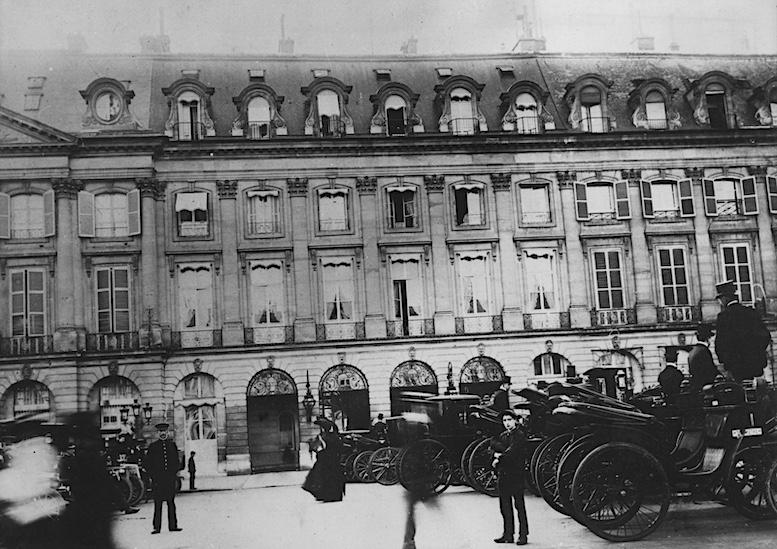 awful people as they imagined. They even
willingly handed over their firearms to the
hotel while there. Unless they were arresting
Jews, the German soldiers were severely
punished if they mistreated the Parisians.
awful people as they imagined. They even
willingly handed over their firearms to the
hotel while there. Unless they were arresting
Jews, the German soldiers were severely
punished if they mistreated the Parisians.
“Chanel’s acceptance
of the Nazis was crucial to that image, so
they allowed her to run her business and keep
her boutique open. Her main
customers for her hugely successful Chanel No.
5 perfume were German officers. She did lose
her grand suite at the Ritz to the Nazis, but
they allowed her to live in two small rooms.
Since no one but the Germans were allowed to
enter the Ritz’s front door, Chanel came in
from the side, up a hidden staircase to get to
her rooms and a bedroom in the attic.
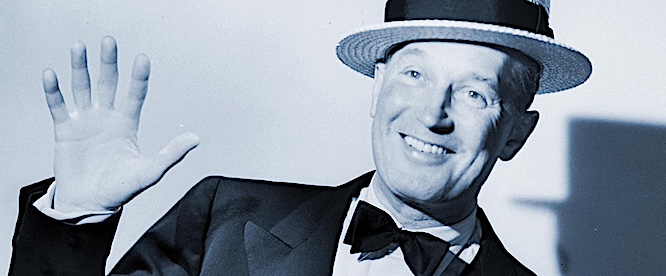 “Chanel
was in a survival mode—this was a time, you
know, when Maurice Chevalier (left) was
singing his gay little songs on the Nazis’
Radio Paris—though she couldn’t have cared
less what happened to the Jews. She still ran
her boutique and designed clothes, and, with
so many Parisians near starving, the Parisian
girls were very skinny, just the way Chanel
wanted them to show off her clothes. And that
is how she met Louise.
“Chanel
was in a survival mode—this was a time, you
know, when Maurice Chevalier (left) was
singing his gay little songs on the Nazis’
Radio Paris—though she couldn’t have cared
less what happened to the Jews. She still ran
her boutique and designed clothes, and, with
so many Parisians near starving, the Parisian
girls were very skinny, just the way Chanel
wanted them to show off her clothes. And that
is how she met Louise.
“Louise had been living with a
non-Jewish French family who had some clout
with the Germans, so, as long as she kept more
or less out of sight, she was safe. She lived
not far from The Ritz, and one day, as she
went out to buy some of the meager rations
allowed—I think it was 500 grams of bread each
day and five grams of sugar each month—Chanel
was headed to her boutique and Louise caught
her eye. Chanel was struck by Louise’s look
and figure, and how she carried herself quite
naturally. Chanel called out to Louise, asked
who she was and where she came from, then
paused to think, asking Louise to turn around.
Then she said, ‘I need a girl like you to be a
fitting model and a model for my shows. Are
you interested?
I cannot pay you very much, but I may
be able to help you to get more food.’
“Louise was just
fifteen then and wasn’t even sure who this
elegant lady was, but she knew about Chanel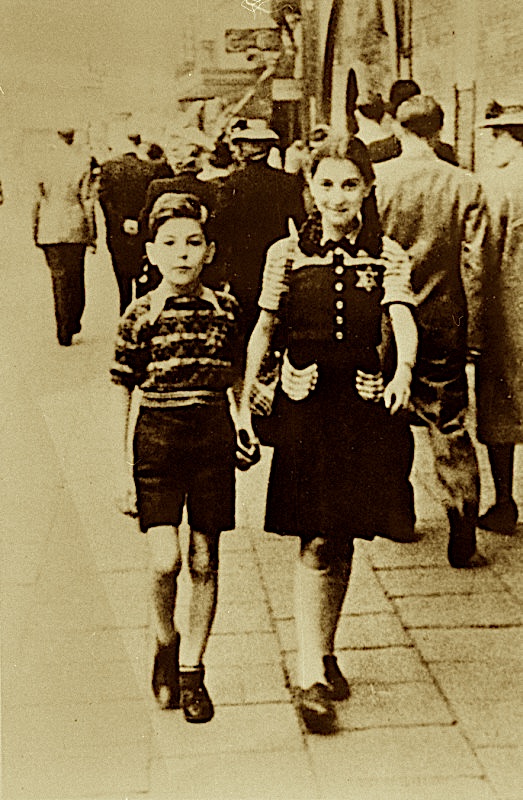 No. 5 and
made the connection. She told Chanel she was
very grateful for the offer, but that her
being Jewish would be very risky for her to
appear in such a public way. Chanel said, ‘I
am sure I can work that out with the
authorities. They grant me certain . . .
privileges.’ They then discussed what Louise
would have to do—she had no job and only
worked for the family she lived with—and
Chanel asked her to come to the boutique to
try on some dresses. She said, ‘First, you
must remove that yellow star.’ After that,
they went to her atelier and introduced Louise
to the much-reduced staff, saying only that
Louise would be working there and making no
reference to her being Jewish.
No. 5 and
made the connection. She told Chanel she was
very grateful for the offer, but that her
being Jewish would be very risky for her to
appear in such a public way. Chanel said, ‘I
am sure I can work that out with the
authorities. They grant me certain . . .
privileges.’ They then discussed what Louise
would have to do—she had no job and only
worked for the family she lived with—and
Chanel asked her to come to the boutique to
try on some dresses. She said, ‘First, you
must remove that yellow star.’ After that,
they went to her atelier and introduced Louise
to the much-reduced staff, saying only that
Louise would be working there and making no
reference to her being Jewish.
“After that, things went very well with
Louise and Chanel, who after a while said the
girl was her favorite model. At first, Louise
was very anxious about appearing in fashion
shows that were attended almost entirely by
German officers and their mistresses. If they
inquired about her, her Jewish identity might
be exposed, but Chanel managed to keep Louise
out of sight when not modelling, and, for a
while all went well. Chanel even confided in
her, believing Louise would never betray this
woman who had given her a better life and knew
her secret.
“One time she said to Louise, ‘My life didn’t
please me, so I created my life, so when
this horrid war is over, so should you.’
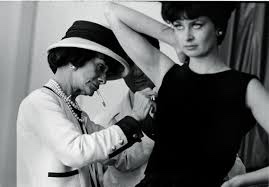 “Chanel
was
certainly a self-made woman. She came from
nothing. Her mother washed laundry. She told
Louise, ‘It’s probably not just by
chance that I’m alone. It would be very hard
for a man to live with me, unless he’s
terribly strong. And if he’s stronger than I,
I’m the one who can’t live with him. I’m
neither smart nor stupid, but I don’t think
I’m a run-of-the-mill person. I’ve been in
business without being a businesswoman, I’ve
loved without being a woman made only for
love. The two men I’ve loved, I think, will
remember me, on earth or in heaven, because
men always remember a woman who caused them
concern and uneasiness.’
“Chanel
was
certainly a self-made woman. She came from
nothing. Her mother washed laundry. She told
Louise, ‘It’s probably not just by
chance that I’m alone. It would be very hard
for a man to live with me, unless he’s
terribly strong. And if he’s stronger than I,
I’m the one who can’t live with him. I’m
neither smart nor stupid, but I don’t think
I’m a run-of-the-mill person. I’ve been in
business without being a businesswoman, I’ve
loved without being a woman made only for
love. The two men I’ve loved, I think, will
remember me, on earth or in heaven, because
men always remember a woman who caused them
concern and uneasiness.’
“For a fifteen-year-old girl such
sentiments made little impact on Louise, but
she knew that she was in the presence of one
of the world’s most remarkable women. When the
war was over, Louise thought she might
continue in Chanel’s employ, although she also
had dreams of entering one of the professions,
like medicine or the law.
“Louise was, of course, as aware as
anyone in Paris what the Germans had done to
our city, and how the Jews and anyone who
opposed them were treated. But for the time
being she was in a safe haven and could do
nothing about that or risk being deported,
like her parents. And then, things turned very
dark for Louise.
“After one of Chanel’s fashion shows, a
young German officer in attendance asked the
designer about Louise and Chanel tried to
divert him by saying, ‘Oh, she’s just another
girl. They come and go.’ But the officer
insisted on meeting Louise and Chanel could
not refuse. He spoke to her at length and
invited her to dine with him at The Ritz that
evening. Louise looked at Chanel, who raised
the palms of her hands and shook her head, as
if to say, ‘What can I do?’
Of course, Louise knew she
could not say no to the officer and agreed to
meet him that night at eight o’clock. After
the man left, Louise broke into tears. Chanel
was not good at showing her emotions. She 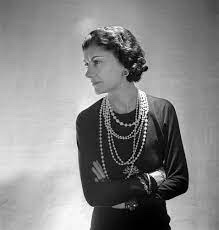 would
not embrace Louise and repeated what she
always said, almost flippantly, ‘If
you’re sad, add more lipstick and attack.’
Then she said she would dress Louise for the
evening, picking a little black dress off the
rack than she had modeled that day. ‘I’ll give
you some pearls,’ said Chanel, who always
wore pearls.
would
not embrace Louise and repeated what she
always said, almost flippantly, ‘If
you’re sad, add more lipstick and attack.’
Then she said she would dress Louise for the
evening, picking a little black dress off the
rack than she had modeled that day. ‘I’ll give
you some pearls,’ said Chanel, who always
wore pearls.
 “I will not go into details of the
dinner, but Louise was terrified, even though
the officer tried very hard to be a gentleman
throughout. Then, at the end of the meal, he
said he wished to see Louise again, if she
would kindly consent, which Louise could
hardly refuse.
“I will not go into details of the
dinner, but Louise was terrified, even though
the officer tried very hard to be a gentleman
throughout. Then, at the end of the meal, he
said he wished to see Louise again, if she
would kindly consent, which Louise could
hardly refuse.
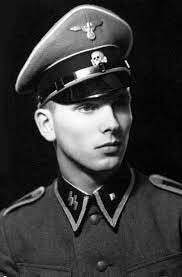
“And so, a one-sided affair began with
the officer. His name was Dieter von
Hoffmann—all the Germans in Paris added ‘von’
to their names to sound aristocratic—and he
was attractive and, at least at first, very
kind to Louise. He proudly showed her off to
his colleagues as a beautiful French girl (he
spoke French, but Louise knew no German) who
was a Chanel model. He would take her to
dinner at least twice a week, and though
Louise pretended to warm to the man, she
loathed him and feared him. Before long he had
taken her to his bed, delighted that she was a
virgin.
© John Mariani, 2024
❖❖❖

FOOD WRITING 101: Don't write trite sentences used by others 10,000 times just in the past year.
"Located in
northeastern Italy, Ravenna is a treat for the
senses." by Kathleen
Wong,"Ravenna: Foodies
should flock to this
less-traveled Italian gem" USA Today (10/25)
❖❖❖
Any of John Mariani's books below may be ordered from amazon.com.
 The Hound in Heaven
(21st Century Lion Books) is a novella, and
for anyone who loves dogs, Christmas, romance,
inspiration, even the supernatural, I hope you'll find
this to be a treasured favorite. The story
concerns how, after a New England teacher, his wife and
their two daughters adopt a stray puppy found in their
barn in northern Maine, their lives seem full of promise.
But when tragedy strikes, their wonderful dog Lazarus and
the spirit of Christmas are the only things that may bring
his master back from the edge of despair.
The Hound in Heaven
(21st Century Lion Books) is a novella, and
for anyone who loves dogs, Christmas, romance,
inspiration, even the supernatural, I hope you'll find
this to be a treasured favorite. The story
concerns how, after a New England teacher, his wife and
their two daughters adopt a stray puppy found in their
barn in northern Maine, their lives seem full of promise.
But when tragedy strikes, their wonderful dog Lazarus and
the spirit of Christmas are the only things that may bring
his master back from the edge of despair. WATCH THE VIDEO!
“What a huge surprise turn this story took! I was completely stunned! I truly enjoyed this book and its message.” – Actress Ali MacGraw
“He had me at Page One. The amount of heart, human insight, soul searching, and deft literary strength that John Mariani pours into this airtight novella is vertigo-inducing. Perhaps ‘wow’ would be the best comment.” – James Dalessandro, author of Bohemian Heart and 1906.
“John Mariani’s Hound in Heaven starts with a well-painted portrayal of an American family, along with the requisite dog. A surprise event flips the action of the novel and captures us for a voyage leading to a hopeful and heart-warming message. A page turning, one sitting read, it’s the perfect antidote for the winter and promotion of holiday celebration.” – Ann Pearlman, author of The Christmas Cookie Club and A Gift for my Sister.
“John Mariani’s concise, achingly beautiful novella pulls a literary rabbit out of a hat – a mash-up of the cosmic and the intimate, the tragic and the heart-warming – a Christmas tale for all ages, and all faiths. Read it to your children, read it to yourself… but read it. Early and often. Highly recommended.” – Jay Bonansinga, New York Times bestselling author of Pinkerton’s War, The Sinking of The Eastland, and The Walking Dead: The Road To Woodbury.
“Amazing things happen when you open your heart to an animal. The Hound in Heaven delivers a powerful story of healing that is forged in the spiritual relationship between a man and his best friend. The book brings a message of hope that can enrich our images of family, love, and loss.” – Dr. Barbara Royal, author of The Royal Treatment.
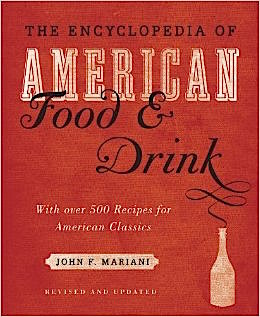 |
The Encyclopedia of American Food and Drink by John F. Mariani (Bloomsbury USA, $35) Modesty forbids me to praise my own new book, but let me proudly say that it is an extensive revision of the 4th edition that appeared more than a decade ago, before locavores, molecular cuisine, modernist cuisine, the Food Network and so much more, now included. Word origins have been completely updated, as have per capita consumption and production stats. Most important, for the first time since publication in the 1980s, the book includes more than 100 biographies of Americans who have changed the way we cook, eat and drink -- from Fannie Farmer and Julia Child to Robert Mondavi and Thomas Keller. "This book is amazing! It has entries for everything from `abalone' to `zwieback,' plus more than 500 recipes for classic American dishes and drinks."--Devra First, The Boston Globe. "Much needed in any kitchen library."--Bon Appetit. |
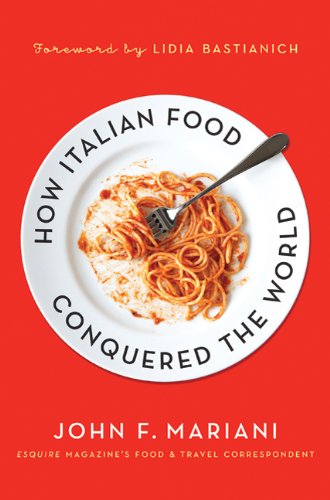
"Eating Italian will never be the same after reading John Mariani's entertaining and savory gastronomical history of the cuisine of Italy and how it won over appetites worldwide. . . . This book is such a tasteful narrative that it will literally make you hungry for Italian food and arouse your appetite for gastronomical history."--Don Oldenburg, USA Today. "Italian
restaurants--some good, some glitzy--far
outnumber their French rivals. Many of
these establishments are zestfully described
in How Italian Food Conquered the World, an
entertaining and fact-filled chronicle by
food-and-wine correspondent John F.
Mariani."--Aram Bakshian Jr., Wall Street
Journal.
"Equal parts
history, sociology, gastronomy, and just
plain fun, How Italian Food Conquered the
World tells the captivating and delicious
story of the (let's face it) everybody's
favorite cuisine with clarity, verve and
more than one surprise."--Colman Andrews,
editorial director of The Daily
Meal.com. "A fantastic and fascinating
read, covering everything from the influence
of Venice's spice trade to the impact of
Italian immigrants in America and the
evolution of alta cucina. This book will
serve as a terrific resource to anyone
interested in the real story of Italian
food."--Mary Ann Esposito, host of PBS-TV's
Ciao
Italia. "John Mariani has written the
definitive history of how Italians won their
way into our hearts, minds, and
stomachs. It's a story of pleasure over
pomp and taste over technique."--Danny Meyer,
owner of NYC restaurants Union Square
Cafe, The Modern, and Maialino.
|
 |
 |
 |
 |
 |
 |
MARIANI'S VIRTUAL GOURMET
NEWSLETTER is published weekly. Publisher: John Mariani. Editor: Walter Bagley. Contributing Writers: Christopher
Mariani, Misha Mariani, John A. Curtas, Gerry Dawes, Geoff Kalish.
Contributing
Photographer: Galina Dargery. Technical
Advisor: Gerry
McLoughlin.
If you wish to subscribe to this
newsletter, please click here: http://www.johnmariani.com/subscribe/index.html
© copyright John Mariani 2025