
Steve Guttenberg, Paul Reiser in "Diner" (1982)
THIS WEEK
EATING AND DRINKING ON ST CROIX
By John Mariani
NEW YORK CORNER
THE VIEW
By John Mariani
HÔTEL ALLEMAGNE
CHAPTER THIRTY-EIGHT
By John Mariani
By John Mariani

For
all
its natural beauty and sunny climes in winter,
St. Croix is not a gastronome’s destination.
But, then, neither are most of the islands in
the Caribbean, where the majority of food
ingredients needs to be shipped in rather than
raised or caught locally. The same goes for
the absentee chefs, who are usually recruited
from hotel chains elsewhere, like Dune by
Jean-Georges Vongerichten at the Four Seasons
on Paradise Island or Blue by Eric Ripert at
the Ritz-Carlton in the Cayman Islands.
 The idea
of finding a plethora of native cooks turning
out local dishes from local ingredients is
largely a myth, and the concierge at your
hotel is unlikely to tell you where to find a
modest place serving indigenous fare that he
might actually eat in.
The idea
of finding a plethora of native cooks turning
out local dishes from local ingredients is
largely a myth, and the concierge at your
hotel is unlikely to tell you where to find a
modest place serving indigenous fare that he
might actually eat in.
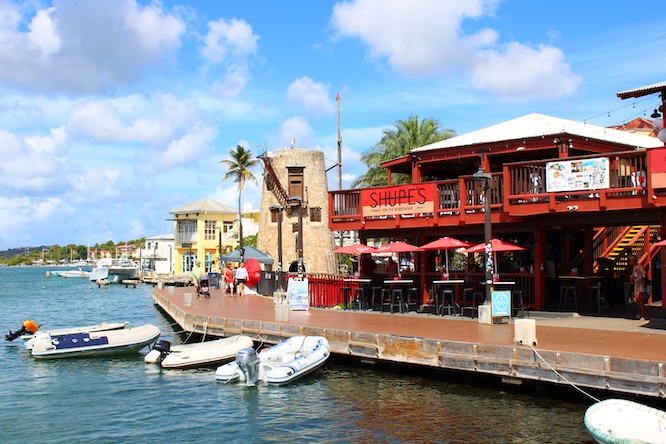
The Boardwalk in
Christiansted
I did find two such modest places on St.
Croix, and they provided me with the best food
and experience on the island. More on them
later.
Otherwise, over four days eating breakfast,
lunch and dinner on St. Croix I found none of
the restaurants I ate exemplified “Crucian”
food, avoiding dishes like kallaloo, johnny
cakes, mafi soup or “fish and fungi,” made 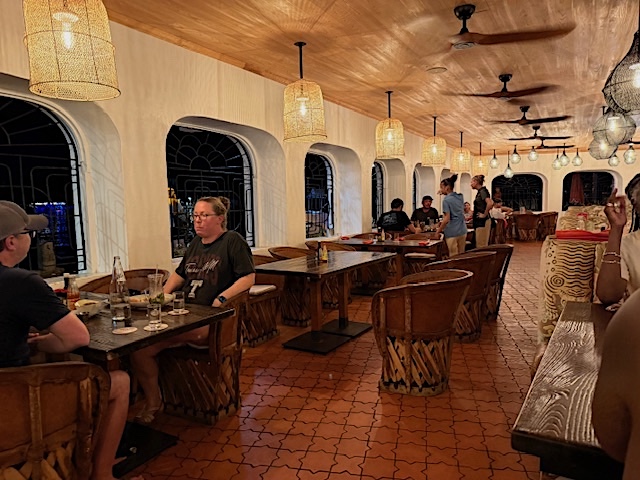 of fish
with cornmeal and okra (pronounced
“foon-jee”). Most menus are a mix of bar and
continental items like Buffalo chicken wings,
burgers, French onion soup and filet mignon,
perhaps a grilled Caribbean snapper
or wahoo––there is no seafood market on the
island, though some fishermen bring in their
catch to sell off their boats to the locals.
of fish
with cornmeal and okra (pronounced
“foon-jee”). Most menus are a mix of bar and
continental items like Buffalo chicken wings,
burgers, French onion soup and filet mignon,
perhaps a grilled Caribbean snapper
or wahoo––there is no seafood market on the
island, though some fishermen bring in their
catch to sell off their boats to the locals.
My first meal was at Harbour Prime, next to the Hotel Christian on the boardwalk (right). It’s a big, pleasantly lighted place with open windows and wrought iron grating, ceiling fans, and wicker chandeliers, roomy booths and tables and an active bar that made a good daiquiri. No A/C. Its menu insists they buy fish from the local fishermen, although only one fish was listed on the menu. I ordered onion soup that was sour and saltier than sweet with onions, and fried whole snapper that was meaty but boney and very salty, sided with a mound of mashed potatoes/
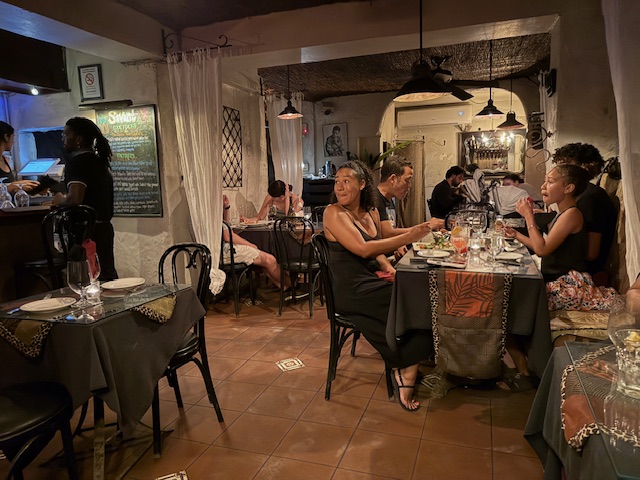 Savant (4C Hospital Street)
had a pleasing intimacy, with café curtains,
glass-topped tables and a small bar up front (left).
It is also air-conditioned, which is not
always a given in restaurants here. The staff
is cordial enough but the lumbering manager,
who was barely in evidence for most of the
night, had the demeanor of a prison guard,
when he was.
Savant (4C Hospital Street)
had a pleasing intimacy, with café curtains,
glass-topped tables and a small bar up front (left).
It is also air-conditioned, which is not
always a given in restaurants here. The staff
is cordial enough but the lumbering manager,
who was barely in evidence for most of the
night, had the demeanor of a prison guard,
when he was.
The
menu is called “eclectic,” which means
anything from shrimp potstickers and chicken
lollipops to a noodle bowl and various cuts of
beef and pork, in addition to a Caribbean
curry. None of it I tasted was out of the
ordinary. 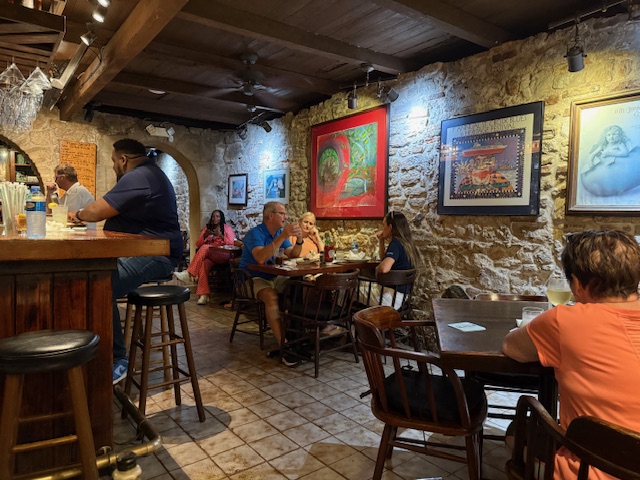
There seems no reason why the Bombay Club
(5A King Street, Christiansted; right)
is called the Bombay Club, and I was hoping it
might be an Indian restaurant. But, despite
its rough stone walls and tile floor that
evoked a Caribbean tavern from long ago, the
menu was the usual mix of ribeyes and lobster,
oast duck and grilled salmon, fettuccine with
steak and parmesan cream. It does have some
good conch fritters and crab chowder, but the
specialty beef brisket had the texture of
rope.
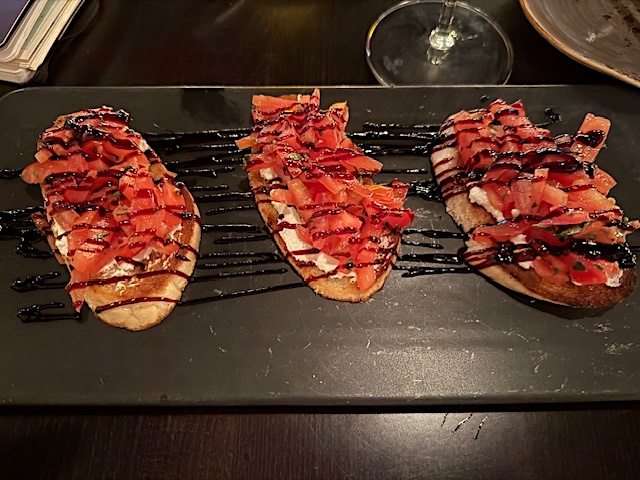 I had
higher hopes for Estera (39A
Strand Street, Christiansted), with its
rustic dining room and bar counter and a menu
that shews Italian. I was buoyed by a starter
of bruschetta lavished with goat’s cheese,
tomatoes, basil and a counterpoint of balsamic
vinegar (left), but the bucatini
all’amatriciana tasted like little more
than tomato concentrate and chile peppers.
Gelato was okay. The wine list is in serious
need of bolstering.
I had
higher hopes for Estera (39A
Strand Street, Christiansted), with its
rustic dining room and bar counter and a menu
that shews Italian. I was buoyed by a starter
of bruschetta lavished with goat’s cheese,
tomatoes, basil and a counterpoint of balsamic
vinegar (left), but the bucatini
all’amatriciana tasted like little more
than tomato concentrate and chile peppers.
Gelato was okay. The wine list is in serious
need of bolstering.
Unimpressed by these established tourist
restaurants, I was taken by a local guide to
two local eateries that could not have been
more enticing or savory.
Despite its aristocratic moniker, La Reine
Chicken Shack is indeed a
roadside shack outside of Christiansted.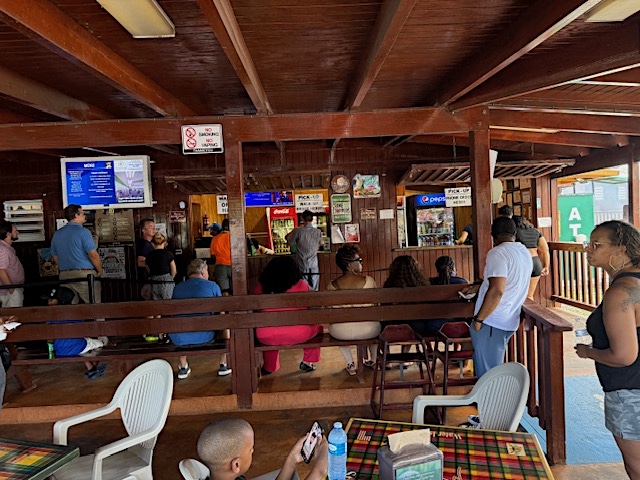 It is open-air and always crowded with people
who come for the daily menu, which is composed
entirely of Crucian dishes like stewed oxtail
and goat, barbecued ribs, saltfish stew, wahoo
and fungi, mashed cassava, breadfruit tostones
and pork kallaloo.
It is open-air and always crowded with people
who come for the daily menu, which is composed
entirely of Crucian dishes like stewed oxtail
and goat, barbecued ribs, saltfish stew, wahoo
and fungi, mashed cassava, breadfruit tostones
and pork kallaloo. 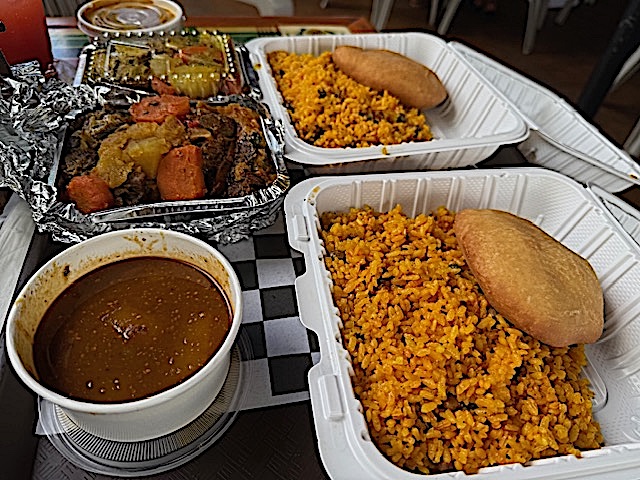 While
I went to the bar to get two rum punches, my
guide ordered all over the menu, and
everything we had was rich in spices, moist
and hearty. They make a point of letting you
know that Martha Stewart ate here, which must
have made Martha very happy.
While
I went to the bar to get two rum punches, my
guide ordered all over the menu, and
everything we had was rich in spices, moist
and hearty. They make a point of letting you
know that Martha Stewart ate here, which must
have made Martha very happy.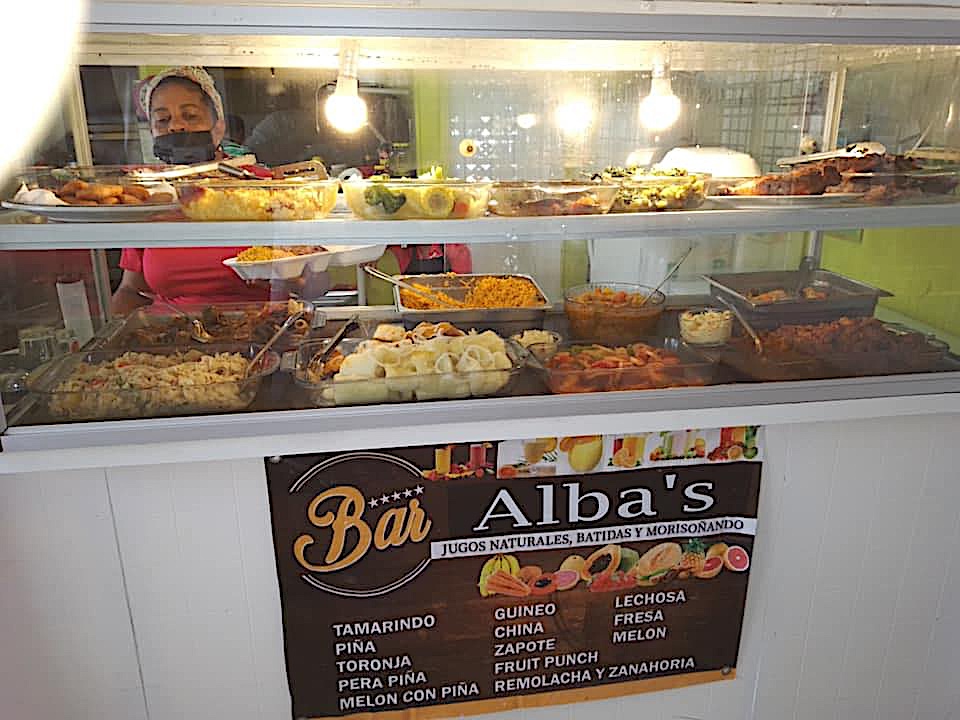
Over
in Frederiksted I had a similar meal at a
little place called Alba’s Bar &
Restaurant (327 A King Street)
was a complete delight: A small room with a
small bar and a small patio outside, it is a
downhome spot with wonderful island flavors in
every dish. You go up to the kitchen window to
see the day’s specials arrayed in a steam
table. The menu sounds simplistic––pork 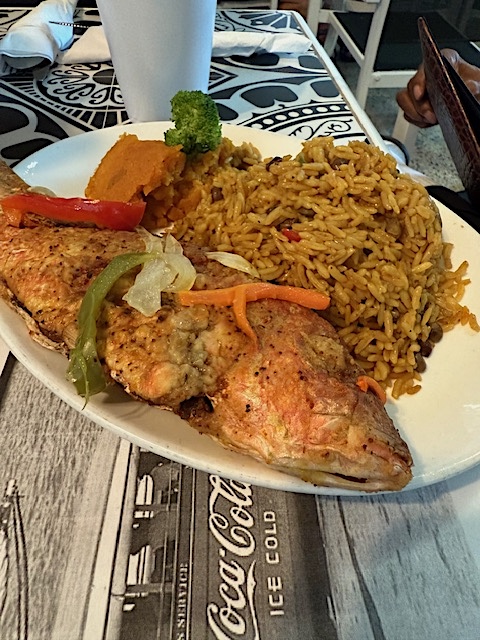 chops,
parrot fish, conch with butter sauce and so
on––but does not hint at the myriad seasonings
used, not least in the side dishes of yams,
corn pudding and rich potato salad. The fish
was impeccably grilled and serve with spicy
rice, the chicken perfectly fried, the goat’s
meat tender and suffused with flavors from the
braising liquid.
chops,
parrot fish, conch with butter sauce and so
on––but does not hint at the myriad seasonings
used, not least in the side dishes of yams,
corn pudding and rich potato salad. The fish
was impeccably grilled and serve with spicy
rice, the chicken perfectly fried, the goat’s
meat tender and suffused with flavors from the
braising liquid.
The
people
who run Alba’s couldn’t be friendlier to both
local friends and visitors, which include many
who get off the cruise liners lucky enough to
be clued in about the place.
There are places like
the Chicken Shack and Alba’s throughout the
Caribbean, but you’ve got to ask the locals
where they go and you will eat every
bit as well.
NEW YORK CORNER
Marriott Marquis Hotel
1535 Broadway
212-704-8900
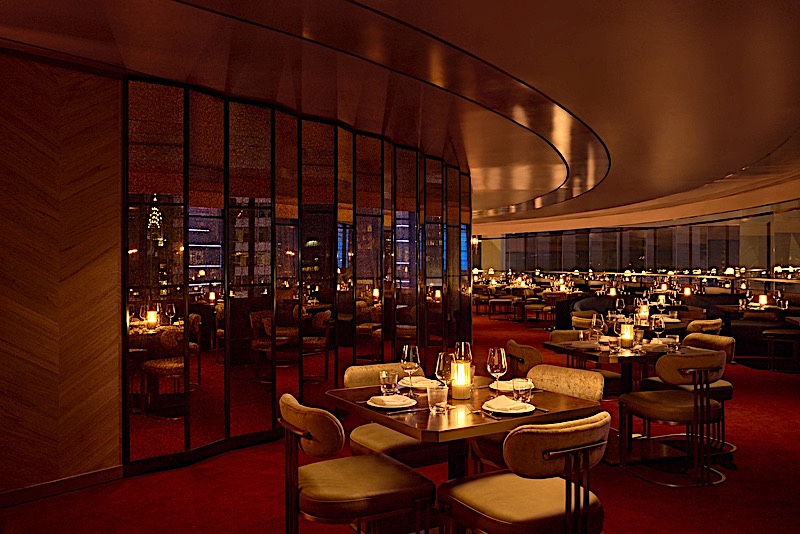
There is much to
defy the success of the new restaurant on the 47th
and 48th floors
of the Marriott Marquis Hotel in Times Square,
not least that the hotel itself has long been an
intimidating behemoth where simply finding the
entrance, exit and elevators can be daunting,
and that Times Square, while no longer tawdry,
has been taken over by hordes of tourists
looking up at the fifty-foot LED screens
advertising Broadway musicals and UniQlo and
Sephora ads.
 The hotel
and restaurant opened in 1985 at a time when
revolving restaurants were already falling out
of favor after
becoming totems of the 1960s, the first being La
Ronde in Honolulu’s Ala Moana shopping center
back in 1961 and followed by imitators from
Indianapolis to Houston, from Rochester to
Detroit. Most closed after the novelty wore off,
or, as happened in Atlanta and Dallas, they had
serious accidents. The Marriott Marquis’s had a
good run before limping to closure in 2021.
The hotel
and restaurant opened in 1985 at a time when
revolving restaurants were already falling out
of favor after
becoming totems of the 1960s, the first being La
Ronde in Honolulu’s Ala Moana shopping center
back in 1961 and followed by imitators from
Indianapolis to Houston, from Rochester to
Detroit. Most closed after the novelty wore off,
or, as happened in Atlanta and Dallas, they had
serious accidents. The Marriott Marquis’s had a
good run before limping to closure in 2021.
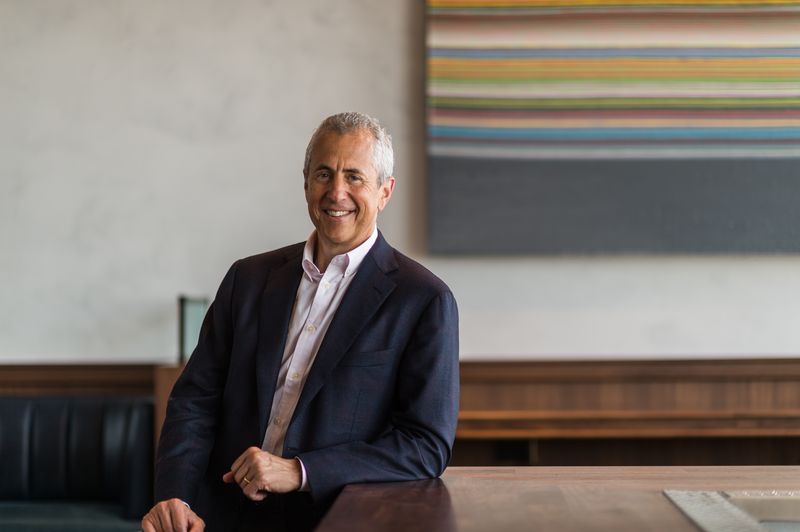
Yet
when approached about the prospect of getting
the restaurant up and spinning again, Master
restaurateur Danny Meyer––originally a kid from
the Midwest who’s always had a streak of
nostalgia to bolster his imagination––thought it
a capital idea. He’d already had success
downtown with non-revolving top-of-a-skyscraper
Manhatta, so what could go wrong?
(Photo by Dan Krieger)
So far, nothing. Completely
refurbished by architect David Rockwell, who’s
done many of Meyer’s projects, the room’s
mechanics had been in good shape and there was a
wrap-around cocktail lounge to have fun with and
a panorama that could match the Rainbow Room in
the nearby Rockefeller Center. 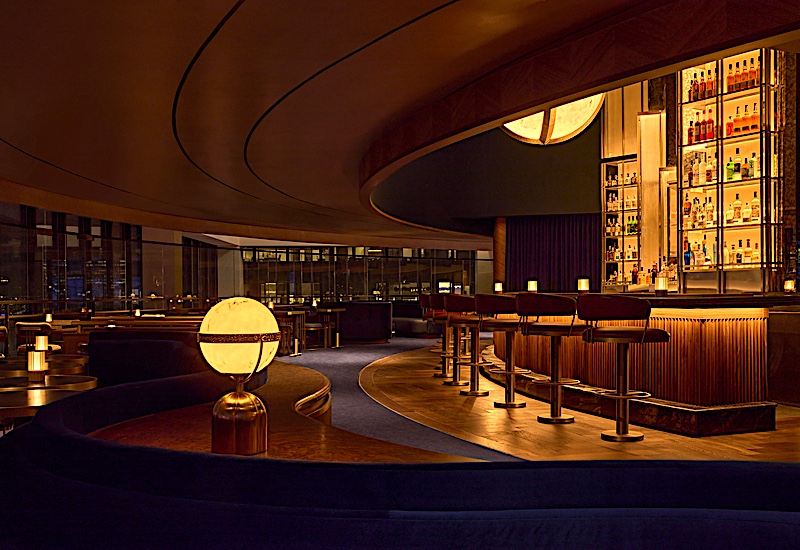
And so
it revolves. . . slowly. . . about eight feet
per minute, but the real excitement is zooming
up in a very fast elevator to the 47th
floor, which my two young granddaughters thought
a match for any ride in Disneyworld. The dining
room is dark, which does allow the lights of the
city to pass as if on a carousel (I’d love to
see it at twilight), though the recessed lights
over the dinner tables go bright and dim for no
discernible reason. It is shadowy, with
arcade-like recesses and very comfortable
booths, and the restaurant is loud (and the live
pianist adds to the decibel level, if you’re
seated nearby..
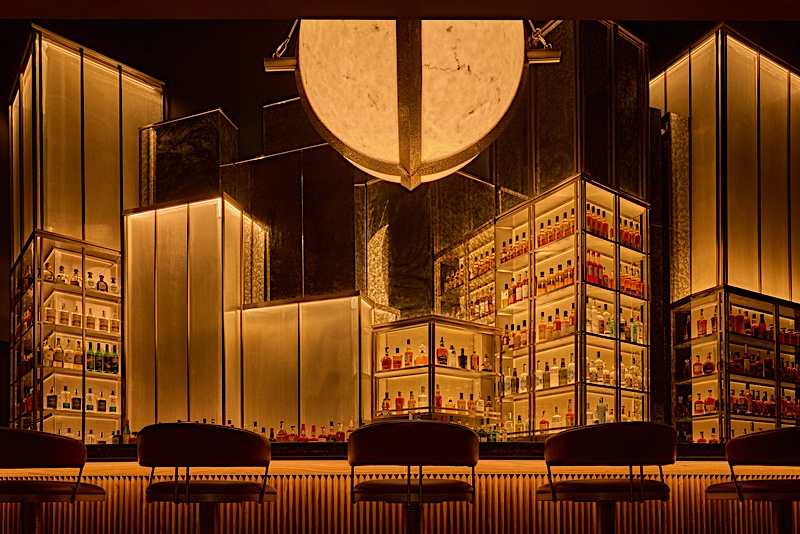
The View’s menu is composed
of what used to be called “continental cuisine,”
an amalgam of American steaks and chops, Eastern
oysters, shrimp cocktail and jumbo lump crabcake
along with more international flavors like tuna
carpaccio, lobster spaghetti alla chitarra,
and fried artichokes––which really
is not much different from a modern day New York
steakhouse menu.
As
ever, it’s really about the quality of
ingredients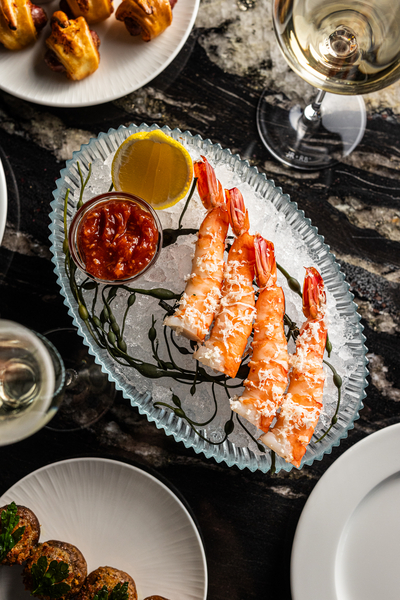 and preparation, and the
kitchen is not skimping on anything. So
the shrimp cocktail is composed of big, fat
critters, not too cold and very meaty. The
crabcakes really do contain jumbo lump meat with
a spicy remoulade, which, given the price of
jumbo lump these days, is a bargain at $36. The
steak tartare with black trumpet mushrooms and
sunchoke chips delivers big flavors, as do the
crisply fried artichokes with a garlicky aïoli.
I’m a sucker for an iceberg lettuce salad with
blue cheese, quail egg and lardons, but the
massive wedge one night was not so much crunchy
as tough.
and preparation, and the
kitchen is not skimping on anything. So
the shrimp cocktail is composed of big, fat
critters, not too cold and very meaty. The
crabcakes really do contain jumbo lump meat with
a spicy remoulade, which, given the price of
jumbo lump these days, is a bargain at $36. The
steak tartare with black trumpet mushrooms and
sunchoke chips delivers big flavors, as do the
crisply fried artichokes with a garlicky aïoli.
I’m a sucker for an iceberg lettuce salad with
blue cheese, quail egg and lardons, but the
massive wedge one night was not so much crunchy
as tough.
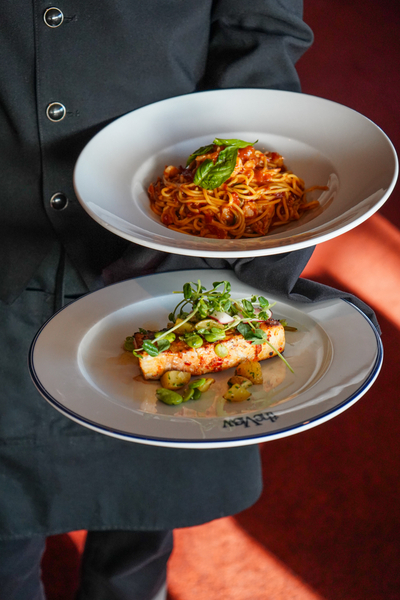 Meyer’s
restaurants, from Union Square Café to Maialino
and Marta, have competed among the city’s best
Italian trattorias, proven at The View by the
hearty lobster spaghetti alla chitarra
with an arrabiata-style spicy sauce.
Meyer’s
restaurants, from Union Square Café to Maialino
and Marta, have competed among the city’s best
Italian trattorias, proven at The View by the
hearty lobster spaghetti alla chitarra
with an arrabiata-style spicy sauce.
Impeccably grilled
swordfish came with braised baby artichokes,
roasted heirloom piquant cherry tomatoes.
Prime
rib au jus is always on the menu but in limited
quantity, so order it as soon as you sit down
just in case they run out. This mighty
dish––once a Sunday dinner fixture when I was
growing up––always brings
back fond
memories of when a great slab of steaming,
medium-rare meat with its own ruby juices was an
evergreen on menus, here served with an
appropriate horseradish cream.
The kitchen is not
likely to run out of the excellent bone-in
ribeye, so feel free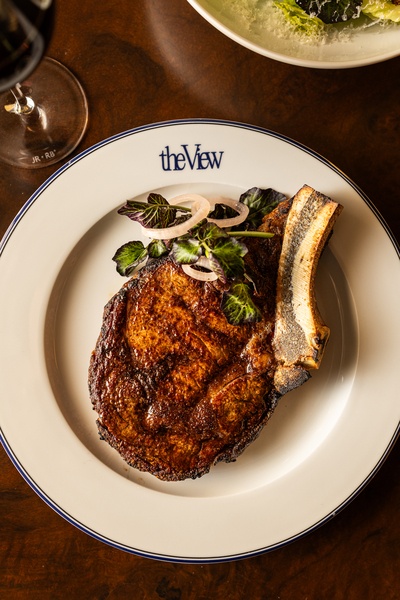 to linger
over that decision. You have a choice of sauces
with the beef for another six bucks. Roast
chicken is a ubiquitous dish in town and The
View turns out a textbook example that stays
very juicy with a crisp exterior.
to linger
over that decision. You have a choice of sauces
with the beef for another six bucks. Roast
chicken is a ubiquitous dish in town and The
View turns out a textbook example that stays
very juicy with a crisp exterior.
Such
main courses just beg for a bowl of generously
buttered mashed potatoes or golden French fries.
The
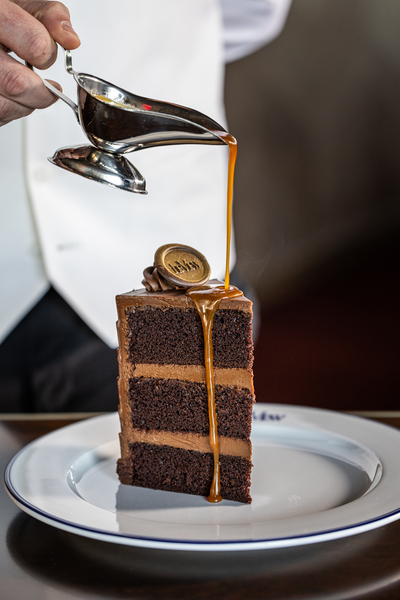
View goes All American with its desserts, not
least in its towering devil’s food cake with chocolate
caramel ganache to gild the lily. There’s a
scrumptious banana oat sundae, and
Prosecco-poached pears with bellini sorbet,
buttermilk mousse and vanilla streusel. And I am
happy to pronounce the “Classic New York
Cheesecake” is exactly that, served with vanilla
schlag and raspberry sauce.
 The
wine list is of a sensible size, pretty much
equal in selections from France, Italy and the
U.S., and with a good number of wines under $80.
It’s not a trophy list for the investment banker
crowd, and kudos for that, and several bottles I
checked against wine shop prices were only about
a 100 percent mark-up, which is low in New York.
The
wine list is of a sensible size, pretty much
equal in selections from France, Italy and the
U.S., and with a good number of wines under $80.
It’s not a trophy list for the investment banker
crowd, and kudos for that, and several bottles I
checked against wine shop prices were only about
a 100 percent mark-up, which is low in New York.
Whether or
not The View revolves––and after a turn or so
the novelty wears off––it is an enchanting
restaurant with food that competes handily with
Meyer’s
Manhatta, the Tavern at Gramercy Park and Union
Square Café, and it’s less expensive than the
first two.
Somehow
I think Danny Meyer would have loved to open
such a restaurant as The View in his hometown of
St. Louis, Missouri, whose own view would be
that of the grand Gateway Arch. And maybe
someday he will, with open arms.
Open nightly for
dinner.
HÔTEL ALLEMAGNE
By John Mariani
Neither Katie nor David slept well
that night, thinking over all they’d been
through and what they’d heard from Judith
Baer. The next morning, they re-booked their
flights home, and Katie called both
Catherine and Alan to tell them what had
occurred. Catherine told her she’d probably
have done the same thing and believed Baer
would never have agreed to a video
interview.
Alan
also agreed that his investigative reporter
should protect her sources and not have called
the police after the interview and was
delighted that Katie had gotten such a scoop,
one that could be followed up, one he’d even
agree to send Katie to Israel for, if
a great article came out of it.
Meanwhile David called
Borel, who was stunned by the news but said he
would probably have had little success in
keeping Baer off the plane the night before.
He, too, felt that such an act by someone who
had been a hero to Parisians would have been
difficult to prosecute. Borel then checked and
found out that Baer had, in fact, traveled on
an Israeli passport and that now she was
beyond apprehending.
“We will make the usual
requests for her return,” said the detective,
“but there’s little chance of that happening. I
might have done what you did, mon ami.
I’m not sure I would want to be the one to
arrest Louise Jourdan. I will reserve the
right, however, to try to follow the virus
back to the Pasteur Institute. Then I can make
the public announcement that there seems
little likelihood there will be any further
hotel attacks. The public needs that assurance
at least.”
“Catherine can probably
help you with that part of it. I’m sure she
wants to be the first to report the story,
even without Baer on camera.”
Katie and David met with
Catherine and Borel that day and shared all
they knew thus far. By then Borel had
found that Baer had arrived in Tel Aviv, where
she apparently kept an apartment. He would
have colleagues in the Israeli police find out
if she checked into a hospital there. He also
found out from Baer’s colleagues at the
Institute that, yes, she had been suffering
for some time from lymphatic cancer and had
made plans to go to Israel weeks before,
telling them she would not be returning to
Paris.
There seemed nothing to
celebrate about what had happened, so
Catherine and her two American friends simply
had a drink, not dinner, and said goodbye to
one another.
The next day Katie and David took the
ten AM flight out of Charles deGaulle.
 Once back at her office,
Katie had long conversations with Alan Dobell
as to how her story was to be crafted. Alan
thought that there should be no question that
Baer was in fact Louise Jourdan, despite her
weak denial. Katie thought the truth should be
left for the reader to make the final
judgment.
Once back at her office,
Katie had long conversations with Alan Dobell
as to how her story was to be crafted. Alan
thought that there should be no question that
Baer was in fact Louise Jourdan, despite her
weak denial. Katie thought the truth should be
left for the reader to make the final
judgment.
“In any case,” said Alan, “I think you
should try to contact Baer, ask her how things
are going and ask if you could fly to Tel Aviv
for a further interview. See what she says now
that she’s safe from French law. She may be
more comfortable a few weeks from now.”
But there was not to be a few weeks
left to Judith Baer. Despite state-of-the-art
treatment at the world-famous Tel-Aviv Sourasky
Medical Center (left), the cancer
raged through her. Ten days after arriving
in Tel Aviv, Dr. Judith Baer was dead.
She had no relatives in Israel but
colleagues who knew and had enormous respect
for her work mourned her passing, and she was
buried according to Jewish rituals. The rumors
of her being Louise Jourdan, French hero, were
mentioned with propriety in the local Israeli
 media,
while the Paris newspapers generally wrote
sympathetic accounts of her life and death,
surveying her career as a leading infectious
disease scientists, with ample quote from her
colleagues. Catherine had been the first to
report the story and garnered further praise
from her CNN bosses.
media,
while the Paris newspapers generally wrote
sympathetic accounts of her life and death,
surveying her career as a leading infectious
disease scientists, with ample quote from her
colleagues. Catherine had been the first to
report the story and garnered further praise
from her CNN bosses.
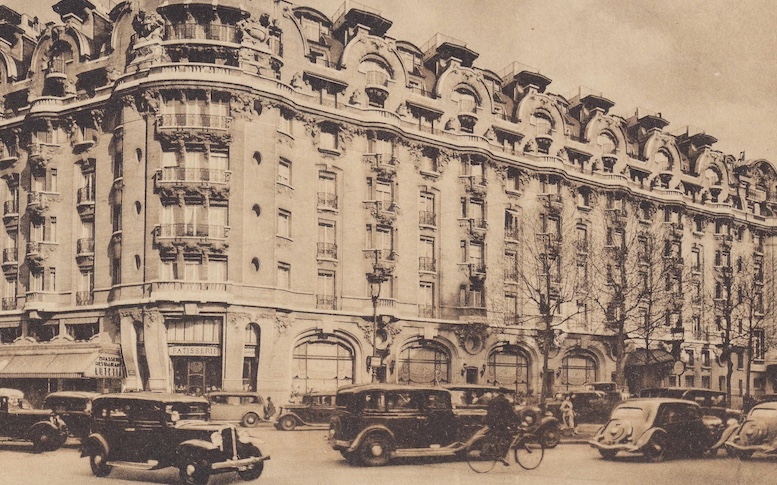
The Paris media did find that
resurrecting the story of Louise Jourdan and
Hôtel Allemagne allowed for two or more
follow-up stories, along with more sensational
histories of the Nazis brothel hotels—a topic
most Parisians had little or no knowledge
about—and articles that stoked again the
debate on who and who did not act with honor
during the war while Paris was occupied. Old
stories about Coco Chanel (right), who
survived the war and thrived, untainted by
scandal, were published as memoirs from those
who knew her. More than
one account quoted Chanel’s cryptic motto, “I’ve done my
best, in regard to people and to life, without
precepts, but with a taste for justice.”
 Chanel died in 1971, but her fashion house
never ceased functioning under other
designers.
Chanel died in 1971, but her fashion house
never ceased functioning under other
designers.
In New York, Katie
assembled all the French material and followed
up on all aspects of what was, basically, a
crime story with a very unlikely hero. She
interviewed dozens of hotel personnel, guests
who had come out of the hospital and were
willing to speak, Baer’s colleagues
at the Institute, as well as infectious
disease specialists in New York research
hospitals.
Her research revealed that after the
liberation of Dachau, Louise Jourdan would
eventually find her way back to Paris, but,
owing to the prospect of being accused of
being a collaborator, she changed her name,
taking Judith Baer—the first name perhaps to
honor the Old Testament heroine who beheaded
the Israelites’ enemy general Holofernes. She
was only seventeen and managed to return to
school, then to study medicine, becoming an
esteemed research scientist in her field. She
never married. Everything related to Louise
Jourdan was rumor or hearsay, while Judith
Baer went on to devote her life to wiping out
viruses.
When Katie’s article
appeared in McClure’s several months
later under the title “The Hôtel Allemagne:
The Story of a World War II Parisian Heroine
and the Pandemic of 2002,” she did not attempt
to prove conclusively that Judith Baer was
Louise Jourdan, though the reader would have
little doubt about its probability. The last
line of the article was somber yet hopeful:
“Judith Baer died of her cancer on May 9,
2001, but the spirit of Louise Jourdan has
been brought back to life in the minds of the
good people of Paris.”
© John Mariani, 2024
❖❖❖

"This dark, moody restaurant doesn’t feel dangerous,
exactly, but it wouldn’t be a surprise if someone in
the back dining room were up to no good. The only
thing missing is a haze of tobacco smoke in the air,
but drink enough sherry and things will get blurry
soon enough."––"25 Best New Restaurants in NYC," New
York Magazine.
❖❖❖
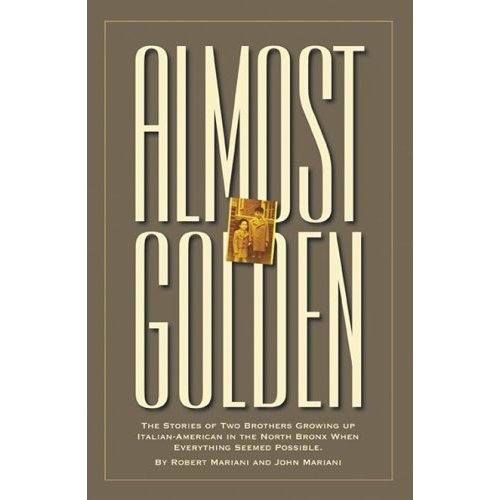
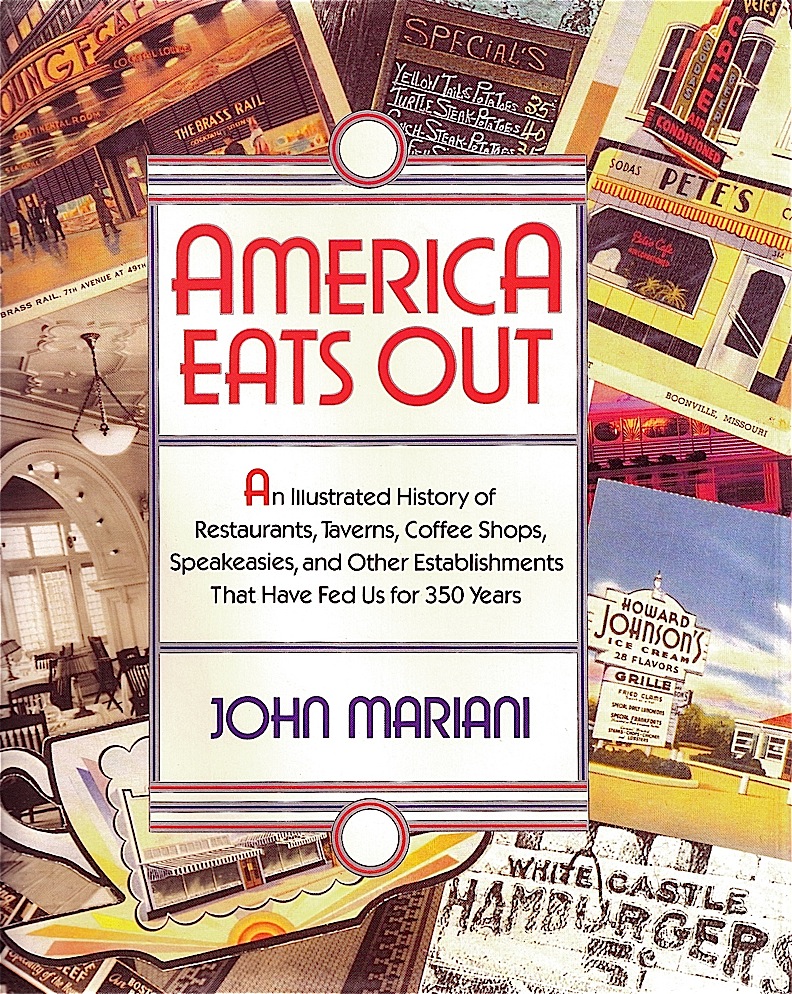
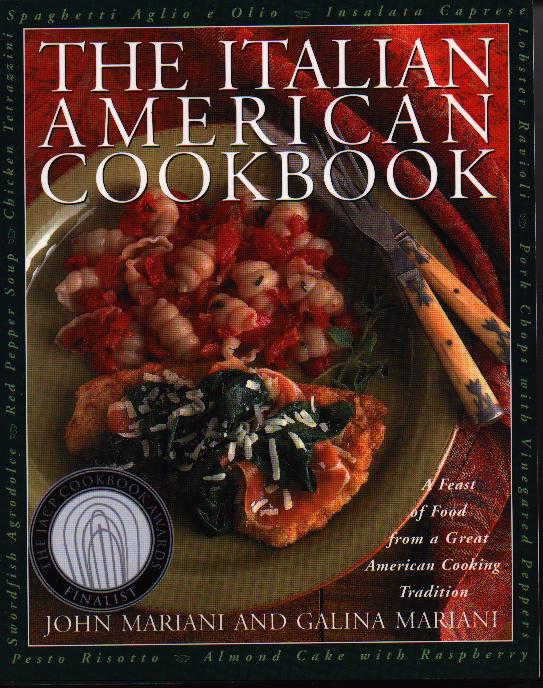
Any of John Mariani's books below may be ordered from amazon.com.
 The Hound in Heaven
(21st Century Lion Books) is a novella, and
for anyone who loves dogs, Christmas, romance,
inspiration, even the supernatural, I hope you'll find
this to be a treasured favorite. The story
concerns how, after a New England teacher, his wife and
their two daughters adopt a stray puppy found in their
barn in northern Maine, their lives seem full of promise.
But when tragedy strikes, their wonderful dog Lazarus and
the spirit of Christmas are the only things that may bring
his master back from the edge of despair.
The Hound in Heaven
(21st Century Lion Books) is a novella, and
for anyone who loves dogs, Christmas, romance,
inspiration, even the supernatural, I hope you'll find
this to be a treasured favorite. The story
concerns how, after a New England teacher, his wife and
their two daughters adopt a stray puppy found in their
barn in northern Maine, their lives seem full of promise.
But when tragedy strikes, their wonderful dog Lazarus and
the spirit of Christmas are the only things that may bring
his master back from the edge of despair. WATCH THE VIDEO!
“What a huge surprise turn this story took! I was completely stunned! I truly enjoyed this book and its message.” – Actress Ali MacGraw
“He had me at Page One. The amount of heart, human insight, soul searching, and deft literary strength that John Mariani pours into this airtight novella is vertigo-inducing. Perhaps ‘wow’ would be the best comment.” – James Dalessandro, author of Bohemian Heart and 1906.
“John Mariani’s Hound in Heaven starts with a well-painted portrayal of an American family, along with the requisite dog. A surprise event flips the action of the novel and captures us for a voyage leading to a hopeful and heart-warming message. A page turning, one sitting read, it’s the perfect antidote for the winter and promotion of holiday celebration.” – Ann Pearlman, author of The Christmas Cookie Club and A Gift for my Sister.
“John Mariani’s concise, achingly beautiful novella pulls a literary rabbit out of a hat – a mash-up of the cosmic and the intimate, the tragic and the heart-warming – a Christmas tale for all ages, and all faiths. Read it to your children, read it to yourself… but read it. Early and often. Highly recommended.” – Jay Bonansinga, New York Times bestselling author of Pinkerton’s War, The Sinking of The Eastland, and The Walking Dead: The Road To Woodbury.
“Amazing things happen when you open your heart to an animal. The Hound in Heaven delivers a powerful story of healing that is forged in the spiritual relationship between a man and his best friend. The book brings a message of hope that can enrich our images of family, love, and loss.” – Dr. Barbara Royal, author of The Royal Treatment.
 |
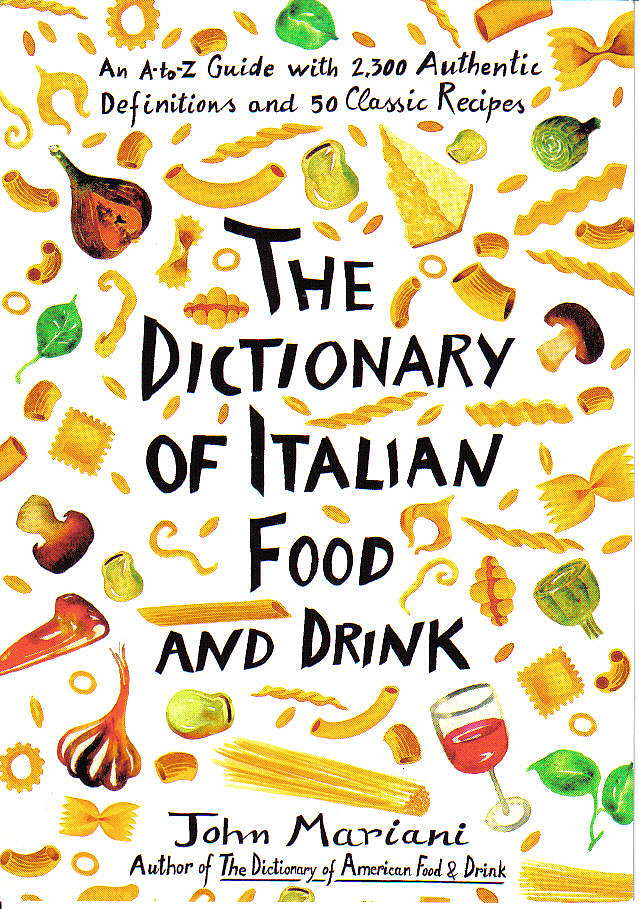
The Encyclopedia of American Food and Drink by John F. Mariani (Bloomsbury USA, $35) Modesty forbids me to praise my own new book, but let me proudly say that it is an extensive revision of the 4th edition that appeared more than a decade ago, before locavores, molecular cuisine, modernist cuisine, the Food Network and so much more, now included. Word origins have been completely updated, as have per capita consumption and production stats. Most important, for the first time since publication in the 1980s, the book includes more than 100 biographies of Americans who have changed the way we cook, eat and drink -- from Fannie Farmer and Julia Child to Robert Mondavi and Thomas Keller. "This book is amazing! It has entries for everything from `abalone' to `zwieback,' plus more than 500 recipes for classic American dishes and drinks."--Devra First, The Boston Globe. "Much needed in any kitchen library."--Bon Appetit. |
"Eating Italian will never be the same after reading John Mariani's entertaining and savory gastronomical history of the cuisine of Italy and how it won over appetites worldwide. . . . This book is such a tasteful narrative that it will literally make you hungry for Italian food and arouse your appetite for gastronomical history."--Don Oldenburg, USA Today. "Italian
restaurants--some good, some glitzy--far
outnumber their French rivals. Many of
these establishments are zestfully described
in How Italian Food Conquered the World, an
entertaining and fact-filled chronicle by
food-and-wine correspondent John F.
Mariani."--Aram Bakshian Jr., Wall Street
Journal.
"Equal parts
history, sociology, gastronomy, and just
plain fun, How Italian Food Conquered the
World tells the captivating and delicious
story of the (let's face it) everybody's
favorite cuisine with clarity, verve and
more than one surprise."--Colman Andrews,
editorial director of The Daily
Meal.com. "A fantastic and fascinating
read, covering everything from the influence
of Venice's spice trade to the impact of
Italian immigrants in America and the
evolution of alta cucina. This book will
serve as a terrific resource to anyone
interested in the real story of Italian
food."--Mary Ann Esposito, host of PBS-TV's
Ciao
Italia. "John Mariani has written the
definitive history of how Italians won their
way into our hearts, minds, and
stomachs. It's a story of pleasure over
pomp and taste over technique."--Danny Meyer,
owner of NYC restaurants Union Square
Cafe, The Modern, and Maialino.
|
 |
 |
 |
 |
 |
 |
MARIANI'S VIRTUAL GOURMET
NEWSLETTER is published weekly. Publisher: John Mariani. Editor: Walter Bagley. Contributing Writers: Christopher
Mariani, Misha Mariani, John A. Curtas, Gerry Dawes, Geoff Kalish.
Contributing
Photographer: Galina Dargery. Technical
Advisor: Gerry
McLoughlin.
If you wish to subscribe to this
newsletter, please click here: http://www.johnmariani.com/subscribe/index.html
© copyright John Mariani 2025