MARIANI’S
Virtual
Gourmet
APRIL 26,
2026
NEWSLETTER
ARCHIVE
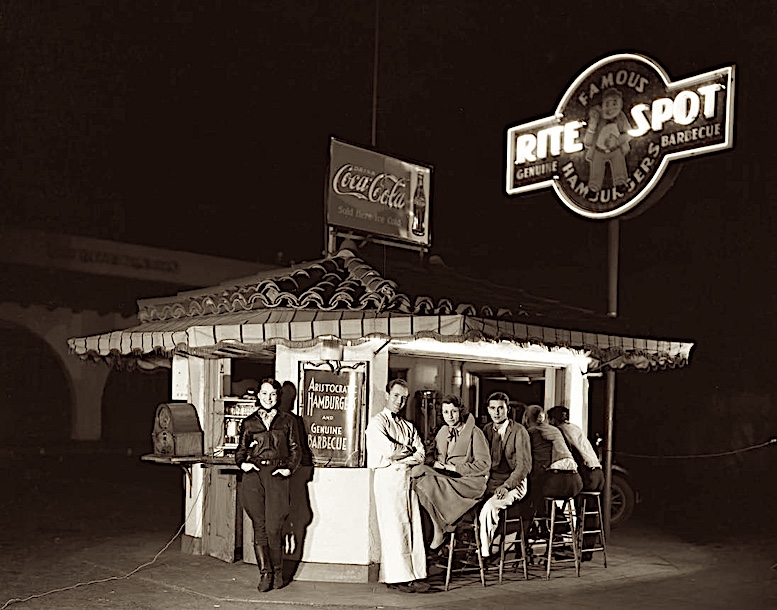
Los Angeles Roadside Eatery
THE INTIMIDATED AMERICAN DINER
By John Mariani
THE BISON
CHAPTER NINETEEN
By John Mariani
NOTES FROM THE WINE CELLAR
ARGENTINE MALBECS DESERVE RECOGNITION
By John Mariani
❖❖❖
THE INTIMIDATED AMERICAN DINER
By John
Mariani
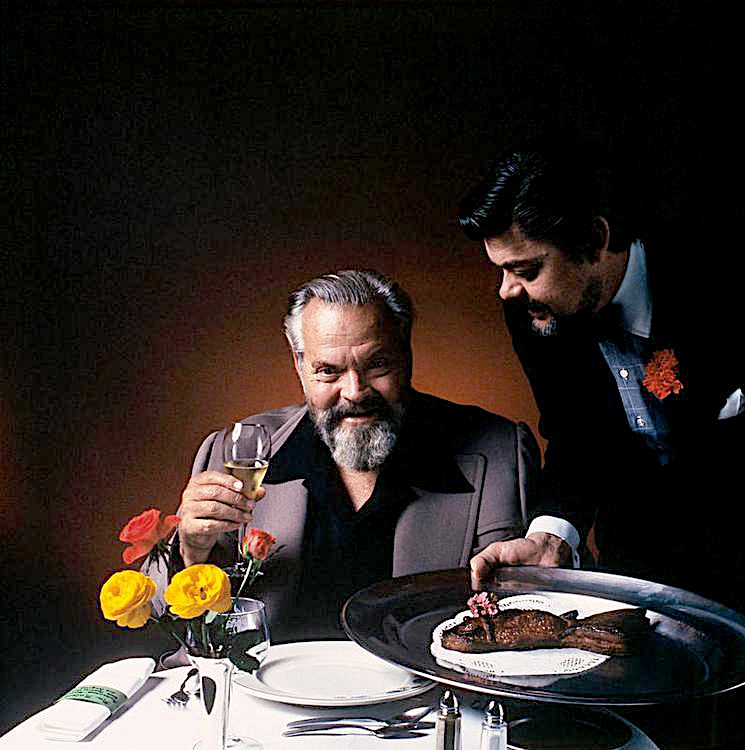
Orson Welles and Patrick Terrail at Ma Maison
People who say that "No
one wants to eat at fine dining restaurants
anymore" are usually people who have not the
acumen or manners to do so.
It’s not about the money, for
those who blanche at the thought of spending $200
for a meal in Paris with wine (including service
and tax) will readily spend that at a steakhouse
where a Tomahawk steak alone runs $150 at Morton’s
in New York.
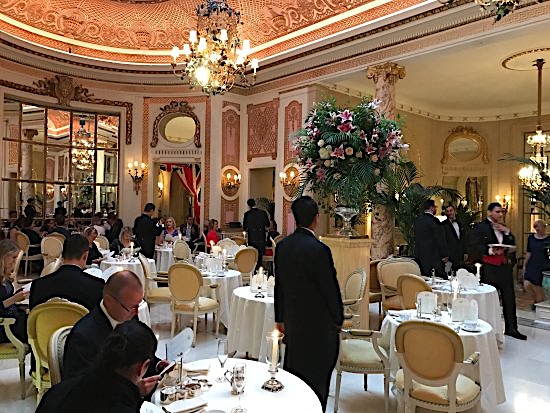 It
is also no longer a reluctance to put on a jacket
and tie to dine at an upscale restaurant, because
the number of restaurants left in the world that
require such an outfit is minuscule: The Ritz in
London (left) does, but the Ritz in Paris
does not. Nowhere in New York does any restaurant
even have a dress code beyond a “request” not to
wear shorts and sandals.
It
is also no longer a reluctance to put on a jacket
and tie to dine at an upscale restaurant, because
the number of restaurants left in the world that
require such an outfit is minuscule: The Ritz in
London (left) does, but the Ritz in Paris
does not. Nowhere in New York does any restaurant
even have a dress code beyond a “request” not to
wear shorts and sandals.
No, the real reason Americans
scoff at going to fine dining restaurants both
here and abroad is because they feel intimidated
by a lack of knowledge and anxiety over how
they’ll be treated.
And
many should feel that way because they
have not taken the least trouble to find out what
to expect and how to act in a posh restaurant.
French Restaurant Syndrome (FRS) is
particularly prevalent when Americans go abroad,
fearing their own ignorance will make them feel
inadequate. They believe that the outdated
stereotype 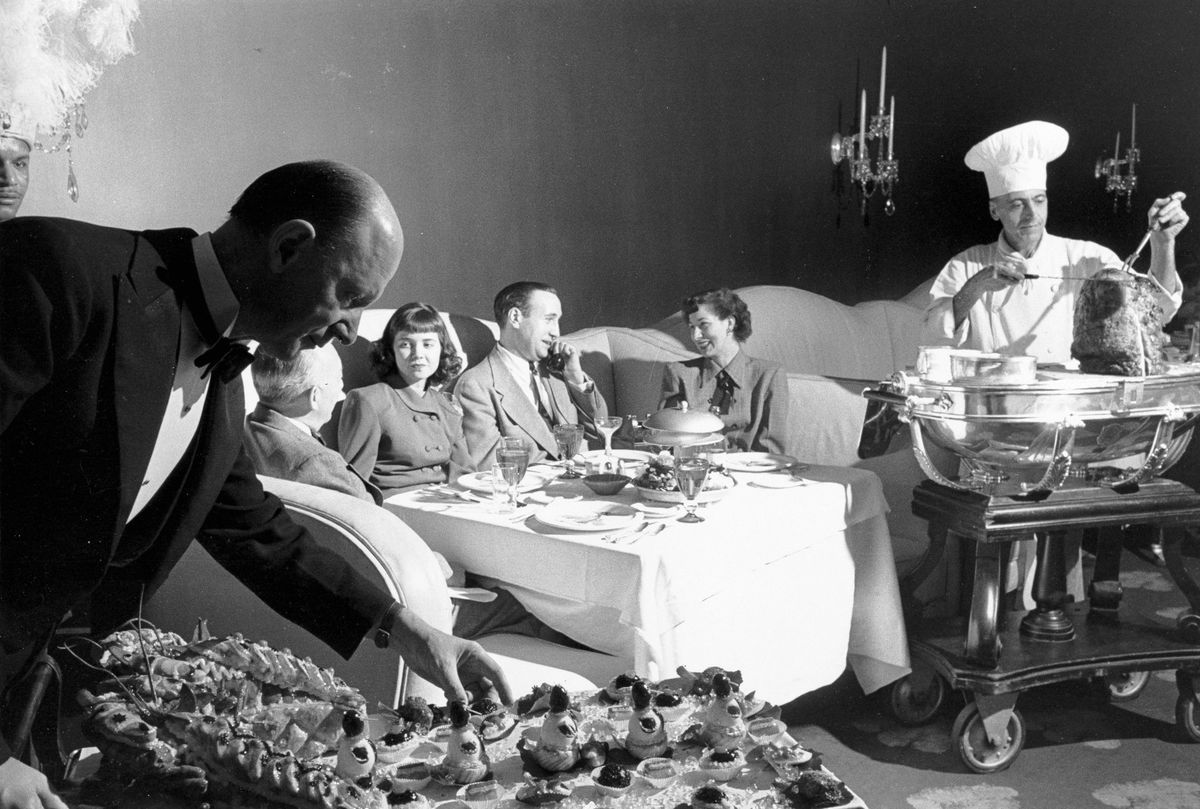 of the
snobbish captain and waiter who seeks to put an
American in his place rather than just seat him is
still firmly entrenched, when nothing could be
further from the truth. Indeed,
the contemporary attitude on the part of any
restaurant staff is to do everything possible to
please every guest wherever he comes from, simply
because another guest is another paying customer.
Only arrogant guests get the treatment they
deserve.
of the
snobbish captain and waiter who seeks to put an
American in his place rather than just seat him is
still firmly entrenched, when nothing could be
further from the truth. Indeed,
the contemporary attitude on the part of any
restaurant staff is to do everything possible to
please every guest wherever he comes from, simply
because another guest is another paying customer.
Only arrogant guests get the treatment they
deserve.
If, by any chance, you do feel a bit
intimidated by the fine dining experience––and it
is an experience that requires
rapport––here are some suggestions to ease your
anxieties.
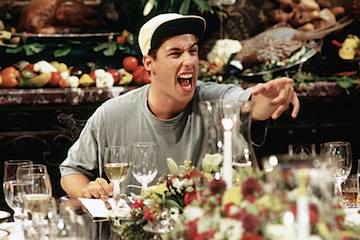 1. Do dress well, which is usually
not a problem for American women but can be for
American men who neglected to pack a sport coat. A
jacket and tie will be very much noticed and
appreciated.
1. Do dress well, which is usually
not a problem for American women but can be for
American men who neglected to pack a sport coat. A
jacket and tie will be very much noticed and
appreciated.
2.
Always
make a reservation, and for that ask your hotel
concierge to make it for you and to relay to him
any special requests you may have––a special
occasion, a quiet table, a table on the terrace.
These are more readily granted, when available,
via a concierge who works with these restaurants
every day.
3.
Consider going to lunch, which
in even the most storied restaurants are more
likely to have an empty table.
4.
Many fine dining restaurants in
Europe have only one seating at night, and they
may not even open until seven PM. So don’t ask for
a 5:30 or 9:30
table, although the latter is fine for a
bistro or trattoria.
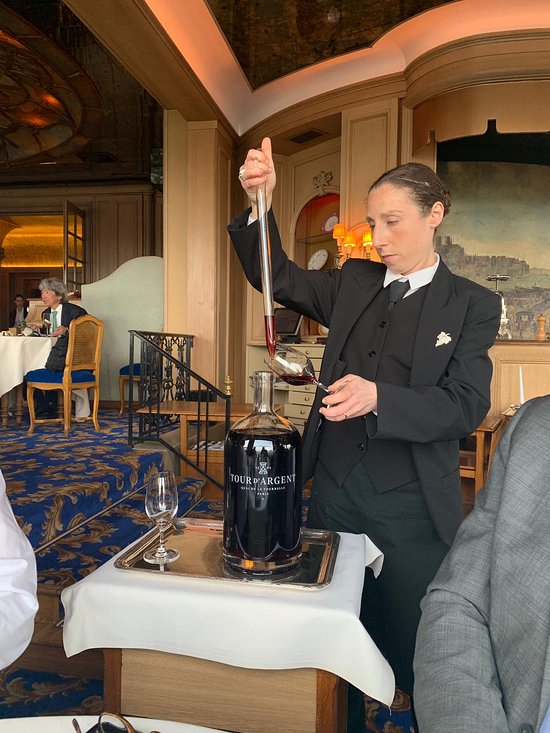 5. Do not in any way be
intimidated by a sommelier or a bible-thick wine
list. Tell the sommelier your budget and his job
is to be helpful, not to push $500 bottles of
Bordeaux on you. Many fine restaurants will have a
selection of particularly well-priced wines they
are proud to serve.
5. Do not in any way be
intimidated by a sommelier or a bible-thick wine
list. Tell the sommelier your budget and his job
is to be helpful, not to push $500 bottles of
Bordeaux on you. Many fine restaurants will have a
selection of particularly well-priced wines they
are proud to serve.
6.Ordering a salad, grilled fish without sauce or
steak well-done is so antithetical to fine dining
that it is better you do not go at all.
7. These days there is never a
problem with speaking English because someone, if
not most, on the staff will be fluent.
8. Do not feel the need to tip: The
service charge is
built into the price of the meal, so
leaving anything more than, say, ten euros on the
table marks you as a patsy.
9. Do afford yourself the pleasure
of the cheese cart, which is one of many things French
restaurants pride themselves on.
French
restaurants pride themselves on.
10.
State your allergies or likes
and dislikes, even if you are a vegetarian.
Vegans, however, will find it nearly impossible to
dine at such restaurants and will surely frustrate
the chef’s efforts to please you.
11.
Learn the simple rules of
etiquette with silverware: There will rarely be
more than an appetizer fork, tablespoon, fork and
knife, though knives
may be different for either fish or meat.
12.
If you do fancy yourself a
gourmand or connoisseur, never try to flaunt it or
show off with pretentious commentary in front of
the staff, who already know what you are spouting
about.
❖❖❖
THE BISON
By John Mariani
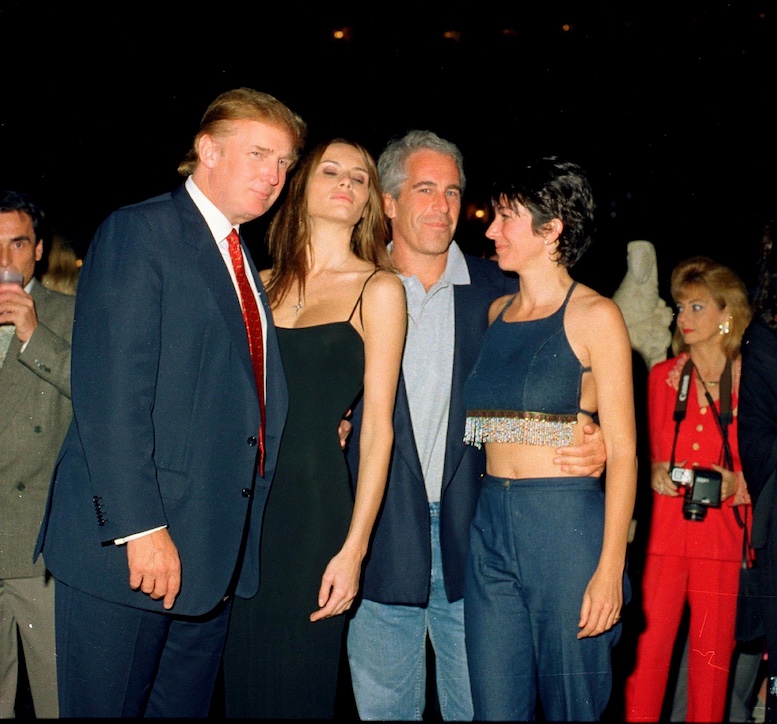
Katie
reported into Dobell who told her, “I’m
warming up to this story but only if we can
get inside the financial dealings. Rich guys
accepting Epstein’s hospitality has got to
result in favors, political or monetary.”
“That’s
mainly why the FBI and IRS are in on this
investigation.”
“They’ll take forever. If they ever get
a court order to thrash around in Epstein’s
house I’d be surprised if there was so much as
a matchbook cover of evidence to be found. The
banks in the Cayman Islands won’t work with
the feds; the Swiss are almost as bad.”
“Want David and me to break into
Epstein’s one night” asked Katie.
“Not a great idea. And if you’re caught
I’ll say I disavow even knowing you, like in Mission
Impossible.”
“Maybe the key is to find someone here
or in New York that Epstein screwed in a
financial or investment deal, like that fund
that went bankrupt.”
“That’s
what I was going to suggest, though I think
your chances are better back here than down
there. Come back and I’ll have the staff get
you names and numbers.”
“Sounds like a plan,” said Katie.
She had her return open ticket and
called David to tell him she were heading back
to New York.
David said, “You go. I think Rush has a few
more cards to play that might follow the
money. Let’s keep in touch.”
Katie flew home that
evening, and the next day she headed into the
office, where Dobell had already alerted some
of the staff as to what they were looking for.
Donna Druley already had names of those who
went down in flames with the Tower Financial
scheme Epstein somehow escaped.
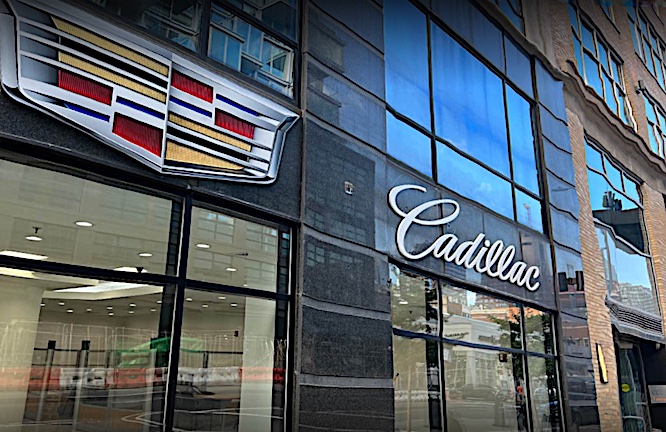 “It’s
a long list but here in New York there are
maybe a dozen people affected,” she said. “I
actually know one of them and remember how
devastated he was when Epstein got away
scot-free. I called him and he would love to
speak with you. Name is Sam Unitas, lives in
the Village. I think he’s out of the market
and runs a Cadillac dealership on the West
Side. Here’s his number."
“It’s
a long list but here in New York there are
maybe a dozen people affected,” she said. “I
actually know one of them and remember how
devastated he was when Epstein got away
scot-free. I called him and he would love to
speak with you. Name is Sam Unitas, lives in
the Village. I think he’s out of the market
and runs a Cadillac dealership on the West
Side. Here’s his number."
Katie immediately phoned Unitas, who was
only to eager to meet with her. When she
arrived at the dealership he was waiting for
her just inside the door. He was in his
forties, in good shape, with a comb-over and
goatee, wearing suit pants and a pink shirt
with white collar.
"I'm a big admirer of
your work," he said. "Glad you survived. So
you want to talk about Epstein's Ponzi
scheme and how I got taken to the cleaners."
Katie said, "Whatever you
can tell me."
"Like I said, it was a
Ponzi scheme. With all his contacts
and backers he’d switch the money around to
each other. In my case, and all those who got
killed in the Tower scheme, one of those
shells turned out to be empty.”
“So, let me get this straight. You’re
saying that Epstein was a conduit for dirty
money.”
“See,” said Unitas, “that’s where
people don’t understand something about huge
amounts of money. There’s definitely ‛dirty’
money that has to be laundered, which is where
Jeffrey came in, but there’s also legitimate
money. But there’s often so much of it that
it, too, has
to be shuffled around and hidden somewhere
it’s difficult to trace. Remember, not only
was Jeffrey devious but he had a
mathematician’s mind. He, really, more than
anyone I’ve ever met, deeply understood
numbers. He analyzed them dispassionately so
that he could assess and adjust large amounts
of cash so as to seem to disappear. Again, the
shell game. Yet as a tax consultant he never
really had more than two or three clients.”
“So,” Katie spoke slowly, “while you
say this goes on all the time, Epstein is the
main pipeline and had the ability to play one
off the other or bring these people together
and work their deals through him.”
“Exactly. Like you say, a pipeline, and
if the pipeline breaks, the oil spills out all
over the place and everything and everybody
gets dirty. And it’s all done because he has
them by the short hairs with regard to their
attending his parties. Not only does he know
where all the money is but he knows what
special services this guy or that guy wants.
I’m sure his mansions are all set up with
video cameras. If he ever gets raided by the
police of feds they’ll find them. But I can
guarantee they won’t find any of the videos
themselves, which he will have safely stored
somewhere else and probably could flick a
switch and have them all self-destruct.”
“Do think all these men fear Jeffrey?”
Unitas snickered. “These guys all
thrive on risk. Jeffrey’s just another risk,
but when you have all your colleagues, and
even your enemies, in the same game, then they
have to trust Jeffrey to protect them. So far
it’s worked for him for a long time. And I and
a lot of other people pray for his time to
come.”
The interview went on for a few more
minutes, then Unitas was called by an employer
to come finish the sales contract of his
customer.
“You interested in a new Cadillac,
Katie?”
“No, I’m good at the moment,” thinking
how ridiculous she’d look driving around in a
Seville, even if her father had always said a
Caddie is the only car worth owning.
David called
Rush and asked him if there were any bankers
he could speak to about Epstein’s money
transfers, but Rush reminded him
that no one was going to speak to him if he
wasn’t a cop or a reporter.
“You can’t just waltz into a branch of
JP Morgan and ask a manager about Epstein’s
financials,” said Rush. “Did you ever think of
getting a private investigator’s license?”
“Never. I’m not interested in being
hired to sneak around looking in windows.”
“Then you’re not going to get to the
money men. Maybe Katie can, but no one will
talk to you. And both Barber and Cherico told
me they can’t help you beyond what they’ve
already told you. And that includes Katie.”
“Well, I guess that means I’ll head
back to New York. I’ll fly out of Miami.”
“Why not just catch
a plane out of Palm Beach?”
“There’s a guy I want to pay a call
on.”
Rush straightened himself in his chair
and said, “David, I hope you’re not thinking
of going after Vargas.”
David shrugged and said, “Hey, thanks
for all your help, Terry. I’ll call you if
Katie and I come across anything else you
should know.”
By the time Rush could say, “David,
don’t be an idiot,” his friend hung up.
David had grown
tired of the back-and-forth drive from Palm
Beach to Miami, but just could not shake the
opportunity to meet with Vargas face to face.
As a cop he would have been on his doorstep
the next day; as a guy with no badge, he was
taking a chance of Vargas reporting him to the
police for harassment. David already knew
Vargas’s address out of which he operated his
brothel in Calle Ocho, so he headed to
Versailles to find out if Vargas had been in
that day.
He approached the manager
who had been present when Vargas had tried to
pull Susannah from Sanchez’s table.
“Señor, remember me?” asked David. “I
want to thank you for backing me up when I was
in here with Vargas.”
“Not a problem, Señor. I don’t like his
type in here, bringing in his girls with a
client. Señora Sanchez would never do that.”
“Has he been here today?”
“No, I think he fears looking like a
fool after the incident last week. Perdió
la cara. He lost face.”
David wanted to
say, he’s going to lose more than face, but
instead thanked the manager and drove to
Vargas’s address. He parked across the street
and waited. Over the next half hour he saw two
men go into the house and one young woman
leave. David knew that Vargas was not running
a cheap whorehouse where any man could knock
on the door unannounced and without an
appointment. And it crossed his mind that if
Vargas did not show up, David would be better
off, but with a flight four hours away, he
also had nothing else to do with his time. He
only wished it wasn’t so damn hot and humid.
Keeping the motor running to keep the a/c on
would have looked suspicious.
❖❖❖
NOTES FROM
THE WINE CELLAR
ARGENTINEAN
MALBECS
DESERVE
WORLD-WIDE RECOGNITION
By John
Mariani
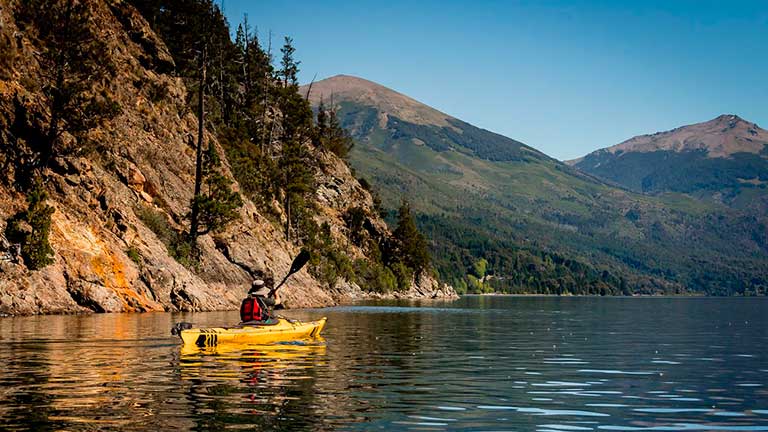
Rio Negro, Patagonia
Who knew?
April 17 has been declared Malbec World Day, at
least according to WoFa (Wines of Argentina),
which is understandable since the country is the main producer of the varietal,
with nearly 110,000 acres of
vineyards cultivated by 200 wineries, making up
22.4% of the total cultivated area in the
country.
Malbec almost didn’t survive
the phylloxera plague of the 19th
century in French vineyards, where it was planted
in Cahors (where Malbec was called "Côt.")
 Fortunately, in 1853, before
phylloxera hit Europe, French agronomist Michel
Aimé Pouget had been commissioned by the
politician and statesman (later President of
Argentina), Domingo Faustino Sarmiento (left),
to import new grape varieties, including Malbec,
which flourished in the Andean foothills.
Fortunately, in 1853, before
phylloxera hit Europe, French agronomist Michel
Aimé Pouget had been commissioned by the
politician and statesman (later President of
Argentina), Domingo Faustino Sarmiento (left),
to import new grape varieties, including Malbec,
which flourished in the Andean foothills.
Argentina has also
been turning out some impressive Garnacha,
Semillon and Marsanne, but the wines you’ll most
likely find in U.S. wine stores will be Malbecs.
I tasted several this week and
found that they are much more appealing than the
since recovered wines of Cahors, which tend to be
inky and tannic. The Argentine examples
were very fresh and ready to drink, although a
2022 Crios ($15), from the Valle de Uco,
Mendoza, had
clearly mellowed, while its acid kept it lively
and, at this price, a real bargain. At 14% alcohol
and
minimal oak it is in impeccable balance.
Cuchillo de
Palo Malbec 2024 ($30) has 5%
Petit Verdot added to the Malbec for a perky
fruitiness, and 2024 was a year of ideal warm
but not intensely hot weather, with gradual
grape ripening. It is aged for 16 months in used
oak barrels, so it has only a faint flavor of
the charred wood. I can see drinking this with
just about any meats this summer, including
poultry.
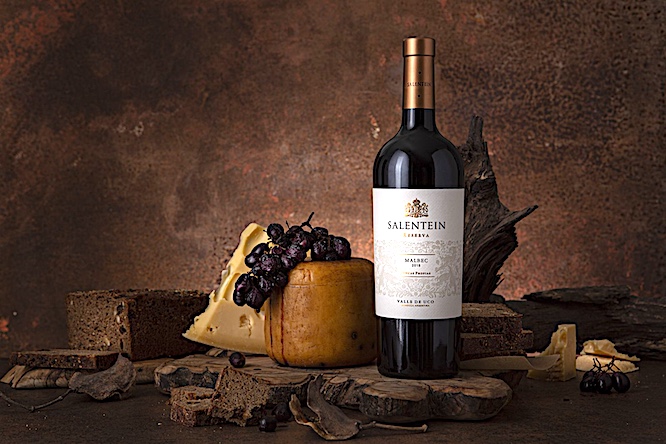
Salentein
Reserve Malbec 2023 ($22)
has a fine complexity, coming out of the Uco
Valley, aged for one year, six months in stainless
steel, six months in oak, which is a good
equilibrium of freshness and mellowness. I like
the fruitiness combined with a little pepper on
the back of the palate, so it would be delicious
with lamb, veal and chicken as well as spicy
pastas.
Wapisa Malbec
2023 ($25)
claims
to be very terroir driven, with its estate in
Atlantic Patagonia on the Rio Negro (left),
so the ocean brings in cool winds and a saline
component to the soil. It spends eight months in
barrel and comes out at a lovely 13.9% that
makes it a good match with salmon or mackerel,
paella, as well as red meats.
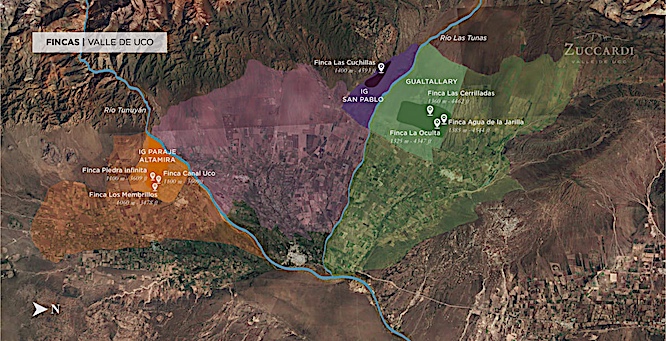
Finca Canal
Uco 2022 ( $100).
If
you wish to
make the leap to the top ranks of
Argentine Malbec, Finca Canal Uco, made by the
Zuccardi family, is
worth the price. It is a high altitude estate
(3,608 feet above the Uco Valley) irrigated by a
canal that draws from the Tunuyán River. The
vintage was a cool year, allowing for good
ripening of sugars. The wine was aged in
concrete vessels with a finesse provided by
winemaker Laura Principiano. Lovely herbal notes
complement the fruit.

PC GONE WILD
"The current steakhouse revival cannot be publicly politically neutral. According to Alicia Kennedy, 'It is a collective fever in which the right wing, masculinist approach of the carnivores has found a palatable way into polite society.'"––Eater.com
❖❖❖
Any of John Mariani's books below may be ordered from amazon.com.
 The Hound in Heaven
(21st Century Lion Books) is a novella, and
for anyone who loves dogs, Christmas, romance,
inspiration, even the supernatural, I hope you'll find
this to be a treasured favorite. The story
concerns how, after a New England teacher, his wife and
their two daughters adopt a stray puppy found in their
barn in northern Maine, their lives seem full of promise.
But when tragedy strikes, their wonderful dog Lazarus and
the spirit of Christmas are the only things that may bring
his master back from the edge of despair.
The Hound in Heaven
(21st Century Lion Books) is a novella, and
for anyone who loves dogs, Christmas, romance,
inspiration, even the supernatural, I hope you'll find
this to be a treasured favorite. The story
concerns how, after a New England teacher, his wife and
their two daughters adopt a stray puppy found in their
barn in northern Maine, their lives seem full of promise.
But when tragedy strikes, their wonderful dog Lazarus and
the spirit of Christmas are the only things that may bring
his master back from the edge of despair. WATCH THE VIDEO!
“What a huge surprise turn this story took! I was completely stunned! I truly enjoyed this book and its message.” – Actress Ali MacGraw
“He had me at Page One. The amount of heart, human insight, soul searching, and deft literary strength that John Mariani pours into this airtight novella is vertigo-inducing. Perhaps ‘wow’ would be the best comment.” – James Dalessandro, author of Bohemian Heart and 1906.
“John Mariani’s Hound in Heaven starts with a well-painted portrayal of an American family, along with the requisite dog. A surprise event flips the action of the novel and captures us for a voyage leading to a hopeful and heart-warming message. A page turning, one sitting read, it’s the perfect antidote for the winter and promotion of holiday celebration.” – Ann Pearlman, author of The Christmas Cookie Club and A Gift for my Sister.
“John Mariani’s concise, achingly beautiful novella pulls a literary rabbit out of a hat – a mash-up of the cosmic and the intimate, the tragic and the heart-warming – a Christmas tale for all ages, and all faiths. Read it to your children, read it to yourself… but read it. Early and often. Highly recommended.” – Jay Bonansinga, New York Times bestselling author of Pinkerton’s War, The Sinking of The Eastland, and The Walking Dead: The Road To Woodbury.
“Amazing things happen when you open your heart to an animal. The Hound in Heaven delivers a powerful story of healing that is forged in the spiritual relationship between a man and his best friend. The book brings a message of hope that can enrich our images of family, love, and loss.” – Dr. Barbara Royal, author of The Royal Treatment.
 The Encyclopedia of American Food and Drink by John F. Mariani (Bloomsbury USA, $35) Modesty forbids me to praise my own new book, but let me proudly say that it is an extensive revision of the 4th edition that appeared more than a decade ago, before locavores, molecular cuisine, modernist cuisine, the Food Network and so much more, now included. Word origins have been completely updated, as have per capita consumption and production stats. Most important, for the first time since publication in the 1980s, the book includes more than 100 biographies of Americans who have changed the way we cook, eat and drink -- from Fannie Farmer and Julia Child to Robert Mondavi and Thomas Keller. "This book is amazing! It has entries for everything from `abalone' to `zwieback,' plus more than 500 recipes for classic American dishes and drinks."--Devra First, The Boston Globe. "Much needed in any kitchen library."--Bon Appetit. |
"Eating Italian will never be the same after reading John Mariani's entertaining and savory gastronomical history of the cuisine of Italy and how it won over appetites worldwide. . . . This book is such a tasteful narrative that it will literally make you hungry for Italian food and arouse your appetite for gastronomical history."--Don Oldenburg, USA Today. "Italian
restaurants--some good, some glitzy--far
outnumber their French rivals. Many of
these establishments are zestfully described
in How Italian Food Conquered the World, an
entertaining and fact-filled chronicle by
food-and-wine correspondent John F.
Mariani."--Aram Bakshian Jr., Wall Street
Journal.
"Equal parts
history, sociology, gastronomy, and just
plain fun, How Italian Food Conquered the
World tells the captivating and delicious
story of the (let's face it) everybody's
favorite cuisine with clarity, verve and
more than one surprise."--Colman Andrews,
editorial director of The Daily
Meal.com. "A fantastic and fascinating
read, covering everything from the influence
of Venice's spice trade to the impact of
Italian immigrants in America and the
evolution of alta cucina. This book will
serve as a terrific resource to anyone
interested in the real story of Italian
food."--Mary Ann Esposito, host of PBS-TV's
Ciao
Italia. "John Mariani has written the
definitive history of how Italians won their
way into our hearts, minds, and
stomachs. It's a story of pleasure over
pomp and taste over technique."--Danny Meyer,
owner of NYC restaurants Union Square
Cafe, The Modern, and Maialino.
|
%202/TEMPLATE%20FOR%20NEW%20ISSUES/HOW%20ITALAIAN.jpg)
 |
 |
 |
 |
MARIANI'S VIRTUAL GOURMET
NEWSLETTER is published weekly. Publisher: John Mariani. Editor: Walter Bagley. Contributing Writers: Christopher
Mariani, Misha Mariani, John A. Curtas, Gerry Dawes, Geoff Kalish.
Contributing
Photographer: Galina Dargery. Technical
Advisor: Gerry
McLoughlin.
If you wish to subscribe to this
newsletter, please click here: http://www.johnmariani.com/subscribe/index.html
© copyright John Mariani 2026