MARIANI’S
Virtual
Gourmet
JUNE 14,
2026
NEWSLETTER
Founded in 1996
ARCHIVE
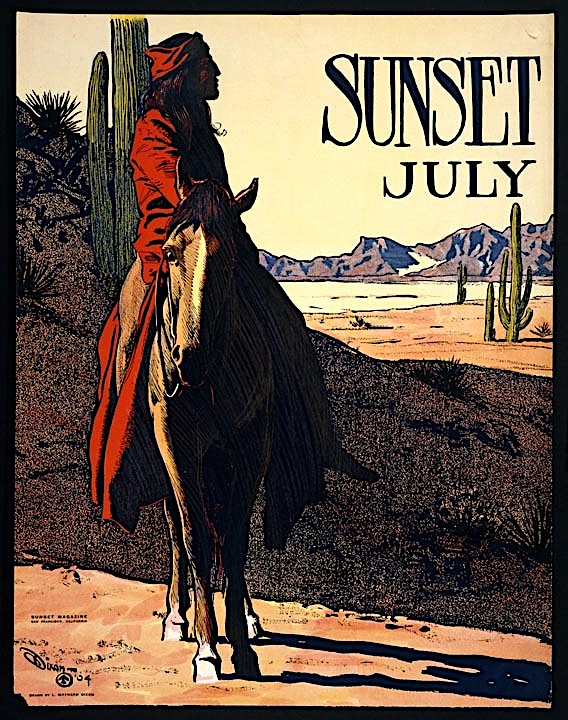
COVER OF SUNSET MAGAZINE (July 1940)
PRACTICAL FATHER'S DAY GIFTS
By John Mariani
NEW YORK CORNER
EL QUIJOTE
By John Mariani
THE BISON
CHAPTER TWENTY-FIVE
By John Mariani
NOTES FROM THE WINE CELLAR
WINE BOOKS MAKE GOOD GIFTS
By John Mariani
SOME PRACTICAL
FATHER'S DAY GIFTS
By John Mariani
Also
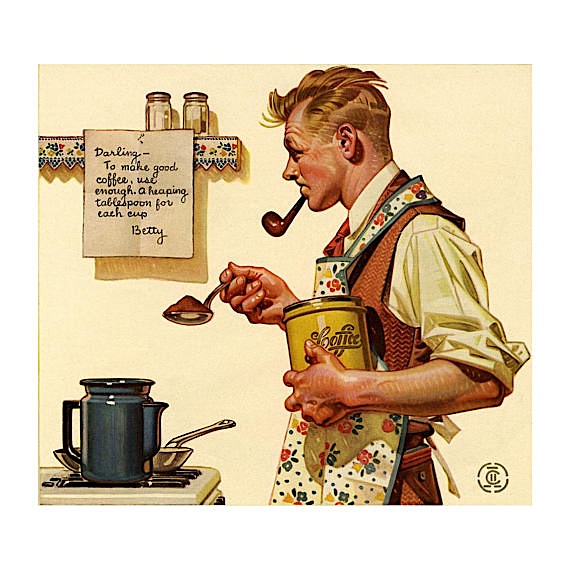
known as the “Day for the Forgotten Man,” Father’s
Day might well be celebrated by allowing one’s
father to do what he wants and only what he wants.
Gifts, however, are appropriate and the more
useful the better. Those shown below might well be
appreciated by either sex, but these have a
certain masculine cast that would buoy a father’s
heart and let him make a better dinner outside.
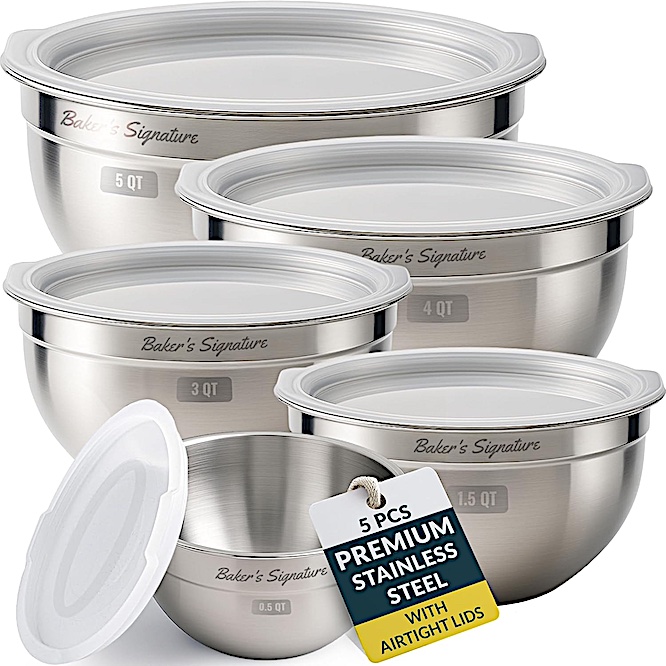 BAKER'S SIGNATURE
5-PIECE STAINLESS STEEL MIXING BOWLS WITH LIDS
($53). The problem with so many mixing bowls is
that they are unstable on the counter while
working in them. These well-designed bowls are
steady, have an air-proof locking lid and stack
into each other flush to the top for easy storage.
BAKER'S SIGNATURE
5-PIECE STAINLESS STEEL MIXING BOWLS WITH LIDS
($53). The problem with so many mixing bowls is
that they are unstable on the counter while
working in them. These well-designed bowls are
steady, have an air-proof locking lid and stack
into each other flush to the top for easy storage.
CUTLUXE
BUTCHER KNIFE SET ($103). Serious cooks
never 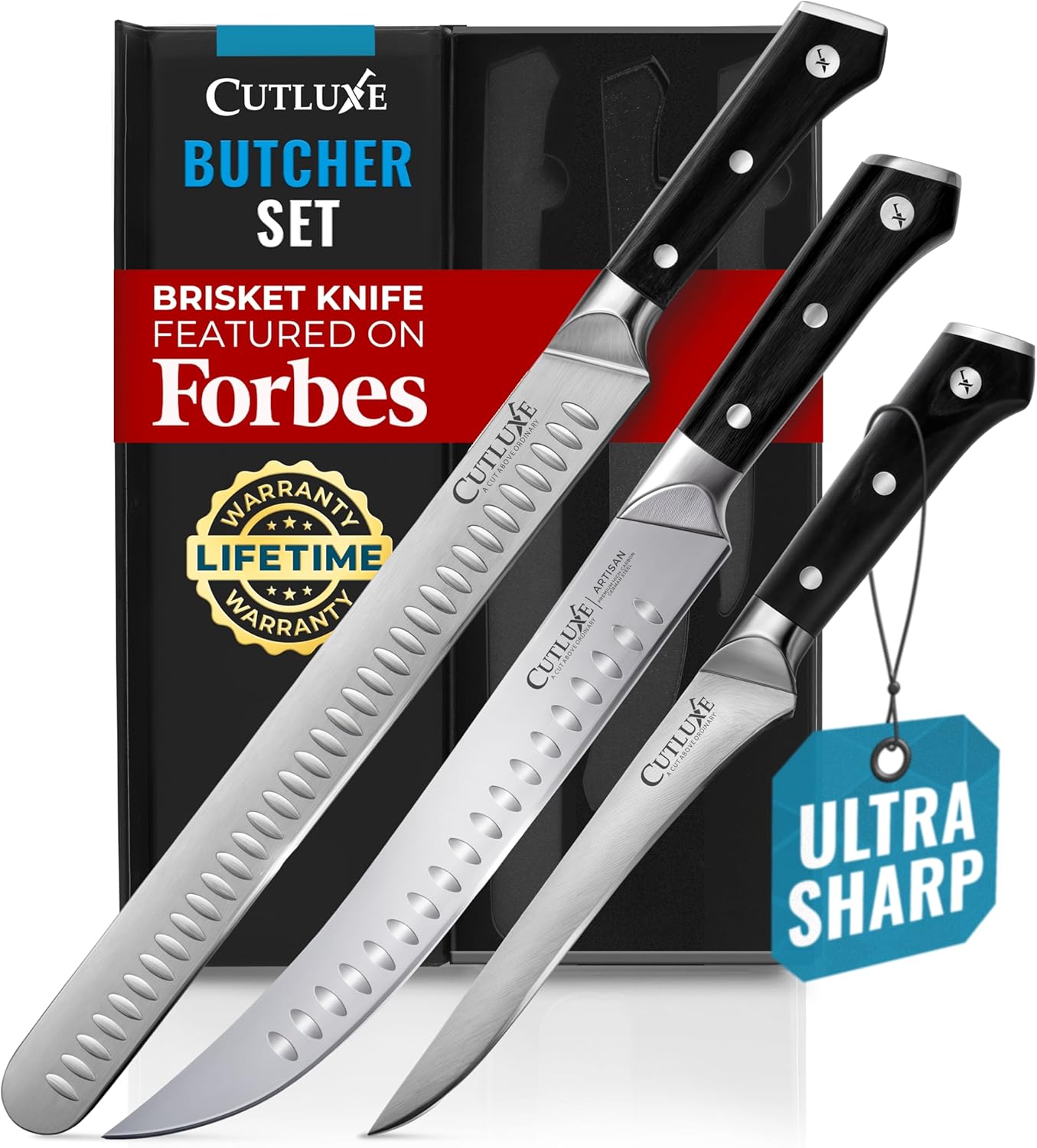 seem to
own enough knives but they are very particular
about their quality and specific to a task.
Cutluxe makes a wide range of models, but this
three-knife set is unusual in that you get a
brisket knife, a breaking knife and a boning knife
of professional quality German steel. The
ergonomic pakkawood wood handles assure a good
grip. A very good price for these three.
seem to
own enough knives but they are very particular
about their quality and specific to a task.
Cutluxe makes a wide range of models, but this
three-knife set is unusual in that you get a
brisket knife, a breaking knife and a boning knife
of professional quality German steel. The
ergonomic pakkawood wood handles assure a good
grip. A very good price for these three.
 WOODENHOUSE
CHARCUTERIE BOARD SET WITH TRAY ($46).
Compacting utensils is essential in the kitchen,
where space is always a problem. This beautiful
bamboo board comes with a hidden slide-out tray
containing a fork and three cutting knives for
cheeses, and on top two bowls for condiments.
There are also marking slate labels to identify
the cheeses. Very easy to clean.
WOODENHOUSE
CHARCUTERIE BOARD SET WITH TRAY ($46).
Compacting utensils is essential in the kitchen,
where space is always a problem. This beautiful
bamboo board comes with a hidden slide-out tray
containing a fork and three cutting knives for
cheeses, and on top two bowls for condiments.
There are also marking slate labels to identify
the cheeses. Very easy to clean.
STAINLESS STEEL BENTO BOX ($38). Plastic
bento boxes may be a dime a dozen or you could
just 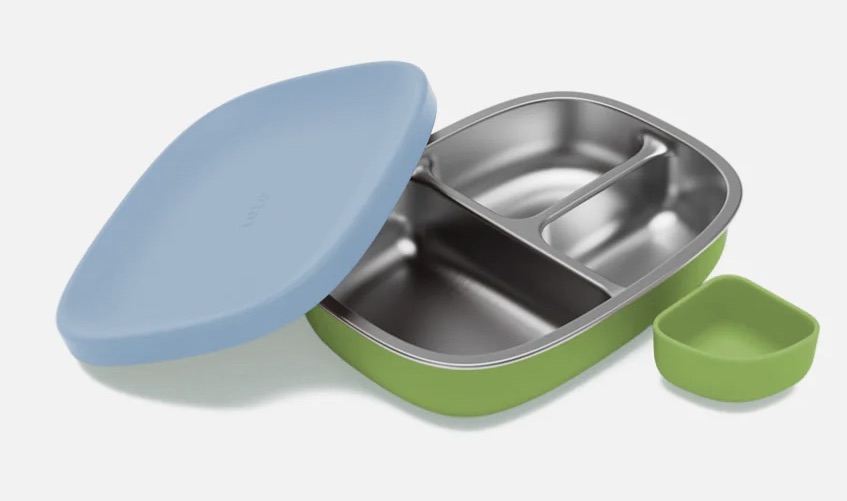 use your old take-out
containers. But this is a very smart, very
durable, very washable box for kids' meals. The
interior is stainless steel, the silicone exterior
food-grade and BPA-free. Foods won't easily
spill over the three segments and because you
never toss it out, it's eco-friendly and
non-porous. For grown men, it's ideal to take on a
camping trip, and it comes in eight colors.
use your old take-out
containers. But this is a very smart, very
durable, very washable box for kids' meals. The
interior is stainless steel, the silicone exterior
food-grade and BPA-free. Foods won't easily
spill over the three segments and because you
never toss it out, it's eco-friendly and
non-porous. For grown men, it's ideal to take on a
camping trip, and it comes in eight colors.
NEW YORK CORNER
EL QUIJOTE
226 West
23rd Street
212-518-1843
By John
Mariani
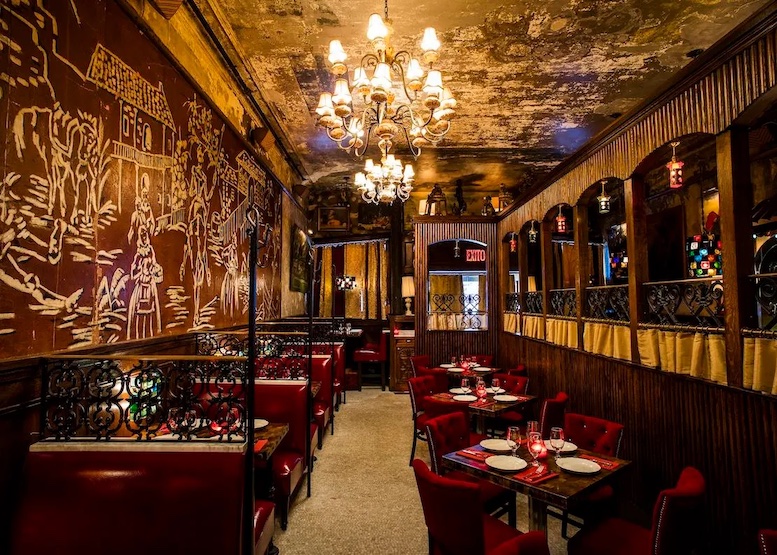
 Back then a “Spanish” restaurant meant
something closer to a Cuban restaurant like El
Chico, El Flamenco, Fundador, Seville and
Havana-Madrid, all long gone. Upon its re-opening
in 2022 El Quijote was cleaned up without
destroying its original funky charm, including a
neon sign out front, a dining
room with a white tile floor and a folkloric mural
depicting Don Quixote as he prepares to joust with
a windmill.
Back then a “Spanish” restaurant meant
something closer to a Cuban restaurant like El
Chico, El Flamenco, Fundador, Seville and
Havana-Madrid, all long gone. Upon its re-opening
in 2022 El Quijote was cleaned up without
destroying its original funky charm, including a
neon sign out front, a dining
room with a white tile floor and a folkloric mural
depicting Don Quixote as he prepares to joust with
a windmill.
Beyond another wall is the
lively bar. Given the ebullient crowd
that comes here both for the true Spanish food,
special cocktails and the vibe, El Quijote can be
very loud, especially when they blast thudding
music. So, on a beautiful mid-May evening, our
party opted to take a table outside, which allowed
for easy conversation and the pleasure of watching
the passing parade of people on broad West 23rd
Street.
The menu begins with some tapas
and
first courses, so the listings at the top 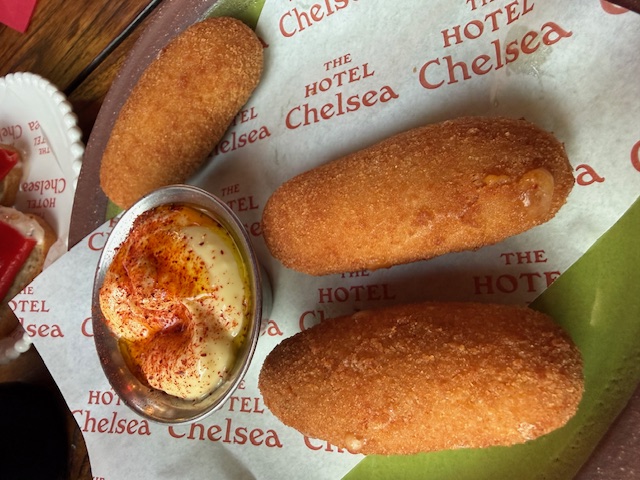 include a tangy-sweet savory pan
con tomate of toasted country bread smeared
with garlic, olive oil and a rich tomato confit.
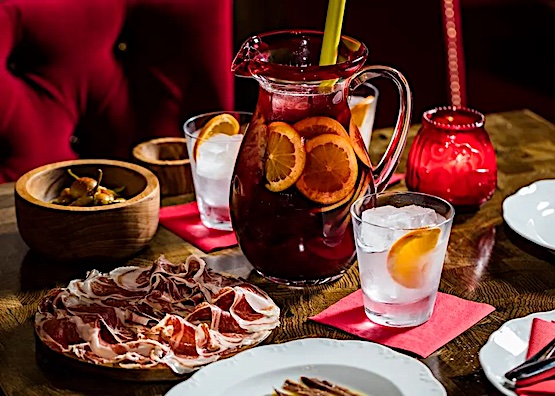
There is certainly Spanish ham, either Serrano or
Ibérico ham cut to order in gleaming, ruby-red
slices.
include a tangy-sweet savory pan
con tomate of toasted country bread smeared
with garlic, olive oil and a rich tomato confit.
There is certainly Spanish ham, either Serrano or
Ibérico ham cut to order in gleaming, ruby-red
slices.
Pulpo adobado is
tender octopus with potatoes and paprika-colored adobo
seasoning. I can’t get enough of the puffy croquetas
de chorizo (right) that look like
fried Twinkies but contain potato, crumbled
chorizo sausage and Mahon cheese. The tortilla
de patata is an omelet with crushed potatoes
that would be lovely for brunch or lunch.
You could even make a meal out
of the fat patatas bravas with spiked
tomato garlic sauce. Very good
for summer is the endive, apple, cheese and
caramelized honey vinegar salad.
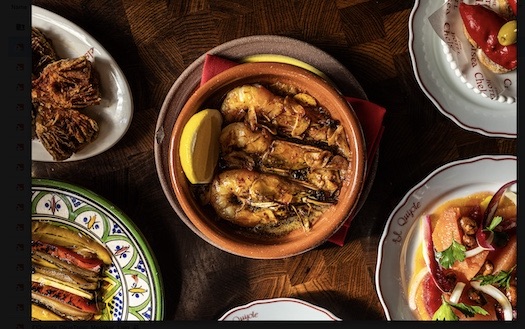 They use the plancha griddle
to wonderful effect, coaxing all the flavor from gambas
al ajillo (left), blue,
heads-on prawns with plenty of garlic, olive oil
and assertive seasonings that infuse the shell and
the body meat completely. So, too, fideuá de
setas is
a classic of toasted angel hair spaghetti snapped
into short pieces and baked like paella in a
casserole with marinated mushrooms and piquillo
peppers that buoy the smoky flavor of the pasta.
They use the plancha griddle
to wonderful effect, coaxing all the flavor from gambas
al ajillo (left), blue,
heads-on prawns with plenty of garlic, olive oil
and assertive seasonings that infuse the shell and
the body meat completely. So, too, fideuá de
setas is
a classic of toasted angel hair spaghetti snapped
into short pieces and baked like paella in a
casserole with marinated mushrooms and piquillo
peppers that buoy the smoky flavor of the pasta.
If paella (below) is one
of the defining tests of a Spanish kitchen’s
mettle—at least in Valencia, where it’s prepared
seaside over an open fire—El Quijote’s is a
generous portion with traditional seasonings, but
surprisingly it
lacked the sought-after crispy burned rice on the
bottom called soccarat.
A party of two can readily
indulge in the “Daily Double” of a ten-ounce
ribeye and a European lobster called bogavante,
with pimenton butter and a mixed salad.
El Quijote’s desserts are true
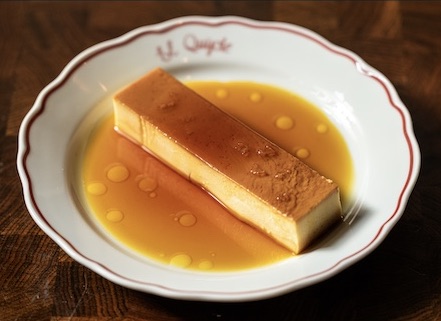
to form: A
flan of caramelized custard with olive oil (below);
rice pudding with vanilla, cinnamon, and orange;
and a swirl of toron nougat ice cream
with caramelized pecans.
 The wine list, overseen by Claire
Paparazzo, is not long but is solid with modern
Spanish labels, and the sangria is really
delicious, flavored with cinnamon and given a
sweet-sour edge with balsamic vinegar.
The wine list, overseen by Claire
Paparazzo, is not long but is solid with modern
Spanish labels, and the sangria is really
delicious, flavored with cinnamon and given a
sweet-sour edge with balsamic vinegar.
Hard as it is to believe, New York is not
rife with Spanish restaurants, and El Quijote
brandishes its authenticity with authority, plus a
good dose of downtown Chelsea cool.
Open
for dinner nightly.
THE BISON
By John Mariani
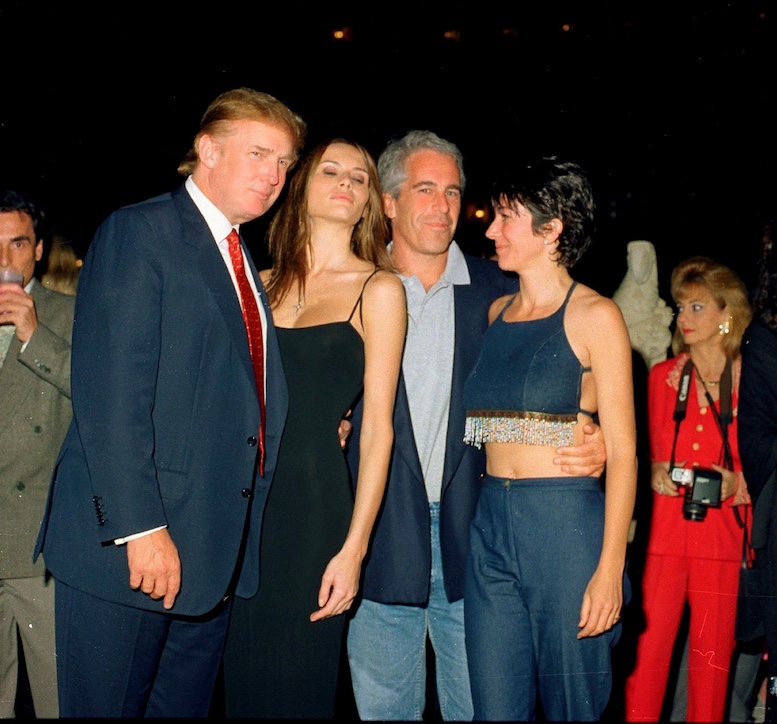
David
didn’t like the way Katie sounded when she
called him on the phone to ask if she could
come up to his house. He detected anxiety at
least, fear perhaps. Perhaps Dobell had killed
the idea for the story. In any case, he was
always delighted at the prospect of her coming
to his house, which he decided needed some
cleaning up before she arrived.
It was a crystal clear early winter’s
day in the Hudson Valley, with high scudding
clouds and sunshine that reflected off the
mantle of sparkling snow
that lay over the Palisades and hills of
Orange County. Icicles hung from the eaves of
David’s house and he had, fortunately, time to
plow his driveway before she arrived on a trip
that would take her about two hours.
David thought about what to
make her for lunch. He drove to a nearby
market where he picked up some cold cuts,
shrimp and a bouquet of flowers. Back home he
put a bottle of Trebbiano d’Abruzzo in the
freezer for an hour. He shaved and put on a
fresh shirt he tucked it into his chinos.
As she always did, Katie
beeped her red Fiat’s horn three times as she
approached, and it was one of David’s favorite
sounds. He came out to the driveway and opened
his arms wide. Katie got out and gave him a
hug somewhat firmer than was usual. She was
wearing a pea jacket under which she had a
black sweater and bluejeans.
“Come on in,” said David.
“It’s freezing out here.”
They went inside and David
took Katie’s coat.
“Hope you’re hungry.”
“I could eat. I could also
use a glass of wine.”
“Coming right up,” he said,
thinking there was no joy in her request.
“So, what’s going on?” he
asked. “Anything new on the article?”
“There’s some,” she said.
“I had an interesting phone conversation with
Donald Trump. Big blowhard, thinks he knows
how to charm the press, especially if you’re a
woman.”
Katie told him how the
interview went as she sipped the white wine
while David started to cook a dish
of spaghetti with shrimp cooked in garlic, oil
and lemon.
“You sound a little down,
Katie. Feel all right?”
“Yeah, I’m fine, but, I
have to tell you, I’m feeling a little
queasy.”
“About what?”
Katie then told David what
had happened in the office and how Sheridan
insisted he was not going to sell the
magazine.
“Well, that’s encouraging,”
said David.
“Indeed it is. But I’m a
little worried as to why someone wants to buy
McClure’s immediately and offer so much
money for it. Alan thinks it must be some tax
dodge that needs to be concluded by a certain
date.”
“Sounds reasonable. What do
you think?”
“I think this somebody
wants to buy the magazine in order to stop us
from investigating Epstein and his cronies,
because for damn sure they all know we’re
looking into their activities.”
“You mean fire you as soon
as he gets hold of the magazine?”
“At the very least.”
“But you could easily go to
another magazine with your story.”
“That’s what bothers me,
David. He needs me gone, permanently.”
David was not really
surprised by her assertion. “He could do that
without buying the magazine. But like I’ve
said before, killing off a cop or a journalist
usually turns out to be bad for business.”
Katie’s temper flared.
“Y’know, I’m tired of hearing that from you.
Both of us have almost been murdered five
times while we’ve been on a story!”
All David could muster in
response was, “True, but in my case I’m not
longer a cop, so I’m fair game. And all those
attempted murders were outside the U.S., where
the bad guys seem to have a more liberal
attitude towards knocking journalists off.”
“So I’ve noticed,” said
Katie, then, “Hey, I’m sorry I snapped at you.
I’m just on edge.”
“I can tell. I mean, it
makes sense that these guys don’t want your
story to get out, but they don’t strike me as
the types that murder people. Not even
Epstein, but I could be wrong about him.”
“What about Vargas acting
on his behalf?”
“I think Vargas is a
strong-arm man but he’d probably botch a
murder. He sure sent the wrong spider after
me.”
Katie shook her head and
said, “I sure hope you’re right. I’m getting
real pissed about people trying to kill us.”
David said nothing but
brought the steaming plates of pasta to the
table and poured more wine.
“Eat. Y’know, once during
World War II when Churchill’s people told him
the Germans had just bombed Coventry, he is
reported to have said, ‛Well, then, let’s have
lunch. Everything looks better after lunch.’”
“Stiff upper lip, eh? Said
Katie. “Maybe the wine will help.”
“So we keep working on this
story, right?”
Katie smiled, “Here’s to
us! May no one try to knock us off this time!”
They clinked glasses and
David said, “That would make for a nice change
of pace.”
Katie did feel better and even took a
nap on the couch before the fireplace after
finishing the wine. David cleaned up the
kitchen and just sat down and watched her
sleep very soundly, saying to himself, “I’m
not going let anything happen to this
girl.”
The next morning Katie put in
a call to Dobell, asking, “Anything new on the
sale of the magazine?”
“Only that it’s still not
for sale. Whatever happens in the next two to
three years may change that if these on-line
blogs and newsletters cut too deeply into
magazine profits. But since McClure’s suitor
demanded an immediate sale, I think we’re all
pretty safe.”
“Well, that’s a relief, she
said.”
“You still believe there’s
an assassin lurking around to get you? You
stock up on Mace?”
“I don’t know. I talked to
David and he made me feel that it’s a
possibility, but a remote one. The question
is, you want me to continue to research this
story?”
“Hell, yes. It’s still
research, not yet a story, but if anyone can
put the pieces together, it’s you.”
Katie thanked Alan and
promised she’d do her best.
From outside Dobell’s
office Donna Druley called out, “Katie,
there’s a phone call for you at your desk.”
“They say who it was?”
“She said her name was
Susannah.”
“Susannah? It’s
Katie Cavuto. What’s up?”
“Something you
need to know.”
Katie
opened her notebook and clicked on the
recorder attached to the phone.
“Something
bad happened to one of Jeffrey’s girls,” said
Susannah, who sounded on the verge of tears
and scared.
“What
happened?”
“This
girl I knew, her name was Sarah. Ghislaine
recruited her a few months ago from, I think,
Texas. She was like sixteen, beautiful blond,
blue eyes. And. . . and she was. . .
murdered.”
Susannah
broke down in tears, and Katie said nothing
until she recovered, then asked, “By one of
Jeffrey’s guests?”
“Yeah,
that pig Pierce.”
“Angus
Pierce? The South African?”
“Yeah,
any time he came to the States he’d be with
Jeffrey either in New York or Palm Beach.”
“So
how did it happen?”
“Pierce
was into very kinky sex, bondage and shit.
Also he drugged the girls, sometimes with
angel’s dust or get them like real out of it
with pain killers like Oxy. And apparently he
overdosed her, and now she’s dead.”
“How
do you know this, Susannah?”
“Like
I said, I knew her pretty well, and we’d talk
on the phone like every few of days. So when I
didn’t hear from her, I called one of the
other girls and she said that Sarah had been
murdered by Pierce and Jeffrey had the body
removed.”
“Do
the police know about this?”
“Not
yet. I wanted
to call you first, then I’ll call them. But
I’m scared, Katie. If Jeffrey finds out it’s
me who called the cops, he’ll come after me.
I’m going to need protection.”
“Have
you told Sanchez? Asked Katie.
“Not
yet.”
“I
think that’s what you should do first. Then
call this police officer David and I have been
working with in Palm Beach, name is Terry
Rush. I’ll call him first if you like.”
“Maybe
you should. Do you have to tell hm my name
right away?”
“No,
but I really want you to call him. He’s trying
to nail Jeffrey every way he can.”
Susannah said she’d do that
after speaking to Sanchez.
“And,
Susannah, you call me after you speak to
Sanchez and Rush, okay? Any time you want to
talk to me, day or night. And
what was Sarah’s last name?”
“Doyle.
Sarah Doyle.”
“And
do you know where her parents are?”
“I
don’t know, somewhere in Texas, maybe
Houston.”
“Okay,
I’m going to follow up on what you’ve told me,
so sit tight. And I’d try to keep away from
Vargas, if I were you.”
“Oh, I know. If anyone’s going to hurt me it will be him. I think I can stay with Señora Sanchez meanwhile.”
❖❖❖
NOTES FROM THE WINE CELLAR
WINE BOOKS FOR SERIOUS WINE LOVERS
By John Mariani
 One Thousand Vines: A New Way
to Understand Wine (Mitchell
Beazley) by Pascaline Lepeltier is as
comprehensive and up to date about world wine
culture today as we’re likely to find for quite
some time. It is full of well-wrought information
on history,
science, microbiology, ecology, geology, terroir
and label mythology.
It is divided into three parts: "Reading
Vines," "Reading Landscapes," and "Reading Wines,"
and she can turn you into a connoisseur of the
kind who shuns snobbery for deep knowledge when it
comes to tasting, smelling, and serving wine and
warns against the media’s overuse of “minerality.”
Lepeltier is young, dynamic and passes on her
enthusiasm with a genteel notion that wine is to
be enjoyed, not just talked about.
One Thousand Vines: A New Way
to Understand Wine (Mitchell
Beazley) by Pascaline Lepeltier is as
comprehensive and up to date about world wine
culture today as we’re likely to find for quite
some time. It is full of well-wrought information
on history,
science, microbiology, ecology, geology, terroir
and label mythology.
It is divided into three parts: "Reading
Vines," "Reading Landscapes," and "Reading Wines,"
and she can turn you into a connoisseur of the
kind who shuns snobbery for deep knowledge when it
comes to tasting, smelling, and serving wine and
warns against the media’s overuse of “minerality.”
Lepeltier is young, dynamic and passes on her
enthusiasm with a genteel notion that wine is to
be enjoyed, not just talked about.
Your
Tasting Brain: A Sensory Approach to Wine,
Beer, and Other Pleasures 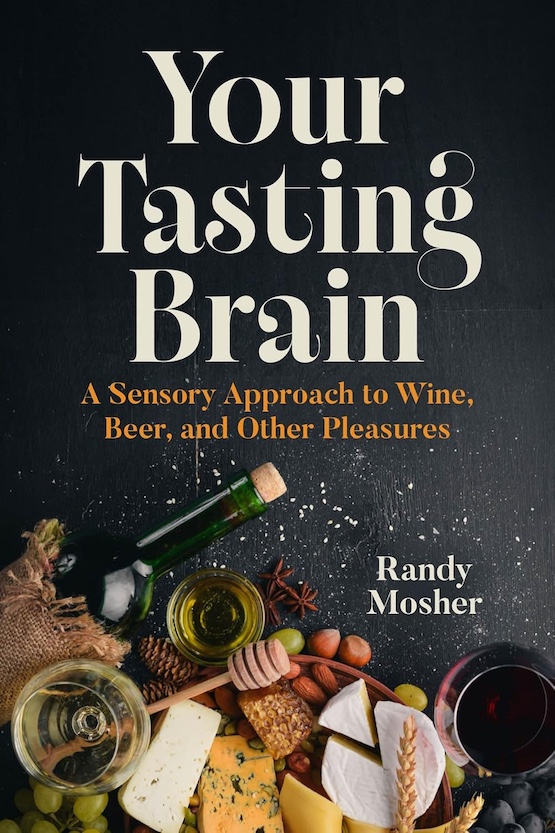 (U. of Chicago Press)
by Randy Mosher is not for the novice, for this
volume, out of the U. of Chicago Press, is an
in-depth investigation of how the brain actually
processes smell, taste and mouthfeel, and that it
grows deeper and more attuned as much with wine as
with beer and food. He treats of acidity, sugar,
heat and cold, and notes how vague and even
nonsensical reviews can be of beverages, noting
“as rich as language can be, it often feels
woefully inadequate for the job of tasting.” This
is not an easy book to wrap your arms around, with
chapters titled, “The Wonder of Multimodal Sensory
Perception” and “Neuroanatomy,” but the
underlying advice is soundly based on extensive
research.
(U. of Chicago Press)
by Randy Mosher is not for the novice, for this
volume, out of the U. of Chicago Press, is an
in-depth investigation of how the brain actually
processes smell, taste and mouthfeel, and that it
grows deeper and more attuned as much with wine as
with beer and food. He treats of acidity, sugar,
heat and cold, and notes how vague and even
nonsensical reviews can be of beverages, noting
“as rich as language can be, it often feels
woefully inadequate for the job of tasting.” This
is not an easy book to wrap your arms around, with
chapters titled, “The Wonder of Multimodal Sensory
Perception” and “Neuroanatomy,” but the
underlying advice is soundly based on extensive
research.
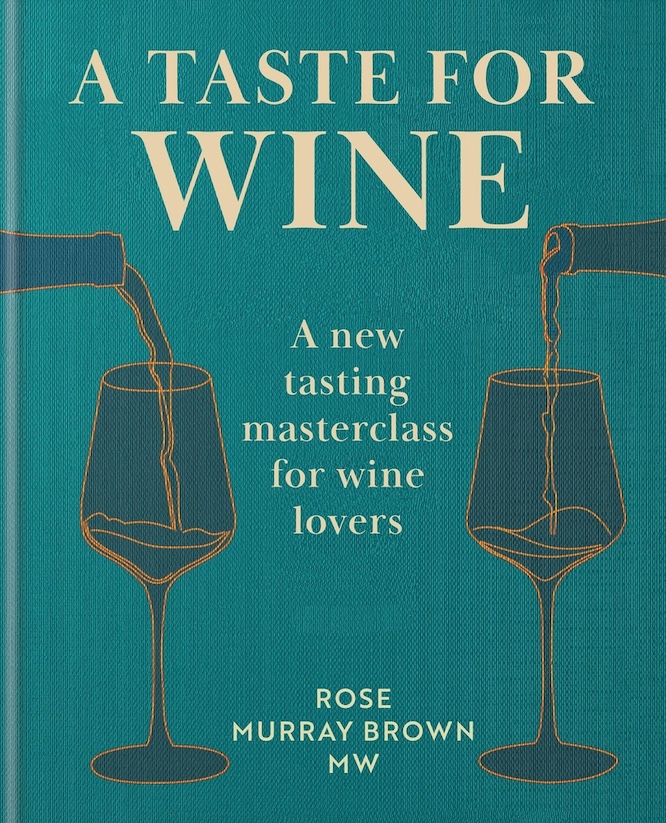 A Taste for Wine: A
New Tasting Masterclass for Wine Lovers
(Mitchell Beazley) by Rose Murray Brown. The
author is a Master of Wine––one of only 425 in the
world––so she knows of what she speaks, and this
book is a good deal more relatable than Your
Tasting Brain, above. It is based on
“self-guiding tasting practices,” and provides
up-to-date info on critical topics like climate
change, which may well get to extreme levels.
There is also a section focusing on 51 regions’
top producers, varietals and wineries open to
visits. One of its best features is the number of
photos
that make her point, page after page. And she’s a
joy to read.
A Taste for Wine: A
New Tasting Masterclass for Wine Lovers
(Mitchell Beazley) by Rose Murray Brown. The
author is a Master of Wine––one of only 425 in the
world––so she knows of what she speaks, and this
book is a good deal more relatable than Your
Tasting Brain, above. It is based on
“self-guiding tasting practices,” and provides
up-to-date info on critical topics like climate
change, which may well get to extreme levels.
There is also a section focusing on 51 regions’
top producers, varietals and wineries open to
visits. One of its best features is the number of
photos
that make her point, page after page. And she’s a
joy to read.
❖❖❖
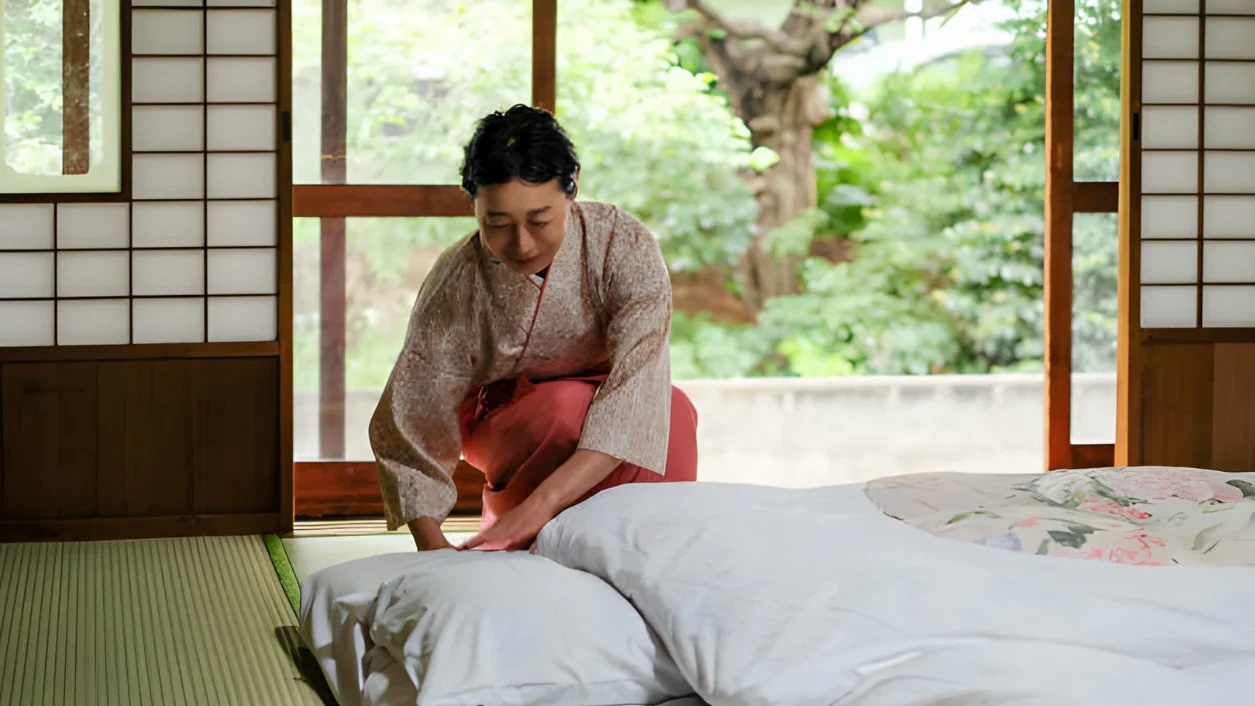
TRAVEL WRITING 101: BLOCK THAT SIMILE!
❖❖❖
Any of John Mariani's books below may be ordered from amazon.com.
 The Hound in Heaven
(21st Century Lion Books) is a novella, and
for anyone who loves dogs, Christmas, romance,
inspiration, even the supernatural, I hope you'll find
this to be a treasured favorite. The story
concerns how, after a New England teacher, his wife and
their two daughters adopt a stray puppy found in their
barn in northern Maine, their lives seem full of promise.
But when tragedy strikes, their wonderful dog Lazarus and
the spirit of Christmas are the only things that may bring
his master back from the edge of despair.
The Hound in Heaven
(21st Century Lion Books) is a novella, and
for anyone who loves dogs, Christmas, romance,
inspiration, even the supernatural, I hope you'll find
this to be a treasured favorite. The story
concerns how, after a New England teacher, his wife and
their two daughters adopt a stray puppy found in their
barn in northern Maine, their lives seem full of promise.
But when tragedy strikes, their wonderful dog Lazarus and
the spirit of Christmas are the only things that may bring
his master back from the edge of despair. WATCH THE VIDEO!
“What a huge surprise turn this story took! I was completely stunned! I truly enjoyed this book and its message.” – Actress Ali MacGraw
“He had me at Page One. The amount of heart, human insight, soul searching, and deft literary strength that John Mariani pours into this airtight novella is vertigo-inducing. Perhaps ‘wow’ would be the best comment.” – James Dalessandro, author of Bohemian Heart and 1906.
“John Mariani’s Hound in Heaven starts with a well-painted portrayal of an American family, along with the requisite dog. A surprise event flips the action of the novel and captures us for a voyage leading to a hopeful and heart-warming message. A page turning, one sitting read, it’s the perfect antidote for the winter and promotion of holiday celebration.” – Ann Pearlman, author of The Christmas Cookie Club and A Gift for my Sister.
“John Mariani’s concise, achingly beautiful novella pulls a literary rabbit out of a hat – a mash-up of the cosmic and the intimate, the tragic and the heart-warming – a Christmas tale for all ages, and all faiths. Read it to your children, read it to yourself… but read it. Early and often. Highly recommended.” – Jay Bonansinga, New York Times bestselling author of Pinkerton’s War, The Sinking of The Eastland, and The Walking Dead: The Road To Woodbury.
“Amazing things happen when you open your heart to an animal. The Hound in Heaven delivers a powerful story of healing that is forged in the spiritual relationship between a man and his best friend. The book brings a message of hope that can enrich our images of family, love, and loss.” – Dr. Barbara Royal, author of The Royal Treatment.
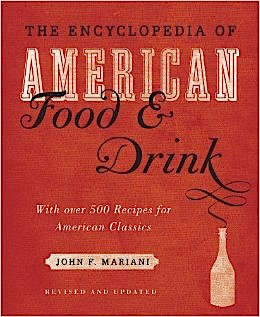 |
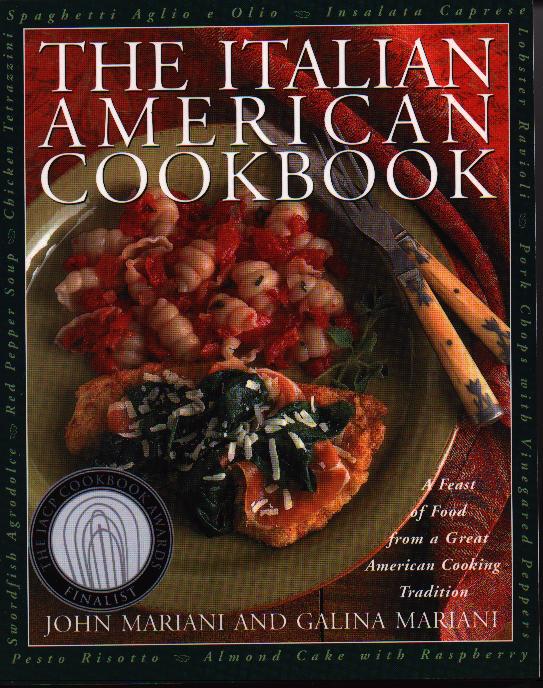
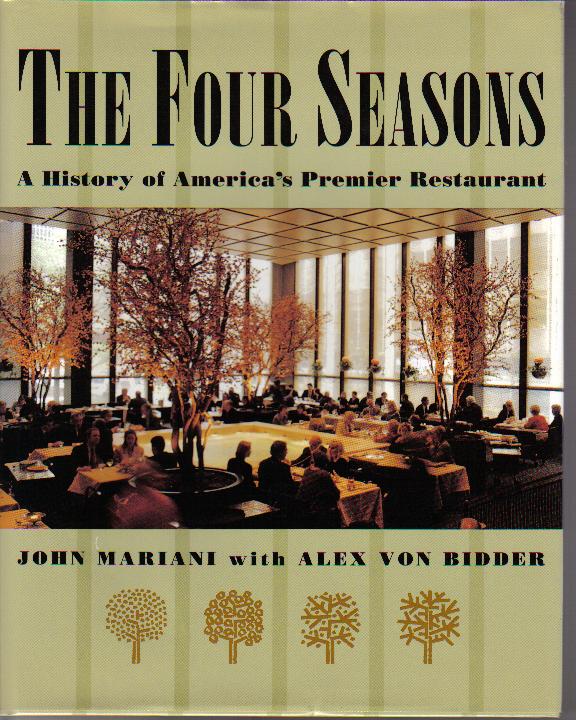
The Encyclopedia of American Food and Drink by John F. Mariani (Bloomsbury USA, $35) Modesty forbids me to praise my own new book, but let me proudly say that it is an extensive revision of the 4th edition that appeared more than a decade ago, before locavores, molecular cuisine, modernist cuisine, the Food Network and so much more, now included. Word origins have been completely updated, as have per capita consumption and production stats. Most important, for the first time since publication in the 1980s, the book includes more than 100 biographies of Americans who have changed the way we cook, eat and drink -- from Fannie Farmer and Julia Child to Robert Mondavi and Thomas Keller. "This book is amazing! It has entries for everything from `abalone' to `zwieback,' plus more than 500 recipes for classic American dishes and drinks."--Devra First, The Boston Globe. "Much needed in any kitchen library."--Bon Appetit. |
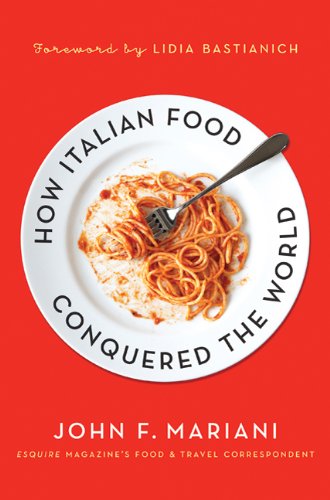
"Eating Italian will never be the same after reading John Mariani's entertaining and savory gastronomical history of the cuisine of Italy and how it won over appetites worldwide. . . . This book is such a tasteful narrative that it will literally make you hungry for Italian food and arouse your appetite for gastronomical history."--Don Oldenburg, USA Today. "Italian
restaurants--some good, some glitzy--far
outnumber their French rivals. Many of
these establishments are zestfully described
in How Italian Food Conquered the World, an
entertaining and fact-filled chronicle by
food-and-wine correspondent John F.
Mariani."--Aram Bakshian Jr., Wall Street
Journal.
"Equal parts
history, sociology, gastronomy, and just
plain fun, How Italian Food Conquered the
World tells the captivating and delicious
story of the (let's face it) everybody's
favorite cuisine with clarity, verve and
more than one surprise."--Colman Andrews,
editorial director of The Daily
Meal.com. "A fantastic and fascinating
read, covering everything from the influence
of Venice's spice trade to the impact of
Italian immigrants in America and the
evolution of alta cucina. This book will
serve as a terrific resource to anyone
interested in the real story of Italian
food."--Mary Ann Esposito, host of PBS-TV's
Ciao
Italia. "John Mariani has written the
definitive history of how Italians won their
way into our hearts, minds, and
stomachs. It's a story of pleasure over
pomp and taste over technique."--Danny Meyer,
owner of NYC restaurants Union Square
Cafe, The Modern, and Maialino.
|
 |
 |
 |
 |
 |
 |
MARIANI'S VIRTUAL GOURMET
NEWSLETTER is published weekly. Publisher: John Mariani. Editor: Walter Bagley. Contributing Writers: Christopher
Mariani, Misha Mariani, John A. Curtas, Gerry Dawes, Geoff Kalish.
Contributing
Photographer: Galina Dargery. Technical
Advisor: Gerry
McLoughlin.
If you wish to subscribe to this
newsletter, please click here: http://www.johnmariani.com/subscribe/index.html
© copyright John Mariani 2026