Virtual Gourmet
AUGUST 2, 2026
NEWSLETTER
Founded in 1996
ARCHIVE

"Summer Strawberries" By William McCloskey (1990)
THE NOT-SO-CLEVER MARKETING
PLOY OF "FARM-TO-TABLE" COOKING
By John Mariani
NEW YORK CORNER
BASSO BY PXK
By John Mariani
THE BISON
CHAPTER THIRTY-TWO
By John Mariani
NOTES FROM THE WINE CELLAR
A ON-SITE REPORT ON THE
VINEYARDS OF BORDEAUX
By
Michel and Maud Naveau
PLOY OF "FARM-TO-TABLE" COOKING
By John Mariani

"American Gothic" By Grant Wood (1930)
Back
in the 1960s,
Henri Soulé, owner of New York’s famed Le
Pavillon, which the Times’s
Craig Claiborne called “the foremost temple
of fine French cooking and the
standard any which all other French
restaurants could be judged,” lamented,
 “Some of the
richest people on earth will dine here
tonight. And for all the
money on earth, I couldn’t give them the
simple good things that every
middle-class Frenchman can afford from time
to time. Six Marennes oysters. A
partridge—very, very young. Some real primeurs—the
first spring
vegetables. A piece of Brie that is just
right.”
“Some of the
richest people on earth will dine here
tonight. And for all the
money on earth, I couldn’t give them the
simple good things that every
middle-class Frenchman can afford from time
to time. Six Marennes oysters. A
partridge—very, very young. Some real primeurs—the
first spring
vegetables. A piece of Brie that is just
right.”
Soulé was despairingly
right: Ingredients of that time in America,
from fruits and vegetables to
seafood and cheese, were rarely of high
quality and often available only in
their frozen, processed state. It
was
really not until 1971, when a former
Montessori teacher named Alice Waters
challenged American purveyors to find her the
best local provender of a kind
she’d enjoyed in Provence bistros for her
little Berkeley, CA, restaurant
named Chez Panisse, that a seismic shift
occurred in the production and
distribution of first-rate  food
products.
From then on—in fits and starts, to be
sure—both chefs and home cooks
could depend on better and better ingredients
with which to make better and
better food.
food
products.
From then on—in fits and starts, to be
sure—both chefs and home cooks
could depend on better and better ingredients
with which to make better and
better food.
The search for the
finest summer’s raspberries, the freshest
Chinook salmon, the highest grade of
beef and lamb and dairy products that tasted
of the farm became the mantra of
young chefs and cooks who transformed the way
we eat today. And if the best of
something came from far away— Dover sole,
Prosciutto di Parma, Stilton cheese,
radicchio, truffles—new services like FedEx
and DHL could deliver them
overnight to any city in America. Soon a chef
could open an authentic Parisian
bistro serving Époisse (left), an
Italian
trattoria using balsamic vinegar and a
modern Mexican restaurant using huitlacoche.
Dover sole,
Prosciutto di Parma, Stilton cheese,
radicchio, truffles—new services like FedEx
and DHL could deliver them
overnight to any city in America. Soon a chef
could open an authentic Parisian
bistro serving Époisse (left), an
Italian
trattoria using balsamic vinegar and a
modern Mexican restaurant using huitlacoche.
As so often happens in
America, once the demand for quality becomes
widespread, it shifted shape: For
in the late 1990s some chefs were preaching
the gospel of what became known as
“farm to table” cooking or “locavorism,” which
insisted that the best expression
of a regional cuisine—Southern, New England,
California, Midwestern—would always be based on indigenous local
ingredients and their sustainability. The
late Cajun chef Paul Prudhomme used to wonder
why his potatoes never
tasted as good as his mother’s, then realized
it was because the latter came
straight from their farm field, cooked that
evening.
always be based on indigenous local
ingredients and their sustainability. The
late Cajun chef Paul Prudhomme used to wonder
why his potatoes never
tasted as good as his mother’s, then realized
it was because the latter came
straight from their farm field, cooked that
evening.
Sean Brock, who opened
Husk in Charleston, SC, in 2010, vowed he
would not use any ingredients that
were not grown within 50 miles of his
restaurant or any that had not existed in
South Carolina before the Civil War. He
therefore based his menus on items like
country ham, heirloom vegetables, cornbread,
catfish,
fried chicken and collard greens,
allowing
only that because South Carolina really didn’t
have any viticulture, he was
forced to import wines from the west coast.
 The idea
made
idealistic sense: Just as Europeans for
centuries had insisted, a region’s
gastronomic character is to be found in the
food and animals that come from
surrounding farms—terroir— because the
cows ate a certain kind of grass,
the fish fed on what was in their lake or
river, and the wine grapes absorbed
certain minerals. The French took pride in
their regional cheeses, the Spanish
proved their pata negra pigs (left)
made the best pork in the world, the
Belgians reveled in the reputation of their
white asparagus, and the Italians
swore they would never eat any food not of
their region or out of season.
The idea
made
idealistic sense: Just as Europeans for
centuries had insisted, a region’s
gastronomic character is to be found in the
food and animals that come from
surrounding farms—terroir— because the
cows ate a certain kind of grass,
the fish fed on what was in their lake or
river, and the wine grapes absorbed
certain minerals. The French took pride in
their regional cheeses, the Spanish
proved their pata negra pigs (left)
made the best pork in the world, the
Belgians reveled in the reputation of their
white asparagus, and the Italians
swore they would never eat any food not of
their region or out of season.
From these sacrosanct
ideas spread the at the admirable popularity
of and dependence on truck farms
and local fishermen to bring in the most
flavorful asparagus, string beans,
oysters and lobsters—raised organically and
without the chemicals that so adulterated
processed foods. Weekend outdoor farmers'
markets flourished.
Unfortunately, almost
overnight, the “farm to table” idea was warped
into a marketing gimmick slapped
 on
every menu by every young cook with the budget
for a p.r. person. Dozens of
books embraced the phrase, even if the recipes
were fudged by using Italian
olive oil, Sichuan peppercorns or Mexican
chocolate. By the middle of the first
decade of the current century, “farm to table”
had become a cliché, one with
far too many exceptions or far too
wide-reaching to make any sense.
on
every menu by every young cook with the budget
for a p.r. person. Dozens of
books embraced the phrase, even if the recipes
were fudged by using Italian
olive oil, Sichuan peppercorns or Mexican
chocolate. By the middle of the first
decade of the current century, “farm to table”
had become a cliché, one with
far too many exceptions or far too
wide-reaching to make any sense.
More important, the
zealotry behind what began as an ideal way to
cook meant that either chefs had
to completely abandon what was not in season
or go outside their region for
everyday staples like tomatoes, strawberries,
blue crabs and lamb.
 Like
the
“Mediterranean Diet,” “Molecular and Modernist
Cuisine” and fads for certain
Super Foods like kale and cauliflower, the
farm-to-table idea was diluted to
accept a range of options not originally
intended.
But now, at the end of
the third decade of the current century, the
terms farm-to-table, farm-to-fork
and sustainability have taken on a new urgency
at a time when climate change
and expanding populations is fast transforming
the way the world grows, transports,
cooks and eats its food. Within
those
changes are the seeds for a more rigorous
examination of what it means to
depend on small farmers, small boat fisherman,
poultry and meat producers who
use humane and healthy methods to deliver
delicious, hormone-free food within a
Like
the
“Mediterranean Diet,” “Molecular and Modernist
Cuisine” and fads for certain
Super Foods like kale and cauliflower, the
farm-to-table idea was diluted to
accept a range of options not originally
intended.
But now, at the end of
the third decade of the current century, the
terms farm-to-table, farm-to-fork
and sustainability have taken on a new urgency
at a time when climate change
and expanding populations is fast transforming
the way the world grows, transports,
cooks and eats its food. Within
those
changes are the seeds for a more rigorous
examination of what it means to
depend on small farmers, small boat fisherman,
poultry and meat producers who
use humane and healthy methods to deliver
delicious, hormone-free food within a  localized
market. Add to this the fact that
transportation by plane, train and
truck is now so well extended that the markets
in Paris, Tokyo, Shanghai,
Madrid and Portland are teeming with better
and better quality food.
localized
market. Add to this the fact that
transportation by plane, train and
truck is now so well extended that the markets
in Paris, Tokyo, Shanghai,
Madrid and Portland are teeming with better
and better quality food.
At
this point, more
cooks, inspired by chefs like Thomas Keller in
Yountville, CA,
are indeed planting their own fruits
and
vegetables, largely those that are indigenous
or proven to be the heartiest and
healthiest of plants within a region.
Fish farming is getting better by being
more dependent on the natural
diet of the fish rather than pellets thrown to
them in tanks.
 The
idea that anyone
can afford to waste food, to throw the
leftovers out and not to utilize every
stalk of a vegetable, every morsel of meat and
bone in a steer, and the
ground-up shells of seafood to make
mineral-rich fertilizer is becoming a thing
of the past.
The
idea that anyone
can afford to waste food, to throw the
leftovers out and not to utilize every
stalk of a vegetable, every morsel of meat and
bone in a steer, and the
ground-up shells of seafood to make
mineral-rich fertilizer is becoming a thing
of the past.
Organizations
like the
Monmouth Conservation Foundation make it
possible to maintain the critical link
to the land that creates awareness of how man
and nature interconnect,
intertwine and depend on each other for
sustenance and survival.  Its
stated
objective is “to preserve land by determining
how a property will be best
preserved and utilized so the public-at-large
benefits.”
Its
stated
objective is “to preserve land by determining
how a property will be best
preserved and utilized so the public-at-large
benefits.”
Given
the availability
of quality food, humanely and sustainably
raised locally—Cape Cod oysters,
Hudson Valley quail, shad roe, springtime’s
ramps, Long Island potatoes, New
Jersey tomatoes and a perfect round of Vermont
goat’s cheese—I feel sure that somewhere
Henri Soulé is smiling.
NEW YORK CORNER
11 King Street
CHAPPAQUA, NY
914-861-2322

Softshell crabs
Chef-partner Peter X. Kelly
has been at Basso By PXK in the suburban hamlet
of Chappaqua (30 miles from Manhattan) for more
than a year now, and has since turned a very
good Italian restaurant, co-owned with and Sammy Ukaj and Sherif
Nezaj (with Kelly below) into one
of the finest in the New York area. Kelly’s
sense of balance and refinement has coaxed rich
flavors from his ingredients while never
betraying tradition. He's got flair in
every dish but it never explodes in to excess.
 Born and bred
in Westchester County, Kelly first distinguished
himself at the fine dining restaurant Xaviar’s
in Piermont, New York, then at some casual spots
and then an eight-year tenure at X20, on
Yonkers’ Hudson River waterfront. I was
impressed by Kelly’s innovations at Basso By PXK
last year, so I looked forward to see how it has
evolved since. And evolved it certainly has.
Born and bred
in Westchester County, Kelly first distinguished
himself at the fine dining restaurant Xaviar’s
in Piermont, New York, then at some casual spots
and then an eight-year tenure at X20, on
Yonkers’ Hudson River waterfront. I was
impressed by Kelly’s innovations at Basso By PXK
last year, so I looked forward to see how it has
evolved since. And evolved it certainly has.
The dining areas are very sunny during the
day and well-lighted at night (the bar area is
less noisy than the main dining room), with
spacious tables and settings. Ukaj is usually on
hand to tend to every guest and has trained his
staff well in modern hospitality.
during the
day and well-lighted at night (the bar area is
less noisy than the main dining room), with
spacious tables and settings. Ukaj is usually on
hand to tend to every guest and has trained his
staff well in modern hospitality.
The menu itself is a full of the favorites in
most Italian restaurants appended with nightly
specials, so I told Kelly to make a menu family
style so our table of four could share and to
choose appropriate wines. We started off with
buttered toasted brioche topped with translucent
sashimi of bay scallops––the first I’ve seen
this season––dressed with Calabrian chili and
lemon-tinged olive oil, and another of
Italian  filone
bread with grilled with wild mushrooms and
shallots glazed with Marsala (left).
filone
bread with grilled with wild mushrooms and
shallots glazed with Marsala (left).
Seaside in Italy you will always find fried calamari, sometimes with zucchini strips, and Kelly does them to perfection, greaseless, crisp and savory with the addition of both a spicy marinara and a garlic aïoli. Fat grilled shrimp were delightfully sweetened with yellow watermelon and acacia homey in a salad with diverse spices..
There’s always a little twist in
Kelly’s cooking, as in his  grilled
Portuguese octopus with baby arugula, fennel,
orange and aged balsamic.
grilled
Portuguese octopus with baby arugula, fennel,
orange and aged balsamic.
As for fresh pastas, Kelly adapts the famous raviolo al uovo with an oozing egg inside brown butter and black truffle dusted with Parmigiano, created at San Domenico in Imola, though bland black truffles in July don’t make sense. Heartier still was pappardelle with a lamb ragù, a sprinkling of fennel seed, assertive pecorino and rosemary crumbs.
 Whenever
I find soft shell crabs I order them, and at
Basso by PXK they come with a crisp exterior
married with a ragout of bitter-salty broccoli
di rabe and orzo pasta with a caper dipping
sauce. I was certainly not disappointed to
find another rendering of sweet bay scallops as
the next course, seared and sided with cherry
tomato and New Jersey white corn
Whenever
I find soft shell crabs I order them, and at
Basso by PXK they come with a crisp exterior
married with a ragout of bitter-salty broccoli
di rabe and orzo pasta with a caper dipping
sauce. I was certainly not disappointed to
find another rendering of sweet bay scallops as
the next course, seared and sided with cherry
tomato and New Jersey white corn  and tender
fava beans.
and tender
fava beans.
Colossal-sized shrimp scampi was next, with an English pea and rice dish called risi e bisi.
The meat dishes were a finely seared and cooked sirloin alla fiorentina scented with sage and rosemary, baby Yukon Gold potatoes and grilled leaf spinach. A massive, pink veal chop came with a spicy cherry pepper glaze and summer’s flavorful asparagus.
 Kelly
is as careful with his desserts as he is about
his previous courses, so a millefoglie
layered with lemon curd within caramelized
pastry and a peach crostata with vanilla
gelato were sumptuous while a playful cannoli
with zabaglione and slices of chocolate
“salami” ended a meal full of wonderful ideas.
Kelly
is as careful with his desserts as he is about
his previous courses, so a millefoglie
layered with lemon curd within caramelized
pastry and a peach crostata with vanilla
gelato were sumptuous while a playful cannoli
with zabaglione and slices of chocolate
“salami” ended a meal full of wonderful ideas.
I’m not sure how many Italian chefs in the area are willing to test their guests’ tastes with the kind of ideas Kelly––a good Irishman––uses to distinguish himself. That his innovations are so consistently improvements is good reason for anyone to take the train or car to Chappaqua, whose historic name, by the way, is an old Algonquian word for a place of “rustling wind,” another good reason to visit.
Open daily for lunch and dinner;
Sun. for brunch.
THE BISON
By John Mariani
Richard Pierce squinted in the low
light if the club, rose from a leather couch
and said, “Alessandra! Good to see you. Let
me introduce you to. . ."––he turned to the
young blonde woman in après-ski clothes
still seated––what was your name again,
darling? Eva, right? Yes, this is Eva. She’s
from Austria.”
Baldassari shook hands then introduced
Katie and David, saying, “Kate is a
well-regarded journalist from American and
David is her assistant.”
Baldassari did not give their last
names, but Pierce said, “You look familiar,
Katie. Whom do you write for?”
Katie hated to give that up but
replied, “McClure’s,” then quickly
added, “I’m here to do a story on Americans in
St. Moritz.”
“Ah, well, you’re out of luck with me.
I’m South African, though I went to school in
the States. First, Boston College, then Amos
Tuck.”
“Very good schools,” she said. “I went
to Fordham.”
Pierce turned to David and asked, “And
you work for the magazine also?”
“No, I’m retired. I’m just along for
the ride with Katie. I’ve never been to
Switzerland before, so I thought here’s my
chance.”
Katie had little doubt that Pierce knew
exactly who she was but hoped his father had
not alerted him to the Epstein story. Pierce
said, “Let me get you some Champagne.
Alessandra, I believe you drink Taittinger?
And you two?”
Katie and David said Champagne would be
fine. Pierce leaned over the bar and ordered a
fresh round.
Katie tried to divert, asking Eva what
she did.
“I work for a fashion designer in
Vienna.”
David quickly said, “Ah, one of my
favorite cities,” recalling the time he’d
spend there with Katie while on the Harry Lime
story.
“You know it?”
This gave Katie and David a way of
turning the conversation away from Pierce and
into mere small talk. Having now met Pierce,
she was intimidated in a setting he seemed
perfectly comfortable in while she felt very
much out of her depth. But Pierce turned the
talk back to Katie.
“I assume you know my family is in the
publishing business?” he asked. “I’ve been
part of it for some time now, more on the
financial side than the editorial.”
“Yes,” said Katie, smiling, “your
father is a well-known figure in publishing.
Is he more closely aligned with the editorial
side?”
Pierce laughed, “He tries not to be,
but he can’t help putting his hand in it
sometimes. He drives his editors crazy. You
should meet him.”
This unexpected invitation came so
suddenly it disarmed Katie.
She fumbled a bit and said, “Well, I
mean, I’m sure your father has better things
to do than meet with a reporter on a story
about Americans in St. Moritz.”
Pierce leaned in and said, as quietly
as the noise in the room allowed, “Oh, I think
you have done a lot of very important stories
in your career. You’re something of a legend
among your colleagues, aren’t you?”
David had to stifle himself from
jumping in and backing Pierce’s opinion up,
deciding it was better to let Katie handle the
situation. But he wondered how Pierce had so
immediately identified a woman named Katie
with the award-winning journalist Katie
Cavuto. Baldassari was watching the interplay
with both professional and personal interest.
Katie smiled and responded, “Modesty
forbids me to answer, Richard.”
“Let me tell you something, Katie. My
father has enormous respect for true
journalists who do the hard digging and come
up with serious stories everyone reads and all
the other reporters envy. I really think my
father would love to meet you. Maybe he’ll
steal you away from McClure’s to work
for one of his papers or magazines.”
Katie knew that sounded suspiciously
flattering after knowing Pierce for only five
minutes. Baldassari was glancing back and
forth between the two of them, while David
kept his eyes on Pierce.
“My father almost never comes
downtown—such as there is one in St.
Moritz—but we have a chalet up mountain, and
if you have the time, perhaps you could come
up there and meet him. We’re here for a few
more days.”
There was a pause all around, then
Katie smiled again and said, “That sounds like
a delightful idea, Richard. When would be
convenient?”
“I’ll check with him. Since these are
the last days of our being here on vacation, I
know he is itching to get back to work. How
about tomorrow, around four PM? And of course
bring David. I think he may enjoy seeing the
chalet.” It was evident he was not inviting
Baldassari.
Katie said that sounded fine and shook
hands, which brought the conversation to a
close, as Eva whispered something to Pierce
and he apologized for having to go somewhere.
“Another club?” asked David.
“No, no, we’re about done for this
evening. So, see you tomorrow. Ask anyone how
to get to our place.” He then turned and moved
to another part of the club.
“Well, that went well,” said
Baldassari.
“I guess it did,” said Katie, then,
after a few moments, “Alessandra, can we go
somewhere where we can talk in quiet?”
 Baldassari
had suspected there was more to Katie’s desire
to meet with the Pierces and ushered them out
and back to their hotel. There, before the
fireplace (left), with no one else
around, Baldassari ordered coffee to the three
of them, and said, “So, what is it we need to
talk about, Katie?”
Baldassari
had suspected there was more to Katie’s desire
to meet with the Pierces and ushered them out
and back to their hotel. There, before the
fireplace (left), with no one else
around, Baldassari ordered coffee to the three
of them, and said, “So, what is it we need to
talk about, Katie?”
Katie took a deep breath and told her
the real story of why she and David were in
St. Moritz, including the alleged murder.
“I suspected something like that,” said
Baldassari, “when you asked me about Jeffrey
Epstein. But what do you expect the Pierces to
say? They’re not going to just talk to you
about Angus’s appetite for young girls.”
“No, but I might make them very uneasy
and, knowing David and I know already, he
might reveal more about his relationship with
Epstein.”
David added, “And he might be very wary
of trying anything to get rid of us if he
believes everything we know is sitting on
Katie’s editor’s desk right now.”
Baldassari shook her head. “This is very
serious. And frankly, if all of this comes
out, it’s something I would have to
address in my own columns. ‛Special tastes’ is
one thing, but murder is quite another. We
haven’t had anything like that here in a long,
long while, at least not among the upper class
people who come here. Many years ago some
German baron murdered his wife, then killed
himself, and that was the whole topic of
conversation for the season.”
❖❖❖
NOTES FROM THE WINE CELLAR
AN ON-SITE REPORT ON THE
VINEYARDS OF BORDEAUX
By
Michel and Maud Naveau

As I write this, the wildfires in Bordeaux are
encroaching on the storied vineyards and the
city itself. This report by the region's tour
guides Michel and Maud Naveau (below)of The
Bordeaux Wine Experience on site tells what the
conditions have been this summer after
successive years of heat and drought. ––John
Mariani
 A note as
we go to print: this piece
captures the mood in the vines, but it was
written before the full scale of the
wildfires burning west of Bordeaux became
clear. And before anything else about
the vintage, that's what needs saying first.
A note as
we go to print: this piece
captures the mood in the vines, but it was
written before the full scale of the
wildfires burning west of Bordeaux became
clear. And before anything else about
the vintage, that's what needs saying first.
Tens of thousands of
families have been evacuated. Firefighters
have been
working around the clock for days. Neighbors
and workers whose homes and
vineyards sit far closer to the flames than
ours are living through something
that makes any talk of grapes feel small by
comparison. Our thoughts are with
all of them. As of today, the fire is
holding steady rather than spreading
further, but authorities  are
still calling it fragile, not contained. So it
isn't over yet.
are
still calling it fragile, not contained. So it
isn't over yet.
We're far from the fire
zone ourselves, and our upcoming Harvest Tour
guests
aren't affected. As for the vintage: experts
say 2026 hasn't been touched so
far; the vines are untouched by fire, and the
grapes aren't yet large enough to
take on smoke taint, the flavor issue that can
come from smoke settling on the
skins. There's genuine reason for cautious
optimism there, even as smoke taint
remains a real concern for the industry more
broadly, particularly for red
varieties.
We didn't want to publish a
lighthearted vintage update without saying
that
first.
It is hot in Bordeaux. 42°C hot.
108°F hot.
 Slow
days. Unruly kids. Friends and in-laws drop in
whenever they feel like it. Evenings
start as dinners and somehow turn into something
much, much longer. Everyone
still at the table because nobody wants to be the
first one to leave.
Slow
days. Unruly kids. Friends and in-laws drop in
whenever they feel like it. Evenings
start as dinners and somehow turn into something
much, much longer. Everyone
still at the table because nobody wants to be the
first one to leave.
This is July in Bordeaux. Hot. Slow.
Unruly.
Fortunately
for me, it's rosé season at the Naveau compound.
Ice. Rosé. And 42°C.But this
year, the heat has given Bordelais something more
interesting than just good gossip
and another reason to drink rosé.
So, What Does this Mean for Bordeaux in
2026? In
Bordeaux, the story usually starts in the vines.
So last week I walked the vineyards of Pomerol
and Saint-Émilion. The first thing that jumped
out? This vintage is running two
to three weeks ahead of normal. In Bordeaux, this
is not a small thing. This is
a region that likes its traditions on a schedule.
Some early parcels could be
picked in the first days of August. While visiting
a few of my favorite spots,
I ran into a viticultural advisor talking about
the heat. Twenty years working
these vines, and he had never seen anything quite
like it.
I laughed. Then looked closer. 
The grapes are ripening quickly. Sugar
levels are climbing ahead of schedule. Vines are
even showing a little
sunburn.Yes, actual sunburn. On the wood. Like
they forgot to put on sunscreen.
He wasn't worried. He was amused. "Well,"
he said, "this is
going to be a year.” It hit me on the drive home.
He was more concerned about
adjusting his August vacation plans than about the
heat and his vines. Of
course, underneath that casual Bordeaux shrug,
there is serious skill happening. Deciding when to
pick. Which vines can wait. Which
ones cannot. That is not luck.That is twenty years
of paying attention. And all
week, I kept hearing one of my favorite Bordeaux
sayings: "La vigne
doit souf frir pour donner de bons raisins"
––"The vine must
suffer to produce good grapes." I
love this. Here, it applies to more than grapes.
It applies to kids, too. I
tell my 6- and 8-year-olds this all the time. They
are not convinced. Suffering
has never sounded very appealing to these two.
 Some
days, I've got a 1982 Lafite on my hands.
Most days, a Beaujolais Nouveau that's been
sitting open since 2018. Either
way, I love 'em. Whether I'm getting it right or
not. At least the vines keep
proving the saying right. A vine that has
everything easy does not always give
you the most interesting wine. A vine that has to
work gives character in the glass.
Some
days, I've got a 1982 Lafite on my hands.
Most days, a Beaujolais Nouveau that's been
sitting open since 2018. Either
way, I love 'em. Whether I'm getting it right or
not. At least the vines keep
proving the saying right. A vine that has
everything easy does not always give
you the most interesting wine. A vine that has to
work gives character in the glass.
So no, I'm not stressing about the heat.
I'm
into it. It's August. It's 42°C. I have plenty of
rosé. This could be one of
those vintages people talk about for years. And
that's exactly the Bordeaux
I love sharing with you from vines
that have to
work a little more often gives you more character
in the glass.
For
info on the Naveaus' Bordeaux Grand Cru Harvest
Experience tours for 2026 and 2027, click:
Bordeaux
❖❖❖
AND HOW MANY EGGS CAN YOU
FIT ON THE HEAD OF A PIN?
“How do you
soft boil an egg? 29 egg questions answered,” By
AND HOW MANY EGGS CAN YOU
FIT ON THE HEAD OF A PIN?
❖❖❖
Any of John Mariani's books below may be ordered from amazon.com.
 The Hound in Heaven
(21st Century Lion Books) is a novella, and
for anyone who loves dogs, Christmas, romance,
inspiration, even the supernatural, I hope you'll find
this to be a treasured favorite. The story
concerns how, after a New England teacher, his wife and
their two daughters adopt a stray puppy found in their
barn in northern Maine, their lives seem full of promise.
But when tragedy strikes, their wonderful dog Lazarus and
the spirit of Christmas are the only things that may bring
his master back from the edge of despair.
The Hound in Heaven
(21st Century Lion Books) is a novella, and
for anyone who loves dogs, Christmas, romance,
inspiration, even the supernatural, I hope you'll find
this to be a treasured favorite. The story
concerns how, after a New England teacher, his wife and
their two daughters adopt a stray puppy found in their
barn in northern Maine, their lives seem full of promise.
But when tragedy strikes, their wonderful dog Lazarus and
the spirit of Christmas are the only things that may bring
his master back from the edge of despair. WATCH THE VIDEO!
“What a huge surprise turn this story took! I was completely stunned! I truly enjoyed this book and its message.” – Actress Ali MacGraw
“He had me at Page One. The amount of heart, human insight, soul searching, and deft literary strength that John Mariani pours into this airtight novella is vertigo-inducing. Perhaps ‘wow’ would be the best comment.” – James Dalessandro, author of Bohemian Heart and 1906.
“John Mariani’s Hound in Heaven starts with a well-painted portrayal of an American family, along with the requisite dog. A surprise event flips the action of the novel and captures us for a voyage leading to a hopeful and heart-warming message. A page turning, one sitting read, it’s the perfect antidote for the winter and promotion of holiday celebration.” – Ann Pearlman, author of The Christmas Cookie Club and A Gift for my Sister.
“John Mariani’s concise, achingly beautiful novella pulls a literary rabbit out of a hat – a mash-up of the cosmic and the intimate, the tragic and the heart-warming – a Christmas tale for all ages, and all faiths. Read it to your children, read it to yourself… but read it. Early and often. Highly recommended.” – Jay Bonansinga, New York Times bestselling author of Pinkerton’s War, The Sinking of The Eastland, and The Walking Dead: The Road To Woodbury.
“Amazing things happen when you open your heart to an animal. The Hound in Heaven delivers a powerful story of healing that is forged in the spiritual relationship between a man and his best friend. The book brings a message of hope that can enrich our images of family, love, and loss.” – Dr. Barbara Royal, author of The Royal Treatment.
 |
The Encyclopedia of American Food and Drink by John F. Mariani (Bloomsbury USA, $35) Modesty forbids me to praise my own new book, but let me proudly say that it is an extensive revision of the 4th edition that appeared more than a decade ago, before locavores, molecular cuisine, modernist cuisine, the Food Network and so much more, now included. Word origins have been completely updated, as have per capita consumption and production stats. Most important, for the first time since publication in the 1980s, the book includes more than 100 biographies of Americans who have changed the way we cook, eat and drink -- from Fannie Farmer and Julia Child to Robert Mondavi and Thomas Keller. "This book is amazing! It has entries for everything from `abalone' to `zwieback,' plus more than 500 recipes for classic American dishes and drinks."--Devra First, The Boston Globe. "Much needed in any kitchen library."--Bon Appetit. |
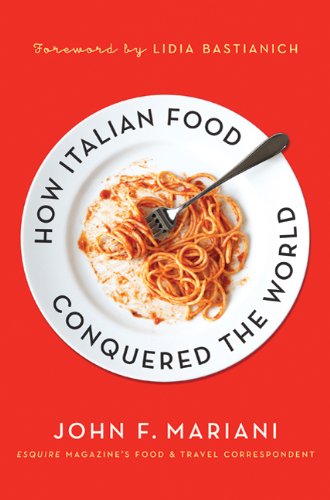
"Eating Italian will never be the same after reading John Mariani's entertaining and savory gastronomical history of the cuisine of Italy and how it won over appetites worldwide. . . . This book is such a tasteful narrative that it will literally make you hungry for Italian food and arouse your appetite for gastronomical history."--Don Oldenburg, USA Today. "Italian
restaurants--some good, some glitzy--far
outnumber their French rivals. Many of
these establishments are zestfully described
in How Italian Food Conquered the World, an
entertaining and fact-filled chronicle by
food-and-wine correspondent John F.
Mariani."--Aram Bakshian Jr., Wall Street
Journal.
"Equal parts
history, sociology, gastronomy, and just
plain fun, How Italian Food Conquered the
World tells the captivating and delicious
story of the (let's face it) everybody's
favorite cuisine with clarity, verve and
more than one surprise."--Colman Andrews,
editorial director of The Daily
Meal.com. "A fantastic and fascinating
read, covering everything from the influence
of Venice's spice trade to the impact of
Italian immigrants in America and the
evolution of alta cucina. This book will
serve as a terrific resource to anyone
interested in the real story of Italian
food."--Mary Ann Esposito, host of PBS-TV's
Ciao
Italia. "John Mariani has written the
definitive history of how Italians won their
way into our hearts, minds, and
stomachs. It's a story of pleasure over
pomp and taste over technique."--Danny Meyer,
owner of NYC restaurants Union Square
Cafe, The Modern, and Maialino.
|
 |
 |
 |
 |
 |
 |
MARIANI'S VIRTUAL GOURMET
NEWSLETTER is published weekly. Publisher: John Mariani. Editor: Walter Bagley. Contributing Writers: Christopher
Mariani, Misha Mariani, John A. Curtas, Gerry Dawes, Geoff Kalish.
Contributing
Photographer: Galina Dargery. Technical
Advisor: Gerry
McLoughlin.
If you wish to subscribe to this
newsletter, please click here: http://www.johnmariani.com/subscribe/index.html
© copyright John Mariani 2026