MARIANI’S
Virtual Gourmet
SEPTEMBER 13, 2026
NEWSLETTER
Founded in 1996
ARCHIVE

REQUIEM FOR A RESTAURANT:
THE LEGACY OF LE CIRQUE LAS VEGAS
By John A. Curtas
NEW YORK CORNER
THE WAVENY TAVERN BY PXK
By John Mariani
THE BISON
CHAPTER FORTY
By John Mariani
NOTES FROM THE WINE CELLAR
FLADGATE PARTNERSHIP DECLARES
2024 A GREAT VINTAGE PORT
By John Mariani
THE ART AND THE AGON(Y) OF TRANSLATION
By John Mariani
REQUIEM FOR A RESTAURANT:
THE LEGACY OF LE CIRQUE LAS VEGAS
By John A. Curtas
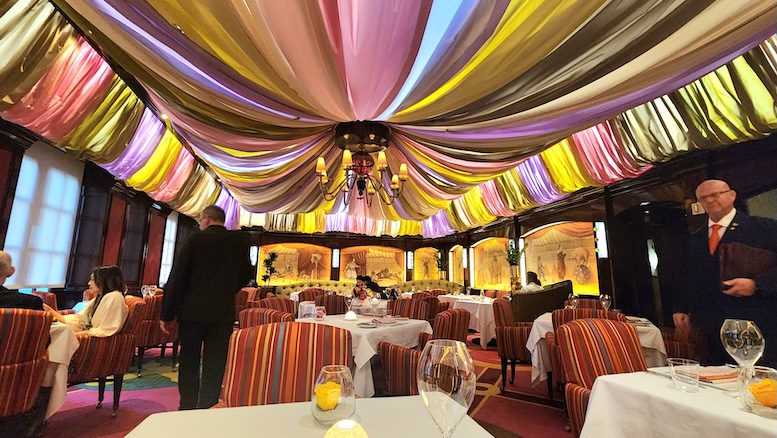
Le Cirque at
Bellagio Las Vegas was
once the most famous restaurant in America.
Such was its reputation on October 15, 1998,
when from the first pour of Perrier-Jouët it
placed our tacky gambling town on the world’s
gastronomic map. Le Cirque was a French
restaurant with an Italian soul. No matter  the
incarnation (and I was fortunate enough to eat
at the original in New
York), the menu was always decidedly haute,
while the service was anything but haughty.
(The enduring myth of imperious, snooty
service was born of the typical, tendentious
New Yorkers who love any tale, no matter how
tall, that confirms their insecurities.)
the
incarnation (and I was fortunate enough to eat
at the original in New
York), the menu was always decidedly haute,
while the service was anything but haughty.
(The enduring myth of imperious, snooty
service was born of the typical, tendentious
New Yorkers who love any tale, no matter how
tall, that confirms their insecurities.)
Our
Le Cirque never had to deal with that problem.
It was welcomed with open arms by locals and
tourists alike, who were grateful for
everything from the elegant circus tent decor,
to the jewel box setting (which flattered
everyone), to a menu which could be as simple
or extravagant as you wanted.
All
of this was overseen by the legendary Sirio
Maccioni (right, with author John
A. Curtas), who, along with his wife Egi
and three sons, brought oodles of Italian
charm to the High Mojave to match their big
city attention to detail. In those early days,
it seemed like all of them were living at
their restaurants (including the inestimable
CIRCO next door, which single-handedly made
every local Eye-talian eatery look puny by
comparison.)
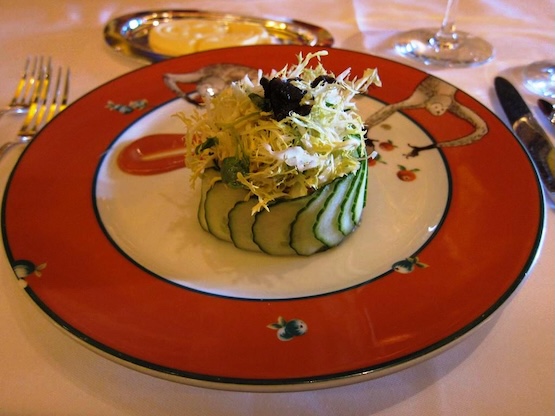
A succession of great
chefs––Mark Poidevin, David Werly, et al––came
and went, but the food never faltered, and the
service never wavered — running like a
finely-tuned watch, with a staff that has
barely changed in 28 years. But Mother Nature
and Father Time claim us all, and by 2018
(twenty years into its run), Sirio’s heart and
health were no longer in the game, and he
retired to his beloved Tuscany.
Grubby
corporate fingerprints replaced the
painstaking hands of the family, and an
absurd, obligatory tasting menu followed,
using risible amounts of caviar to justify its
larcenous prices.
Thus
did milking the old cow begin, which is
fitting because the Bellagio now
has all the charm of a stockyard, full of
compliant cattle being led to slaughter. The
restaurant is now a relic, an otiose ode to a
bygone era, where hospitality served the
client, instead of the customers serving the
spreadsheet.
No
one should be sadder than I at Le Cirque’s
demise, but watching everything I once loved
about the great restaurants of Las Vegas get
destroyed by real estate deals has robbed me
of the ability to feel sorrow.
Since
the romance I once held for this town has been
hollowed out, I shall leave you with a bit of
romantic poetry to summarize my feelings (with
apologies to William Wordsworth): I shall not
weep for thee, Le Cirque, even as I pine for
the days of splendor in the glass, of the
radiance which was once so bright, and the
glory of the flower which, now gone, will
never again be.
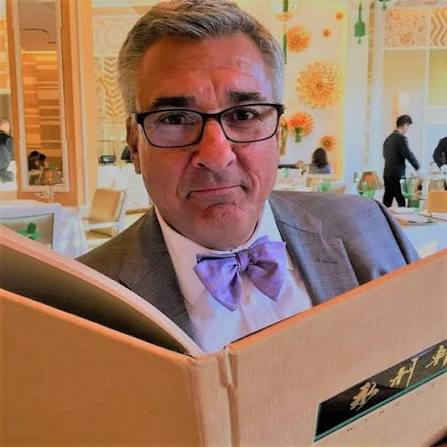
John Curtas has been
covering the Las Vegas restaurant scene
since 1995--for 15 years as a
restaurant/critic commentator on
KNPR-Nevada Public Radio and also as a
critic for Las Vegas Life, CityLife
and Las Vegas Weekly magazines. He now podcasts about the Las Vegas
restaurant scene at Eat. Talk.
❖❖❖
NEW YORK CORNER
36 Pine Street
New Canaan, CT
203-920--1414
By John Mariani
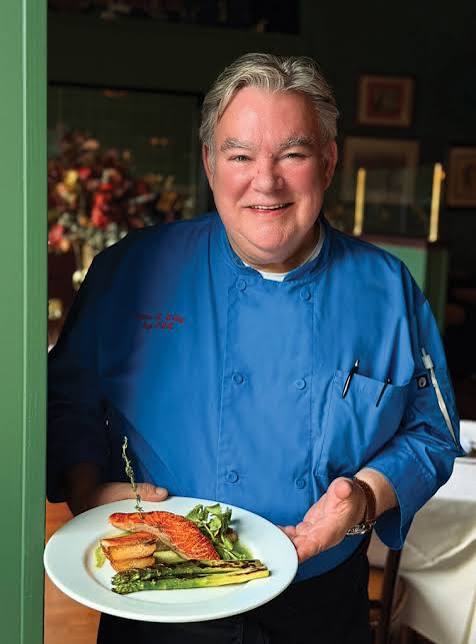
Peter X.
Kelly has for four decades been
regarded as one of the finest and most
innovative chefs in the Tristate area, first
when he distinguished himself at the fine dining
restaurant Xaviar’s in Piermont,
NY, and other upscale restaurants in
Rockland County, then for an eight-year tenure
at X20, on Yonkers’ Hudson River
waterfront. Last year he joined Basso By PXK
in Chappaqua as partner. Now this year he has
given the affluent suburb New Canaan, CT,
its best restaurant since Elm opened in
2012.
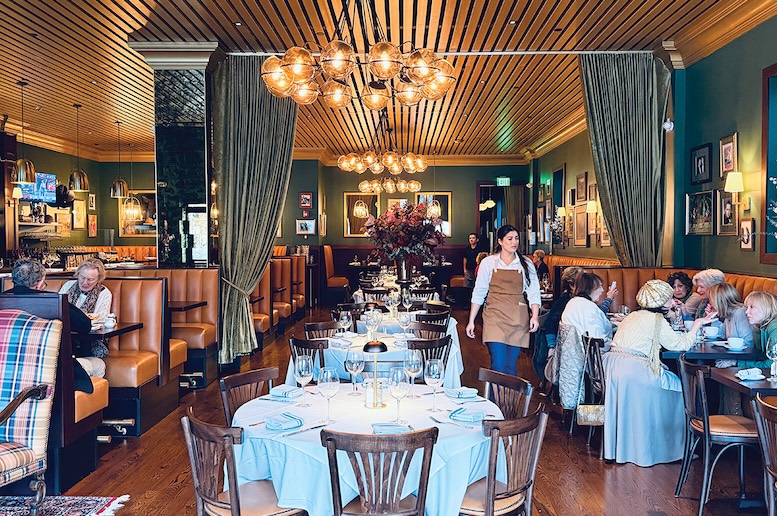
 The
space had been the handsome if predictable Waveny Polo Bar and
Grill and before that South End, and Kelly and
his operations partner Dan Camporeale, have
maintained the upholstered, clubbish look with a
grand bar, hunter green walls set with
equestrian photos, globe chandeliers and in the
dining room spacious well-set tables and roomy
banquettes, swag curtains and mahogany-colored
wooden booths.
Little details add up, like having
the service station and ice buckets
strategically within easy reach and sturdy
comfortable chairs. Tablesettings are excellent,
wine glasses thin.
The
space had been the handsome if predictable Waveny Polo Bar and
Grill and before that South End, and Kelly and
his operations partner Dan Camporeale, have
maintained the upholstered, clubbish look with a
grand bar, hunter green walls set with
equestrian photos, globe chandeliers and in the
dining room spacious well-set tables and roomy
banquettes, swag curtains and mahogany-colored
wooden booths.
Little details add up, like having
the service station and ice buckets
strategically within easy reach and sturdy
comfortable chairs. Tablesettings are excellent,
wine glasses thin.
It is the goal of every committed 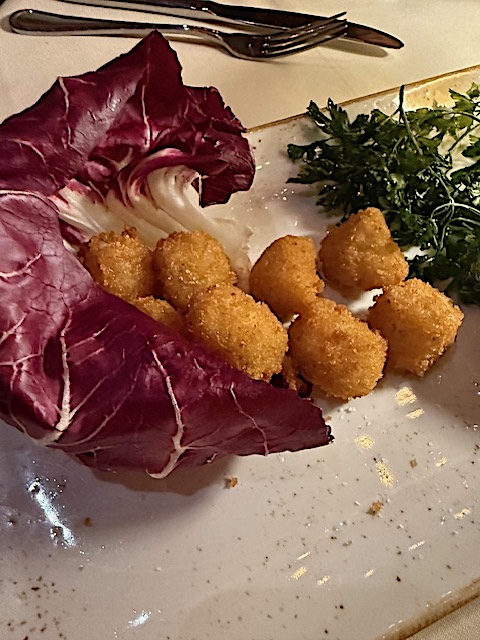 chef
to distinguish his food from others, but the
real knack is to take longstanding favorites on
the menu of the American tavern and grill and to
tweak them so as to seem brand new and so much
better. That is what Kelly is so good at: He
assesses every dish with an eye to improvement
while never betraying what makes a dish so good
to begin with.
chef
to distinguish his food from others, but the
real knack is to take longstanding favorites on
the menu of the American tavern and grill and to
tweak them so as to seem brand new and so much
better. That is what Kelly is so good at: He
assesses every dish with an eye to improvement
while never betraying what makes a dish so good
to begin with.
 As
you’ll find at Basso by PXK, pastas go beyond
the usual, and at The Waveny he makes his own tagliatelle
alla cacio e pepe but adds, Sungold
tomatoes that purists will sniff at.
As
you’ll find at Basso by PXK, pastas go beyond
the usual, and at The Waveny he makes his own tagliatelle
alla cacio e pepe but adds, Sungold
tomatoes that purists will sniff at.
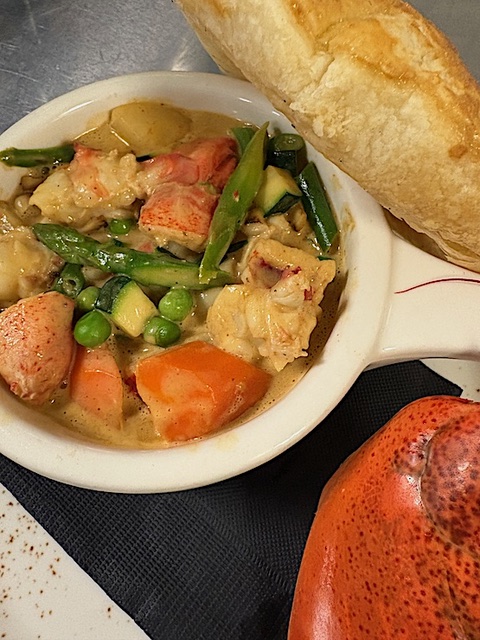
You don’t run across lobster
pot pie (left) too often, and, once
you’ve tasted Kelly’s rendition, with crispy,
golden brown pastry crust, crowded with plenty
of lobster meat, a little tarragon and
Hon-Shimeji mushrooms, you’ll wonder why not.
Among other seafood entrees,
the Alaskan black cod with tomato jam glaze,
sweet corn mousseline and green onion is a wise
combination, and while I question why Kelly puts
the ubiquitous branzino on his menu rather than
so many other species he might find in the
Atlantic waters, his version gains by being in a
vegetable, hot-and-sour broth.
He could
get away with merely serving good meat expertly
cooked, but he adds to the pleasure, as in his
beef cheeks with gremolata and grilled
trumpet 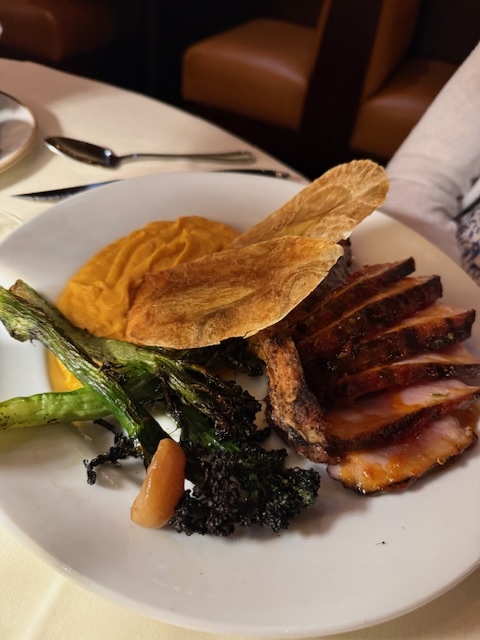 royal
mushroom and farro risotto lashed with the
meat’s braising juices. A well-fatted, massive
pork chop enjoys a fiery bite with Calabrian
chili, sided with autumnal gingered sweet
potatoes and charred broccolini.
royal
mushroom and farro risotto lashed with the
meat’s braising juices. A well-fatted, massive
pork chop enjoys a fiery bite with Calabrian
chili, sided with autumnal gingered sweet
potatoes and charred broccolini.
This is a tavern so
there’d better be a good burger on the menu, and
Kelly’s is based squarely on the quality of the
meat, not the smothering add-ons so many cooks
toss on top. His just gets good New York cheddar
and caramelized onions on a buttery brioche bun.
 Desserts
continue in line with the sumptuous degree of
the previous food, starting with a Key Lime
tartlet with buttery Graham Cracker crust and
soft cream; a satiny Belgian chocolate dome
filled with chocolate genoise and crunchy
praline (left); warm bread pudding with
crème anglaise; and a devastatingly rich sticky
toffee pudding with hazelnut ice cream.
One bite is all you need; take three.
Desserts
continue in line with the sumptuous degree of
the previous food, starting with a Key Lime
tartlet with buttery Graham Cracker crust and
soft cream; a satiny Belgian chocolate dome
filled with chocolate genoise and crunchy
praline (left); warm bread pudding with
crème anglaise; and a devastatingly rich sticky
toffee pudding with hazelnut ice cream.
One bite is all you need; take three.
The
wine list is not huge, nor need it be when it’s
so carefully chosen with such unusual bottlings;
mark-ups are on average 150%.
Price,
by the way, are a bit lower than elsewhere in
the region, with most main courses under $44.
The Waveny
Tavern by PXK is a rare thing, a dining
establishment where every detail has been
carefully thought through and registers with
equal weight, from cuisine to décor to service.
Decades in the business and the kitchen make
such a thing possible, and Kelly is right to put
“PXK” in the name.
Open
for lunch Tues.-Thurs; Brunch Fri. & Sat.;
dinner Tues-Sun.
THE BISON
By John Mariani

CHAPTER FORTY
Upon their return
to the U.S. David went to his home up
the Hudson, left things unpacked and
collapsed into bed. The exhaustion of
the plane ride and the jet lag had
worked their wiles, but he also felt
wholly drained by his experience in St.
Moritz, and he was already missing
Katie’s presence. Usually after their
adventures together he didn’t see her
for weeks as she put together her story.
Then, after the story came out and Katie
dutifully brought pre-publication copies
of the magazine up to his house, they
didn’t see each other for a while.
David didn’t exactly
enjoy feeling sorry
for
himself but it kept her clearly in his
mind’s eye. He just always wondered if
theirs really was just a professional
relationship, albeit one bound by repeated
dangers, and he reminded himself that he
and Katie had once gone to Paris for a
vacation—one that itself turned into an
adventure.
Katie, meanwhile, immediately went
to the office the next day to huddle with
McClure’s staff, detail her story,
bring a copy of her tape recordings and
start further research that included
reading over coverage in U.S. papers about
her time in St. Moritz. She really didn’t
have much time to see or think about David
in the flurry of activity to get the story
nailed down, written, fact-checked, go
through photos and art direction and all
the other rubrics of magazine publishing.
There were plenty of loose ends,
not least what would happen in the Swiss
legal system as Katie pulled together her
story. She would, of course, be putting in
phone calls to everybody she’d interviewed
before about Epstein, including Donald
Trump, Mort Zuckerman, Harvey Weinstein
and the rest, hoping for comment. Epstein
would never speak to her, but she hoped
Ghislaine Maxwell would. In fact, one of
the first calls Katie received that
morning was from her.
“Katie, it’s Ghislaine. You’re all
right?”
“I’m fine, thanks.”
“I told you Pierce is a beast and
might try something like that.”
Katie thought fast about why
Maxwell was calling her again and what to
ask her. Maxwell’s expression of sympathy
and concern was not suspect but why she
would even bother to call was. Katie
decided she had to play it along strict
journalistic lines.
“I have to ask you, Ghislaine,” she
began, “and I think you know that this is
on the record, why are you calling me?”
“I told you, I’m glad you did not
get hurt.” There was a pause, then, “I
will tell you this, off the record?”
“No, Ghislaine. That’s no longer
possible. If you don’t want me to know it
and use it don’t say it.”
Another pause. “Right,” said
Maxwell. “Then I will say what I said
before: Jeffrey believes that her death
was an accident.”
“By a drug overdose?”
“Yes, I suppose so.”
“And that it was not Angus but
Richard Pierce who was in the room with
the girl?”
“Yes. I have to tell you that I was
not there that weekend, so I can’t say
anything about what happened.”
“Well, you know, Ghislaine, that
this exposes Jeffrey to a great deal of
investigation. The police and the feds
seem to have good reason to get a court
order to get into Jeffrey’s various
properties.”
“I suppose you’re right, Katie. As
I said, I wasn’t there.”
“Ghislaine, stop being coy. You
telling me that you were always and
forever unaware of what Jeffrey and his
friends were doing? That many of these
girls were underage? And that you had
nothing to do with bringing them to
Jeffrey for sexual purposes? Across state
lines, I might add.”
“I’m not going to speak about all
that, Katie. I just wanted to tell you I
was glad you were safe and for bringing
out the truth about my father’s murder. I
guess that’s all I have to say."
Maxwell hung up. Katie pushed her
head back and said to herself, “And this
is just the beginning.”
Dobell
knew
as much, meaning that Katie’s story would
now have to focus largely on the Pierce’s
alleged murders, certainly not without
reference to their behavior in Epstein’s
properties, but it was no longer a story
about the rot and depraved Epstein
entourage. That was going to be a story
everybody in the media would be following
as it wended its way through door after
door, legal and circumstantial, across two
continents. Dobell certainly allowed that
Katie, too, should keep her nose to the
grindstone but first to write the best and
most
objective story she could about the
Pierces, given that she and David were
unwilling participants. It would be
tricky, but Katie had pulled it off
admirably with all her former stories that
involved David and her.
Katie began calling everyone she’d
previously spoken to, including those whom
David had had a closer tie to, such
as Ramona Sanchez and Vargas. She
wanted comments from all the New York
powerbrokers whom she’d interviewed during
the New York Magazine
investigation. Most said they’d all heard
of Pierce but had never met him. Those who
had said it was never at one of Epstein’s
parties. Every one of them said they were
shocked, even if the y found Pierce’s
business dealings unsavory. Only
Donald Trump seemed to defend Pierce,
saying, “I didn’t really know the guy that
well. He had a lot of money, owned a lot
of real estate—he even had a condo in my
Trump Tower—and his son Richard seemed
like a nice guy. Angus liked to play the
tough guy, but, hey, I’ll be honest with
you, all those guys they called the
‛Bisons’ weren’t playing touch football.”
David didn’t see much reason to
call Vargas but since Katie asked him to,
he did. David already knew that Vargas had
known about Sarah’s death and how he
thought that was the kind of thing that
could bring the whole house down.
“You think they goin’ to bring me
in to talk to me about this shit?” asked
Vargas.
“I can’t see how they won’t. I
don’t think you’re going to get a trip to
Switzerland out of it though,” said David.
“Switzerland? Man, that is way too
cold for a Cubano like me. I don’t like
freezin’ my balls off and drinkin’ Swiss
Miss.”
“Just play it cool with the feds
this side of the Atlantic and give them as
much material as you can. They’re not
interested in lowlife like you.”
“Then I guess bein’ a lowlife pays
off in more ways than one. The wages of
sin, man, wages of sin.”
David hated that Vargas seemed to
be getting chummy.
“Just remember, you and I may still
have a date sometime in the future. I
haven’t forgotten that spider in the box,
Vargas. I’d still like to split your head
open.”
Vargas laughed and said, “Well,
then, you just stay out of my way too. You
just an old ex-cop to me, Greco. Nothin’
to stop me from poppin’ you anytime I see
you.”
“Well, that wasn’t our agreement,
but at this point I don’t really give a
fuck.”
 Katie hated
being a minor celebrity in the glare of
the media of which she was a part. She’d
long ago tired of the “Nancy Drew”
comparison to her exploits and didn’t want
to be the focus of other reporters’
stories. She’d been through it with all
the other stories she’d written and almost
gotten killed while doing them—although
she did kind of like being called “The
Indestructible Katie Cavuto”—and
she was tired of the interruptions to her
work. These things always took about ten
days to a week until the news cycle
passed, and she was hard at work on
writing her own story and didn’t need the
interruptions.
Katie hated
being a minor celebrity in the glare of
the media of which she was a part. She’d
long ago tired of the “Nancy Drew”
comparison to her exploits and didn’t want
to be the focus of other reporters’
stories. She’d been through it with all
the other stories she’d written and almost
gotten killed while doing them—although
she did kind of like being called “The
Indestructible Katie Cavuto”—and
she was tired of the interruptions to her
work. These things always took about ten
days to a week until the news cycle
passed, and she was hard at work on
writing her own story and didn’t need the
interruptions.
Meanwhile she worked most days at
the office in concert with researchers and
the photo editor. She’d take photos along
the way of those she’d met in Florida and
St. Moritz, and if they weren’t usable the
photo department would use them to have
professional shots taken.
One afternoon the phone rang and it
was Susanna calling from Miami.
“Hey, Katie, you okay? I mean, I
heard what happened in Switzerland to you
and David.”
“We’re fine. What about you?”
“I’m good, real good. I left
Vargas. I’m out of the business. Done with
all of it. I’m gonna get my life back.”
Katie felt enormous relief to hear
what the young woman said.
“Did you break it off with Vargas?
I remember he didn’t take kindly to his
girls leaving him.”
“Oh, he was pissed, all right. We
had big fights about it. But I reminded
him of everything I knew about him and
Epstein and he backed off. Then I had
Señora Sanchez call him, and that seemed
to take the wind out him. So, I packed up
my stuff—most of which I’m getting rid of,
the whore clothes, y’know—and moved in
with a friend I know from church. Lives
off Biscayne Boulevard.”
“So what’s your plan, if I may
ask?”
“I’m not sure really. Probably get
a waitress job for the time being. What
I’d really like to do is to get a job with
social services where I can help with
other girls who’ve got dragged in. I don’t
have any degree in that, but I have a
helluva lot of professional experience.”
“That’s great to hear, Susannah. I
think you’d be terrific at it.”
“We’ll see. I know a lotta girls
who want out but, as usual, their pimps
keep them under their thumb. It’s
like a spell, really. They get taken care
of until the abuse starts, then they get
like terrified of leaving.And, Katie,
y’know what? If the police want me to
testify about anything to do with Epstein,
I’ll do it. You let them know, I’ll do it
in a heartbeat.”
“Why don’t you call them yourself?”
Susannah laughed. “A girl likes to
be asked, Katie.”
After a
week or ten days the media were on to
other news items and scandals: Italian
Prime Minister Silvio Berlusconi
(right) was charged with a bribery
scandal; British rock star Gary Glitter
was convicted of molesting eleven- and
twelve-year old girls in South Vietnam;
South African Deputy President Jacob Zuma
pleaded not guilty to a charge of rape.
And the former Vice-President of
Yugoslavia, Slobodan Milošević (below), was
found dead in his prison cell.
Silvio Berlusconi
(right) was charged with a bribery
scandal; British rock star Gary Glitter
was convicted of molesting eleven- and
twelve-year old girls in South Vietnam;
South African Deputy President Jacob Zuma
pleaded not guilty to a charge of rape.
And the former Vice-President of
Yugoslavia, Slobodan Milošević (below), was
found dead in his prison cell.
 By keeping her
focus on the Pierces, which included
plenty of connections to Epstein, Katie
was able to finish the story within three
weeks, during which David kept her up to
date on how the Palm Beach police and the
feds’
investigations were going.
Apparently the police did get access to
Epstein’s home, and the feds began looking
deeply into his financial dealings with JP
Morgan Chase. The Swiss had thus far
refused extradition of the Pierces to the
U.K. or the U.S., on the basis that the
attempted murder was entirely within their
purview.
By keeping her
focus on the Pierces, which included
plenty of connections to Epstein, Katie
was able to finish the story within three
weeks, during which David kept her up to
date on how the Palm Beach police and the
feds’
investigations were going.
Apparently the police did get access to
Epstein’s home, and the feds began looking
deeply into his financial dealings with JP
Morgan Chase. The Swiss had thus far
refused extradition of the Pierces to the
U.K. or the U.S., on the basis that the
attempted murder was entirely within their
purview.
The prospect of Katie’s article
appearing generated a good deal of media
interest, though she refused comment
until the issue was ready to hit the
stands. When it did, she agreed to appear
on CNN, MSNBC, CNBC and CBS, with David by
remote. She also did interviews with the New
York Times, the Wall Street
Journal and the London Times.
As she always had in the past,
Katie drove up to David’s house with
pre-publication copies on McClure’s
so they could go through it together. As
usual, David would prepare lunch and open
a bottle of wine, this time a sparkling
Prosecco.
“So whaddaya think?” asked Katie as
she showed David the cover, which was a
montage of photos of the Pierces, Epstein,
the St. Moritz chalet, the Palm Beach
house and the bronze bison statue. Katie
and David’s photo together was kept small,
next to their identification on the
editor’s page. They paged through the
issue slowly, finding the 7,500-word story
spread out over several pages and
continued in the back pages.
“You happy with it?” asked David.
“Pretty much so. Allen cut about a
thousand words, mostly references to
Sanchez and Susannah, but it was pretty
painless. He said he does want me to keep
my eyes open for developments in the
Epstein story, maybe as a follow-up if
he’s indicted for anything.”
“Aren’t you due for vacation time
now?”
“Oh, yeah,” said Katie. “Three
weeks on some blissful tropical island
where no one can find me. Margaritaville
and summer reading.”
“No crime novels?”
“God, no! I don’t need to be
reminded of nefarious villains trying to
kill off feisty heroines.”
David served up a plate of steaming
hot eggplant parmigiana with a green
salad, and the two of them toasted.
“To new adventures?” David offered.
“Not like the last few together. I
know I keep saying it, David, but I’m
really not looking to be a feisty heroine.
You seem to thrive on it.”
David shrugged. “I can’t say I
haven’t enjoyed our adventures together. I
got to see a lot more places than when I
was an NYPD cop, made some money from it,
and you gotta admit, we did some great
work together.”
“That we did,” Katie said. “But,
Jesus, I can’t take the stress and strain
anymore.”
David hesitated for a moment, then
asked, “You going to your tropical island
with the lawyer guy?”
Katie sighed. “No, that’s over.
He’s not going to leave Boston and I’m not
moving up there. We kind of had a fond
farewell a couple of weeks ago.”
David said, “That’s too bad.” He
cleared the table. From the sink he asked,
“So you think you’ll ever get married?”
Katie tilted her head. “Why? You
asking?”
THE
END
EPILOGUE
●
Angus and Richard
Pierce were tried in a Swiss court and
found guilty of attempted murder, and Richard
of possession of an illegal handgun. He was
sentenced to ten years imprisonment; his
father to seven. Angus served five years,
then, in 2013, was tried for the murder of
Robert Maxwell but not convicted. Also that
year, Richard was extradited to the U.S. to
face charges of manslaughter, sentenced to
eight years and was released in 2019. Both
Pierces returned to South Africa to live and
sold off most of their media holdings outside
of the country.
 ●
In
2006 the FBI
launched “Operation Leap Year” against Jeffrey
Epstein in a 53-page
indictment, identifying
36 girls,
some as young as 14 years old, whom Epstein
had sexually abused. Epstein
pleaded guilty to charges of soliciting
and procuring prostitution, and as part of his
plea deal it was agreed he would not tried for
complicity in the murder of Sarah Doyle. Also
as part of his deal, the U.S. Attorney for the
Southern District of Florida, Alexander
Acosta, squashed the FBI indictment, along
with those of four named co-conspirators and
any unnamed "potential co-conspirators." Epstein’s
lawyers included Kenn Starr and Alan
Dershowitz.
●
In
2006 the FBI
launched “Operation Leap Year” against Jeffrey
Epstein in a 53-page
indictment, identifying
36 girls,
some as young as 14 years old, whom Epstein
had sexually abused. Epstein
pleaded guilty to charges of soliciting
and procuring prostitution, and as part of his
plea deal it was agreed he would not tried for
complicity in the murder of Sarah Doyle. Also
as part of his deal, the U.S. Attorney for the
Southern District of Florida, Alexander
Acosta, squashed the FBI indictment, along
with those of four named co-conspirators and
any unnamed "potential co-conspirators." Epstein’s
lawyers included Kenn Starr and Alan
Dershowitz.
Epstein was sentenced to
only eighteen months. The judge said that
Epstein’s short sentence (he served thirteen)
was because he was told that Epstein "belonged
to [CIA] intelligence," was "above his pay
grade" and to "leave it alone."
An investigation of
Epstein’s affairs by the Palm Beach Police
stretched into 2008, when he lost a
large part of his fortune in that year’s
financial crisis. Court
documents showed that a search of Epstein's
residence by Palm Beach Police detectives
uncovered an receipt for books like SM
101: A Realistic Introduction, SlaveCraft:
Roadmaps for Erotic Servitude – Principles,
Skills and Tools and Training
with Miss Abernathy: A Workbook for Erotic
Slaves and Their Owners.
Epstein did have to register as a
sex offender and pay restitution to three
dozen victims identified by the FBI, but
instead of a
state prison where sex offenders were usually
sent, Epstein was housed in a private wing of
the Palm Beach County Stockade. After
three-and-a-half months, he was allowed to
leave the jail on "work release" for up to 12 hours a day, 6 days a week—a
privilege for which sex offenders were
supposed to be ineligible.
Epstein's cell door was
left unlocked, he had access to the attorney’s
room where a television was installed for him,
then was moved to the Stockade's previously
unstaffed infirmary and supposedly worked at
the office of a foundation he had created
shortly before reporting to jail, which he
immediately dissolved upon being released.
That office was monitored by "permit deputies"
whose overtime was paid by Epstein. They were
required to wear suits and to check in
"welcomed guests" at the "front desk.” The
guest logs were destroyed.
Epstein was allowed to use
his own driver to drive him between jail and
his office and other appointments. Upon
release he served one year under house arrest,
but while on probation made numerous trips in
his private jets to New York and the Virgin
Islands, as well as being allowed to go on
shopping trips.
After release and over the
objections of Manhattan District Attorney
Cyrus Vance Jr., Epstein had to register as a
"level three" (high risk of repeat offense) sex
offender who had to check in with the NYPD
every 90 days, but it was never enforced.
Once at liberty, Epstein
renewed his contacts and added new ones who
included Bill Gates; Barack
Obama; deputy secretary of
state William Burns; academic Noam Chomsky;
Swiss banker Ariane de Rothschild; Goldman
Sachs senior
lawyer Kathryn Ruemmler; former secretary of
the Treasury Lawrence Summers; ex-FedEx
board member and co-CEO
of Henry Kissinger’s consulting company, Joshua Cooper Ramo;
former Israeli prime minister Ehud Barak; Bard
College president Leon Botstein; and
CIA
director William Burns.
Then, on July 6, 2019,
Epstein was
arrested on federal charges, accusing
him of paying underage girls hundreds of
dollars in cash for massages and then
molesting them at his homes in Florida and New
York. The police search of
Epstein's home found two hidden cameras and
photos of girls whom the police had
interviewed in the course of their
investigation. The FBI compiled reports on
"34 confirmed minors" eligible for
restitution, while the Miami
Herald identified
about 80 victims and located about 60 of
them.
After his conviction,
Epstein arrived at the Metropolitan
Correctional Center and spent 22 hours in the
jail’s general population before officials
moved him to the special housing unit because
of his notoriety. He was upset about wearing
an orange jumpsuit and being treated “like a
bad guy.”
Medical records showed he was
suffering from sleep apnea, constipation,
hypertension, lower back pain and
prediabetes and had been previously treated
for chlamydia. He signed up for a kosher
meal.
Over the
next 36 days Epstein tried to connect by mail
with another high-profile pedophile: Larry
Nassar, the U.S. gymnastics team doctor
convicted of sexually abusing scores of female
athletes, but the letter was never sent out by
the prison.
On August
8, Epstein bought $73.85 worth of items from
the prison commissary, including an AM/FM
radio and headphones. He had $566 left in his
account.
Placed on
suicide watch, he was reported “sitting at the edge
of the bed, lost in thought, with his head
against the wall.” The next day he excused himself from
a meeting with his lawyers to make a
telephone call to his mother, who had been
dead for 15 years.
The next
day, August 10,
he was found hanged in his cell. The
medical examiner ruled it a suicide. Though
suspicions and conspiracy theories were rife
about his death, a Justice Department
investigation showed that the guards had been
seriously derelict in their oversight of the
prisoner, concluding that these blunders
essentially created a situation where he “was
provided with the opportunity to take his own
life.”
 ● A
year later, Ghislaine Maxwell was
charged with sex crimes, having helped recruit
the underage girls that Epstein sexually abused
and that she sometimes participated in the abuse
herself. On December 30, 2021 she was found
guilty and sentenced to 20 years in prison.
After Trump’s election in 2024, the Justice
Department moved Maxwell to a minimum security
prison for reasons never explained. Her
attempts to have her case overturned have been
unsuccessful.
● A
year later, Ghislaine Maxwell was
charged with sex crimes, having helped recruit
the underage girls that Epstein sexually abused
and that she sometimes participated in the abuse
herself. On December 30, 2021 she was found
guilty and sentenced to 20 years in prison.
After Trump’s election in 2024, the Justice
Department moved Maxwell to a minimum security
prison for reasons never explained. Her
attempts to have her case overturned have been
unsuccessful.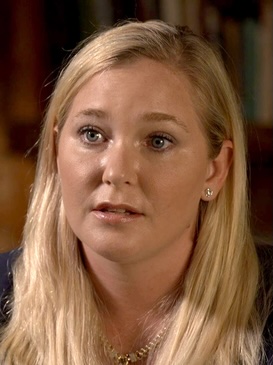 ● In
2021 Virginia Giuffre brought
a case against Prince Andrew under
New York’s Child Victims Act, filing a civil
action to
show
“all perpetrators of abuse should be held
accountable.” Prince Andrew settled the case
out of court for
at least
$13 million
and was barred from any official duties by the
Royal Family. Giuffre
died by suicide at her home Neergabby,
Australia, on April 25, 2025, at the age
of 41. Giuffre's
father alleged that "somebody got to her."
● In
2021 Virginia Giuffre brought
a case against Prince Andrew under
New York’s Child Victims Act, filing a civil
action to
show
“all perpetrators of abuse should be held
accountable.” Prince Andrew settled the case
out of court for
at least
$13 million
and was barred from any official duties by the
Royal Family. Giuffre
died by suicide at her home Neergabby,
Australia, on April 25, 2025, at the age
of 41. Giuffre's
father alleged that "somebody got to her."
●
In 2013 Staley left JP Morgan Chase to
become CEO of London-based bank Barclays,
which fired him in 2021 after British banking regulators
raised questions about how he had
characterized his relationship with
Epstein. In November, 2022 women who say
they were abused by Epstein filed class
actions against JP Morgan Chase and Deutsche
Bank, alleging
that the banks provided financial services to
Epstein that allowed him to operate his
sex-trafficking ring. They said the banks did
so “knowing they would earn millions of
dollars” from their relationship with Epstein
and chose to put “profits over the law.” In
2023 court filings claimed that JP
Morgan
had allegedly paid for Staley’s trips to meet
Epstein and that the bank maintained
accounts for “all the girls and women publicly
alleged in 2006 to be recruiters, accomplices
or victims” of Epstein. It allegedly opened an
account for a woman brought to the US in her
teens whom Epstein was reported to call his “Yugoslavian
sex slave.”
● In May
2023 Deutsche
Bank AG agreed to pay $75 million to settle
the Jane
Doe lawsuit. The
following month, JP Morgan Chase agreed to
pay $290 million to settle, saying, “We all
now understand Epstein’s behavior was
monstrous, and we believe this settlement is
in the best interest of all parties,
especially the survivors, who suffered
unimaginable abuse at the hands of this
man.”
 ●
In
May, Jamie Dimon, CEO of JP Morgan
Chase, which had severed ties with Epstein in
2013, was
deposed. “I
don’t recall knowing anything about Jeffrey
Epstein until the stories broke sometime in
2019,”said Dimon, “and I was surprised that I
didn’t even — had never even heard of the guy,
pretty much. And how involved he was with so
many people.” Yet in 2023 Staley testified that
he told Dimon about Epstein’s misconduct as
early as 2006.
●
In
May, Jamie Dimon, CEO of JP Morgan
Chase, which had severed ties with Epstein in
2013, was
deposed. “I
don’t recall knowing anything about Jeffrey
Epstein until the stories broke sometime in
2019,”said Dimon, “and I was surprised that I
didn’t even — had never even heard of the guy,
pretty much. And how involved he was with so
many people.” Yet in 2023 Staley testified that
he told Dimon about Epstein’s misconduct as
early as 2006. 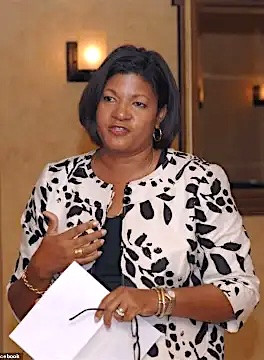 The bank
also alleged in a court filing that Cecilie
de Jongh, wife of the U.S. Virgin
Islands’ former governor, and
other officials in the territory had helped
Epstein dodge sex offender laws and helped him
procure his alleged victims. The suit
alleged that she “drove donations from
Epstein to support her husband and allies,”
and that he also paid her $200,000 in 2007
alone for management work at his companies
and paid the school tuition the governor’s
children, the bank claimed in its filing. In June,
2023, JP Morgan agreed to pay $290 million
to the nearly 200 victims of a class action
suit against Epstein. In September, JP
Morgan agreed to pay $175 million in
penalties for
The bank
also alleged in a court filing that Cecilie
de Jongh, wife of the U.S. Virgin
Islands’ former governor, and
other officials in the territory had helped
Epstein dodge sex offender laws and helped him
procure his alleged victims. The suit
alleged that she “drove donations from
Epstein to support her husband and allies,”
and that he also paid her $200,000 in 2007
alone for management work at his companies
and paid the school tuition the governor’s
children, the bank claimed in its filing. In June,
2023, JP Morgan agreed to pay $290 million
to the nearly 200 victims of a class action
suit against Epstein. In September, JP
Morgan agreed to pay $175 million in
penalties for  “enabling
Jeffrey Epstein’s sex trafficking.”
“enabling
Jeffrey Epstein’s sex trafficking.”
In
addition the Virgin Islands sued billionaire
investor Leon Black, who had been
fired as CEO of Apollo Global Management in
2021, and
reached a settlement of $62.5 million (without
admitting guilt) of facilitating Epstein’s sex
trafficking. Black had paid Epstein $$158
million for “financial
advisory
services”
through an entity called Southern
Trust, operated out of a marina on St. Thomas.
 ● After
Epstein’s indictments, Les Wexner cut off
all ties to him, and in 2020 stepped down as CEO of
Victoria’s Secret’s parent company L Brands amid
criticism for his previous connection to
Epstein. In a complaint filed by shareholders,
Wexner was accused of fostering an “entrenched
culture of misogyny, bullying and harassment.”
● After
Epstein’s indictments, Les Wexner cut off
all ties to him, and in 2020 stepped down as CEO of
Victoria’s Secret’s parent company L Brands amid
criticism for his previous connection to
Epstein. In a complaint filed by shareholders,
Wexner was accused of fostering an “entrenched
culture of misogyny, bullying and harassment.”● Jean-Luc Brunel, head of MC2 Model Management
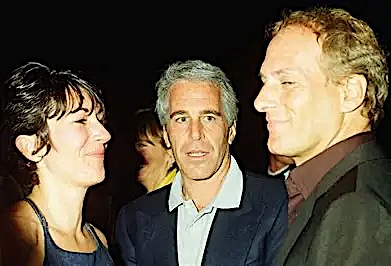 funded
by Epstein was accused of sex trafficking and
was arrested in 2020 and charged with the rape
of minors by French prosecutors after he went
into hiding. Brunel died from an apparent
suicide before his trial began.
funded
by Epstein was accused of sex trafficking and
was arrested in 2020 and charged with the rape
of minors by French prosecutors after he went
into hiding. Brunel died from an apparent
suicide before his trial began.
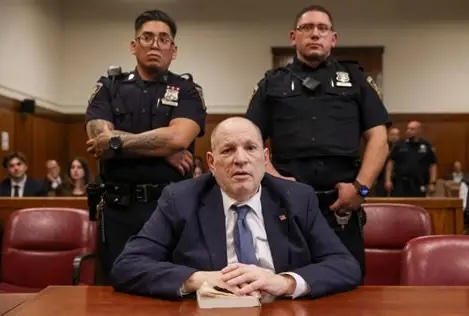 ●
Following
allegations by more than 80 women of rape and
sex abuse dating back three decades, Harvey
Weinstein was dismissed
from his own company, Miramax, and
expelled from the Academy of Motion Picture
Arts and Science. The allegations led to the
beginning of the #MeToo movement to hold
powerful sexual predators to account. He was
arrested and charged with rape in New York in
2018 and found guilty of two of five felonies and
sentenced to 23 years in prison. He was
extradited to Los Angeles to face further
charges and was sentenced to 16 years, to be
served separately from his New York sentence.
●
Following
allegations by more than 80 women of rape and
sex abuse dating back three decades, Harvey
Weinstein was dismissed
from his own company, Miramax, and
expelled from the Academy of Motion Picture
Arts and Science. The allegations led to the
beginning of the #MeToo movement to hold
powerful sexual predators to account. He was
arrested and charged with rape in New York in
2018 and found guilty of two of five felonies and
sentenced to 23 years in prison. He was
extradited to Los Angeles to face further
charges and was sentenced to 16 years, to be
served separately from his New York sentence.
●
Upon
Epstein’s 2019 arrest, Alexander Acosta resigned as Labor
Secretary under Donald Trump amid public
outrage over his role in the initial
investigation.
 ●
Having
received $150,000 for the college from one
of Epstein’s charitable foundations, Leon
Botstein, president of Bard College,
told the New York Times he didn’t
regret it, saying, “People don’t understand
what this job is. You cannot pick and
choose, because among the very rich is a
higher percentage of unpleasant and not very
attractive people. Capitalism is a rough
system.”
●
Having
received $150,000 for the college from one
of Epstein’s charitable foundations, Leon
Botstein, president of Bard College,
told the New York Times he didn’t
regret it, saying, “People don’t understand
what this job is. You cannot pick and
choose, because among the very rich is a
higher percentage of unpleasant and not very
attractive people. Capitalism is a rough
system.”
 ●
In
2016 Donald Trump became President of
the United States. In 2019 he said, "I
knew [Epstein]like everybody in Palm
Beach knew him," but contended he
had not seen him or been in contact for
years after finding out about his alleged
sex crimes. In 2023 a jury found Trump
guilty of defaming a woman named E. Jean
Carroll, who had ccused him of rape. Trump
was ordered to pay $5 million to Carroll.
●
In
2016 Donald Trump became President of
the United States. In 2019 he said, "I
knew [Epstein]like everybody in Palm
Beach knew him," but contended he
had not seen him or been in contact for
years after finding out about his alleged
sex crimes. In 2023 a jury found Trump
guilty of defaming a woman named E. Jean
Carroll, who had ccused him of rape. Trump
was ordered to pay $5 million to Carroll.
In 2025 the Democrats
in the U.S. House of Representatives
demanded release of all FBI files on
Epstein, and although millions of
documents were turned over, millions more
were not and are still being kept from
scrutiny. As of 2026 the U.S. Justice
Department under Attorney General Pam
Bondi (who was fired) and her successor
Todd Blanche never interviewed most of
Epstein's accusers.
❖❖❖
NOTES FROM THE WINE CELLAR
FLADGATE PARTNERSHIP DECLARES
A 2024 VINTAGE FOR ALL ITS PORTS
By John Mariani
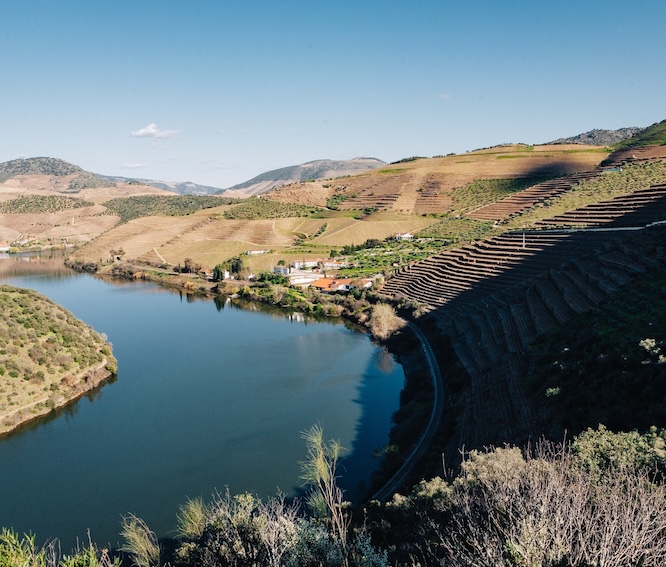
The Douro River Valley, Portugal
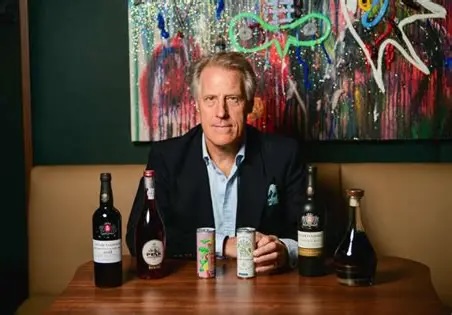
Portugal's reputation for wines has always been based on the eminence of Port, beginning in the 17th century, with the most eminent of all being vintage Ports, declared only a few times in any decade. The 2024 vintage, now in bottle, has been declared thus far by The Fladgate Partnership under the houses Taylor's, Fonseca, Croft and Quinta do Portal, all made in the Douro Valley. To find out why 2024 was so exceptional and what the current market conditions for Port––whose producers create a bewildering number of non-vintage styles––are as consumption, tastes and climate are in such flux, I interviewed Adrian Bridge, CEO of The Fladgate Partnership.
Q: Tell me the clear definition of what
Vintage Port is and why it is not made in every
vintage, as with other wines?
Vintage Port is the finest
expression of a single harvest and represents the
very highest level of quality a Port house can
produce. The important distinction is that we do not
make a classic Vintage Port every year. We only
declare when the wines have the concentration,
structure, balance and ageing potential to represent
the house at its very best. If the quality is not
there, we simply do not declare.
Once declared, Vintage Port
spends only a relatively short period in wood,
usually around two years, before being bottled,
where it can continue to develop for many decades.
That combination of exceptional quality, very
limited production and longevity is what makes
Vintage Port unique.
Q: What are the
conditions and metrics that made Fladgate declare
a 2024 vintage?
There is no formula, and
there is certainly no single number that tells us to
declare a Vintage. Ultimately, you taste the wines
and ask whether they have the quality and balance to
become great Vintage Ports and to represent their
respective houses for generations.
In 2024, the winter provided very
good water reserves, which were particularly
important for the vineyards. We then had a warm
growing season followed by a cooler harvest period.
Those conditions allowed the grapes to achieve
excellent maturity while retaining freshness and
acidity.
What impressed us most was the
combination of purity of fruit, structure, fine
tannins, freshness and balance. Just as important,
the individual character of our three houses is very
clear in the wines. Taylor’s tastes like Taylor’s,
Fonseca like Fonseca and Croft like Croft. For us,
that is always an important part of a great
declaration.
Q: Why doesn’t every Port
producer and competitor declare a vintage in any
given year? This is the first time in seven years
that all of yours were declared. Is it likely that
all the producers will for 2024?
Every Port house makes its
own decision. There is no committee that tells us
when to declare, and there is no obligation for
producers to agree with one another. That
independence is an important part of the tradition.
What makes 2024 particularly significant is that it
has become the first general declaration of Vintage
Port since 2017, with the majority of the leading
Douro houses deciding independently that the quality
justified a declaration. For us, it is also the
first time since 2017 that Taylor’s, Fonseca and
Croft have all declared classic Vintage Ports from
the same year. And these are exceptionally small
releases. We produced only 5,000 nine-liter cases of
Taylor’s, 3,900 of Fonseca and 1,600 of Croft. We
would always rather produce less wine at the quality
we expect than increase volumes simply because there
is demand for it.
Q: Why was 2024 such a
small vintage?
Because only a very small
proportion of the wines met the standard we require
for classic Vintage Port. A Vintage declaration is a
qualitative decision, not a commercial one. Once we
have identified the very best wines, that determines
the quantity available – not the other way
around. These are exceptionally small
quantities, which makes 2024 one of the rarest
releases we have made. That scarcity is
genuine. You cannot manufacture more Vintage Port
after the harvest has passed.
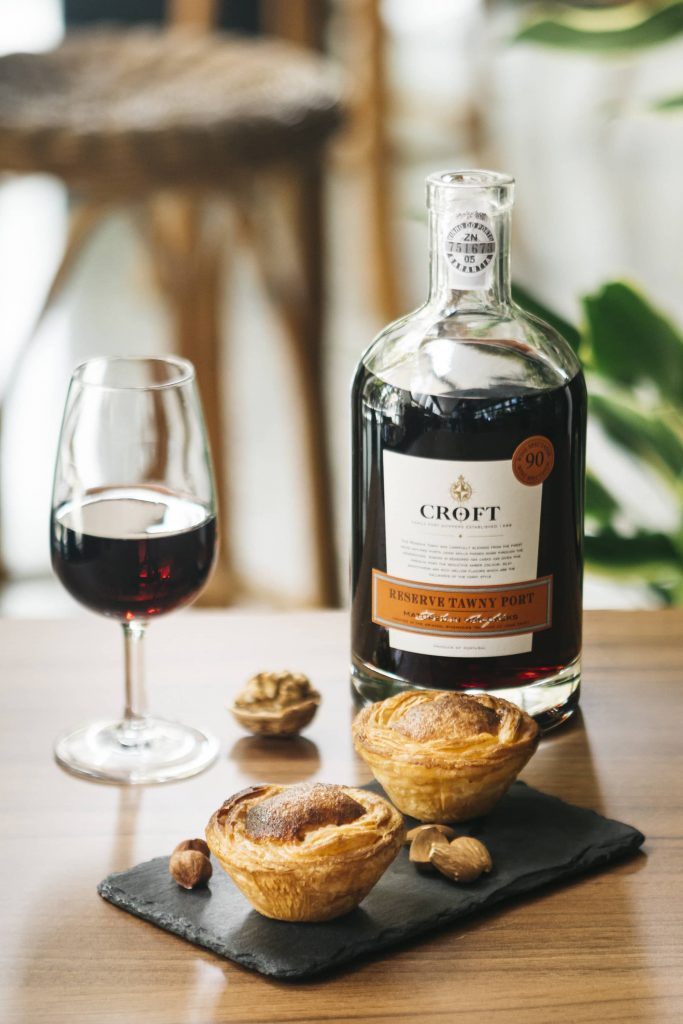
Q: What is the point of
having so many styles of Port that can confuse the
potential customer, including Ruby, Tawny,
Vintage, Vintage Reserve, Colheita, Late Bottled
Vintage, Vintage Character, Single-Quinta Vintage,
Crusted and Garrafeira, as well as producer names
such as Founder’s Reserve, Hunting Port and Silval
Vintage?
I would turn the question
around. One of Port's great strengths is precisely
its diversity.You do not need to understand every
classification before you can enjoy Port, any more
than you need to understand every appellation in
France before drinking a glass of wine.
There are essentially different
styles for different occasions. Ruby Ports emphasize
youthful fruit. Aged Tawnies develop complexity
through long ageing in seasoned oak casks. LBV gives
you much of the depth and character of a single
harvest but is ready to drink when released. Vintage
Port is the pinnacle – made in exceptional years and
capable of ageing for generations.
Then you have White Port, which
can be served chilled or in a Porto Tónico, and Rosé
Port, which has opened up completely different
drinking occasions. Our responsibility as producers
is not to eliminate that diversity. It is to make
the category easier to navigate.
Q: Of these Port styles
above, which are the best-selling?
It varies considerably by
market. In the United States, Ruby and Aged Tawny
are particularly important parts of our portfolio.
Fonseca Bin 27 has introduced generations of
American consumers to Port, while Taylor Fladgate 10
and 20 Year Old Tawny are very strong performers.
LBV is also an important category for Taylor’s
internationally. What is interesting is that these
different styles provide different entry points into
Port. Someone might first discover Port through an
LBV, an Aged Tawny or even a Porto Tónico and later
become interested in Vintage Port. There is no
single journey into the category anymore, and I
think that is a positive thing.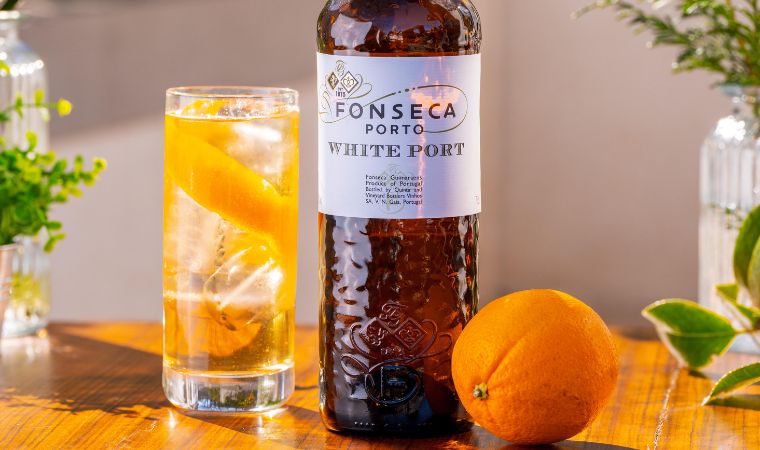
Q: Is there still a big
market for Vintage Port? What are the largest
importers?
Yes, although Vintage Port
has never been about volume. It is a fine wine with
limited production, and that is how we should think
about it. The United Kingdom and the United States
remain two of our most important international
markets. But the audience for fine Port today is
genuinely global, encompassing established
collectors as well as consumers discovering Vintage
Port through fine wine merchants, restaurants,
travel and visits to Portugal. Portugal itself has
also changed enormously as a market and as a
showcase for Port. The growth of tourism in Porto
and the Douro means that millions of international
visitors can now experience Port where it is made,
understand the landscape and meet the people behind
it. That is extraordinarily valuable for the
category. What gives me confidence is that Vintage
Port offers something increasingly rare in the
modern wine world: authenticity, extraordinary
longevity, provenance and genuine scarcity.
Q: Wine and spirits
consumption has been dropping for several years,
and even top Sauternes and German sweet wines have
a problem selling their wines. What marketing
plans do you have for increasing public
perception?
We cannot pretend that
drinking habits are not changing. They are. People
are drinking less, but many are also drinking better
and becoming more interested in authenticity,
provenance and experience. That can actually work in
Port's favour. Our job is not to persuade somebody
to drink Port every day. It is to make Port relevant
to more occasions and to make it easier for people
to discover. That means continuing to invest in
education and experiences in Porto and the Douro,
bringing consumers closer to the vineyards and the
history behind the wines. It also means showing the
breadth of the category, from a chilled White Port
or Porto Tónico before dinner to an Aged Tawny by
the glass, an LBV with cheese or a great Vintage
Port shared at the end of a meal.
At the same time, we should not
modernize Port by removing what makes it special.
More than three centuries of history, extraordinary
vineyards, traditional winemaking and wines capable
of ageing for generations are tremendous
assets. The opportunity is to make those
traditions relevant to today's consumer rather than
trying to reinvent them.
Q: How has climate
affected the vineyards?
The most obvious change is
greater variability. We have always worked in a
demanding region, but today we need to think even
more carefully about water management, vineyard
exposure, soil health, biodiversity and the timing
of the harvest. The Douro is fortunate because it
has enormous diversity, different altitudes,
exposures, grape varieties and vineyard sites, and
that gives us important tools with which to adapt.
In 2024, good winter water reserves were extremely
important, followed by a warm growing season and
then cooler conditions during harvest, which helped
us retain freshness and achieve balanced ripening.
We have to think in generations.
Some of our vineyards have been producing
extraordinary wines for centuries, and our
responsibility is to ensure that they can continue
to do so for the next 50 or 100 years.

Q: Should Port producers
try to get away from the dated image of a man
sitting before the fireplace with his hound,
drinking a glass of Port?
I have nothing against the
man, the fireplace or indeed the hound! The problem
is only if that becomes the single image people have
of Port. There will always be a place for the
ceremony of opening and decanting a great Vintage
Port and sharing it after dinner. That tradition is
part of Port's appeal, and we should not be
embarrassed by it. But Port has many other
lives.
The Porto Tónico is a very good
example. White Port, tonic and citrus make a
wonderfully refreshing aperitif, and it has been
enjoyed in Portugal for generations. You can drink
it on a terrace in Porto, beside the sea or with
friends before dinner.
So I don't think we need to
replace the fireplace. We simply need to show that
Port also belongs on the terrace.
❖❖❖
AGON(Y) OF TRANSLATION
“Poetry is what
gets lost in translation.”––Robert
Frost
By John Mariani
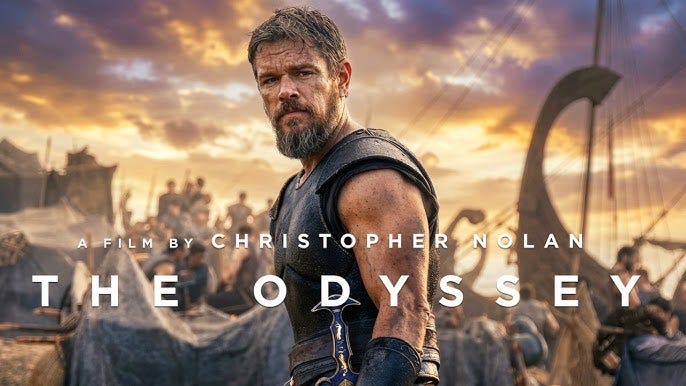
It’s a little late
to join the debate over the merits and demerits of
Christopher Nolan’s film The Odyssey, but
while my own criticism of the work is more
dramatic and cinematic than academic, I begrudge
no filmmaker or any artist the right to create his
own vision of a work by an author(s) about which
we know nothing and about events that never
happened to characters who never existed. The
Odyssey is a grand, rollicking fairy tale,
as appropriate for entertaining a royal court as
around a campfire, and it was not even written
down in Greek until the Greeks developed an
alphabet in the 8th century BCE. The
earliest manuscript dates to the 3rd
century, when a Roman dramatist Livius Andronicus
translated it into Latin.
 For hundreds of years
the poem was transmitted orally by singers who had
no text to guide their memory. Later, libraries
might own either or both “city editions” and
“individual editions” used as school texts. Copy
editors were few and far between in those days to
make sure every word was correct.
For hundreds of years
the poem was transmitted orally by singers who had
no text to guide their memory. Later, libraries
might own either or both “city editions” and
“individual editions” used as school texts. Copy
editors were few and far between in those days to
make sure every word was correct.
The Byzantines used a Greek version, but
the Renaissance Europeans had better access to
Latin translations, which were then translated
into German (1537) and English (1616), in iambic
pentameter, as opposed to the original’s dactylic
hexameter. Since then, various authors––not always
Greek language scholars––provided new versions to
suit their times:  Alexander
Pope’s in rhymed heroic couplets (1725-6) was very
much in the aura of the English Enlightenment,
while others cast the 12,000-line poem into prose.
Some are literal, word for word, others fanciful,
many pedantic. As contemporary British scholar
Edith Hall warned the reader, “Be wary of translators,
convinced that they understand the moral outlines
of the story and have often imposed meanings of
their own.”
Alexander
Pope’s in rhymed heroic couplets (1725-6) was very
much in the aura of the English Enlightenment,
while others cast the 12,000-line poem into prose.
Some are literal, word for word, others fanciful,
many pedantic. As contemporary British scholar
Edith Hall warned the reader, “Be wary of translators,
convinced that they understand the moral outlines
of the story and have often imposed meanings of
their own.”
Of recent translations of The Odyssey,
the 2020 rendition by Emily Wilson (below)
has garnered the most praise both for its
exactitude and for its readability. Indeed, I’ve
found it very enjoyable reading, despite the
hundreds of references to obscure gods and their
spawn, the lines racing along as, I’m told, the
original poem must have. It was certainly not a stodgy poem––one critic of
the wildly popular version translated by Pope (and
assistants) described it as “Homer in a powdered
wig declaiming in a baroque theater.” Compare
Pope’s opening lines
It was certainly not a stodgy poem––one critic of
the wildly popular version translated by Pope (and
assistants) described it as “Homer in a powdered
wig declaiming in a baroque theater.” Compare
Pope’s opening lines
The man for
wisdom’s various arts renown’d,
Long exercised in woes, O Muse! resound;
Who, when his arms had wrought the destined fall
Of sacred Troy, and razed her heaven-built wall,
Wandering from clime to clime, observant
stray’d,
Their manners noted, and their states survey’d,
On stormy seas unnumber’d toils he bore,
Safe with his friends to gain his natal shore:
. . . with
Wilson’s:
Tell me about
a complicated man.
Muse, tell me
how he wandered and was lost
when he had
wrecked the holy town of Troy,
and where he
went, and who [sic] he met,
the pain
he suffered
on the sea, and how he worked
to save his life and bring his men back home.
The plot and sentiments are the same in
W.D. Rouse’s prose translation (1937), though in
his first lines, the Muse is never even mentioned:
“This is the story of a man, one who was never at
a loss.” Prosaic
it most certainly is. For The Odyssey is
not just a collection of ripping yarns full of
strange goddesses and Greek revelers. It is a
poem, rich in its imagery, rolling in its cadence
and truly meant to be sung, with its repeated
Homeric epithets like “wine-dark sea,”
“rosy-fingered Dawn” (below, by Guido Remi)
and “earth-shaking Poseidon,” precisely as folk
balladeers would repeat “old man winter,” Robin
Hood’s “merrie men” and “snow white breast.”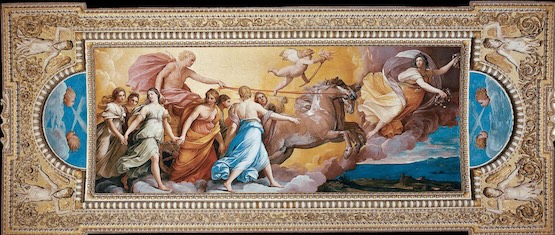
Translating is damn difficult. The idea
that a translation of any kind can be accurate and
at the same time express all the nuances,
connotations and denotations, as well as the sound
of an original text seems highly improbable. In
even the simplest English slang, say, “Isn’t she a
crackerjack?” the reference is only clear to an
American of a certain age who knows the
connotation of “crackerjack,” as well as
appreciating those "k" sounds. A “cuppa” coffee
has its own sound, while substituting “java” or
"Joe” for “coffee” needs more than a one-word
translation to provide the meaning, as do other
slang terms like “mud,” “rocket fuel,” “jitter
juice,”  “unleaded,” “fix” and “brain
juice.” Footnotes may explain the meaning but the
actual translation does not. The French “jus de
nervosité” for “jitter juice” sounds just
plain ridiculous, as does the Italian for “a cuppa
rocket fuel”: “Una tazza di carburante per
razzi.” How does one translate Cockney slang
like “trouble and strife” for “wife” into Chinese?
“unleaded,” “fix” and “brain
juice.” Footnotes may explain the meaning but the
actual translation does not. The French “jus de
nervosité” for “jitter juice” sounds just
plain ridiculous, as does the Italian for “a cuppa
rocket fuel”: “Una tazza di carburante per
razzi.” How does one translate Cockney slang
like “trouble and strife” for “wife” into Chinese?
The
Judaeo-Christian Bible, aside from its own
standing as edifying fiction, is rife with textual
errors and misinterpretations. First written down
in Hebrew and Aramaic, it was translated into
Koine Greek, Roman Latin and, since then, a
hundred other languages. Mistakes abound: In Genesis,
the Hebrew word tsela was long translated
as “rib,” as in “Adam’s rib”; but the word more  frequently means “side”
or the whole body. The Hebrew “almah” means
a young woman of child-bearing age, not, as in
early Greek, Parthenos, for “virgin.” And
despite Yam Suph being translated as “Red
Sea,” the term actually means “reed sea,” which
the Israelites might have crossed, had they ever
been captive in Egypt, which they were not.
frequently means “side”
or the whole body. The Hebrew “almah” means
a young woman of child-bearing age, not, as in
early Greek, Parthenos, for “virgin.” And
despite Yam Suph being translated as “Red
Sea,” the term actually means “reed sea,” which
the Israelites might have crossed, had they ever
been captive in Egypt, which they were not.
The
Romance Languages (French, Italian, Portuguese,
Spanish, Romanian) offer another hurdle because
most words end in a vowel, as do Federico Garcia
Lorca's surrealistic lines from Romance
Sonámbulo: "Verde que te quiero verde,"
whose translation as "Green, how I want you
green" sounds like something Kermit the Frog
would croon.
The finest translation (2024)
of Dante's Tuscan tongue used in his Divina
Commedia is by Michael Palma (himself a
published poet), who not only maintains the
original's terza rima scheme (invented by Dante
for the poem) but artfully captures the voluptuous
sound and majesty of the poetry throughout the
entire Inferno, Purgatorio and Paradiso.
As Palma writes of the text, "With the Inferno
we are dealing not with a mere fourteen lines
[of a sonnet] but with forty-seven hundred, in a
book-length poem that not only tells a vivid,
intricate story but also engages religion,
morality, history, politics, myth, philosophy,
psychology, and the author-protagonist's
personal experiences," and he admits that an
"ideal translation is, of course, impossible. . .
. In practical terms, my approach means that every
problem of translation must be solved not by the
unflinching imposition of some abstract theory or
principle, but by the immediate needs, in context,
of that particular moment of the poem." No one
said it would be easy.
Any poet
can rhyme and make music, but great poets help
create a new language, not least Shakespeare, who
added 1,700 words to English, including
“alligator,” “bedroom,” “downstairs,” “gossip,”
“kissing,” “zany” and “skim milk,” which in
Turkish is “yağsiz süt.”
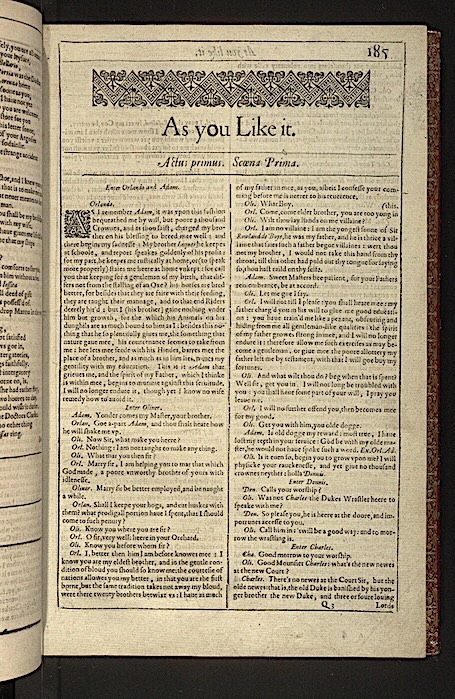 Elizabethan
puns are barely understood by English readers
today and, for that, not very funny. And anyone
with a scholarly edition of Shakespeare’s works
could spend an equal amount of time reading the
gloss of what words were erroneously copied down
from various early editions. In As
You Like It, whose text is considered
largely uncorrupted in the First Folio, there were
still plenty of printer’s errors that later
scholars sought to correct by conjecture: “Shew”
or “shoe,” “whooping” or “hooping,” “wearing” or
“wearying,” “swoon” or “sound.”
Elizabethan
puns are barely understood by English readers
today and, for that, not very funny. And anyone
with a scholarly edition of Shakespeare’s works
could spend an equal amount of time reading the
gloss of what words were erroneously copied down
from various early editions. In As
You Like It, whose text is considered
largely uncorrupted in the First Folio, there were
still plenty of printer’s errors that later
scholars sought to correct by conjecture: “Shew”
or “shoe,” “whooping” or “hooping,” “wearing” or
“wearying,” “swoon” or “sound.”
The more deliberately personalized or
obscure a poet gets, like Gertrude Stein, whose
cinematic word play by frame-by-frame repetition
(“A rose is a rose is a rose”), becomes all the
more puzzling in another language. What does
one make of so many of Ezra Pound’s 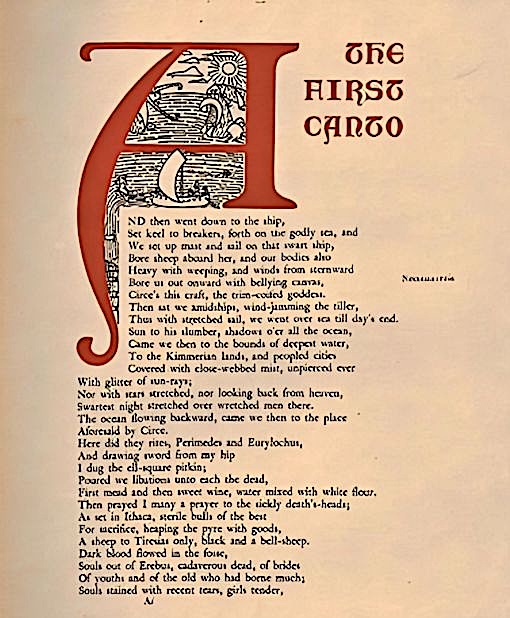 Cantos
that play with syntax, onomatopoeia, esoterica and
Asian ideograms––as well as foreign languages
within the text––that are hard enough to decipher
in English let alone Czech? Four scholars worked
for years to assemble a 332-page Annotated
Index to the Cantos, containing 17,000
explications of words, foreign phrases and “other
exotica” of the first 88 Cantos, which
explains the references but doesn’t consider the
poem’s esthetic elements any more
than identifying the figures on the Sistine Chapel
ceiling explains
Michelangelo’s genius as a painter.
Cantos
that play with syntax, onomatopoeia, esoterica and
Asian ideograms––as well as foreign languages
within the text––that are hard enough to decipher
in English let alone Czech? Four scholars worked
for years to assemble a 332-page Annotated
Index to the Cantos, containing 17,000
explications of words, foreign phrases and “other
exotica” of the first 88 Cantos, which
explains the references but doesn’t consider the
poem’s esthetic elements any more
than identifying the figures on the Sistine Chapel
ceiling explains
Michelangelo’s genius as a painter.
I have never peeked into any translations
of James Joyce’s deliberately enigmatic dream poem
Finnegans Wake (1922-39), because I am
incapable of reading the original’s 628 pages of English
text, whose first page contains this:
“The
fall
(bababadalgharaghtakamminarronnkonnbronntonner-
ronntuonnthunntrovarrhounawnskawntoohoohoordenenthur-
nuk!) of a
once wallstrait oldparr is retaled early
in bed and later
on life down
through all christian minstrelsy. The great
fall of the offwall entailed at such short notice the pftjschute of
Finnegan, erse solid man, that the humptyhillhead
of
humself prumptly sends
an unquiring one
well to the west in quest of his
tumptytumtoes:
and their upturnpikepointandplace is at the knock out in the park
where oranges have been laid
to rust upon
the green since dev-
linsfirst
loved livvy.”
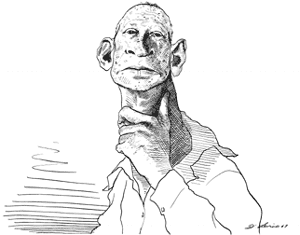 So, too, how
does one translate E.E. Cummings (left),
whose jewel-like poems seem strung together with
silken strings, tumbling, breaking off, ramming
into each other within white space, seeming to
come from outside the poem and still causing
pleasure to those open to both the sound and
sight:
So, too, how
does one translate E.E. Cummings (left),
whose jewel-like poems seem strung together with
silken strings, tumbling, breaking off, ramming
into each other within white space, seeming to
come from outside the poem and still causing
pleasure to those open to both the sound and
sight:
in Just-
spring
when
the world is mud-
luscious the little
lame balloonman
whistles
far
and wee
and eddieandbill come
running from marbles and
piracies and it's
spring
when the world is puddle-wonderful
the queer
old balloonman whistles
far
and
wee
and bettyandisbel come dancing
from hop-scotch and jump-rope and
it's
spring
and
the
goat-footed
balloonMan
whistles
far
and
wee
Emily
Dickinson crafted elliptical miracles with phrases
like “Hope is the thing with feathers,” which is
easy to translate literally, but she gave her
words layered meanings, like “Eden is that
old-fashioned house” 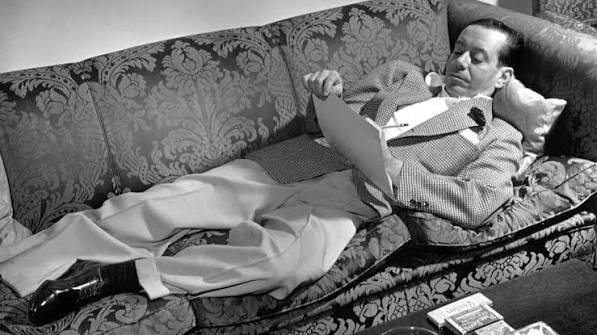 and “Forever is composed of Nows.”
And
how does a translator hope to cope with lines'
meaning, brilliant rhymes, rat-a-tat melodic sound
and placement within the verses of so many of Cole
Porter's songs. One would have to be a certain age
simply to get the preponderance of wink-wink jokes
in “You’re the Top,” released in 1934 when many of
the references were wholly contemporary, like
Mickey Mouse, Jimmy Durante and Boulder Dam (which
was then still under construction).
You're
the top
You're Mahatma
Gandhi
You're the top
You're
Napoleon brandy
You're the purple
light of a summer night in Spain
You're the National
Gallery, you're
Garbo's salary
You're cellophane
You're sublime
You're a turkey
dinner
You're the time
Of the Derby
winner
I'm a toy balloon
that's fated soon to pop
But if, baby, I'm
the bottom
You're the top
 You're the top!
You're the Colosseum
You're the top
You're the Louvre Museum.
You're a melody
from a symphony by Strauss
You're a Bendel
bonnet,
A Shakespeare
sonnet,
You're Mickey
Mouse.
You're the Nile,
You're the Tower
of Pisa,
You're the smile
on the Mona Lisa
I'm a worthless
check, a total wreck, a flop,
But if, baby, I'm
the bottom you're the top!
You're the top!
You're an Arrow
collar
You're the top!
You're a Coolidge
dollar,
You're the nimble
tread of
the feet of Fred Astaire,
You're an O'Neill
drama,
You're Whistler's mama!
You're
Camembert.
You're a rose,
You're Inferno's Dante,
You're the
nose
On the great Durante.
I'm just in the way,
As the French would say, "De trop.”
But if, baby, I'm the bottom,
You're the top!
You're the top!
You're a dance in Bali.
You're the top!
You're
a hot tamale.
You're an angel, you,
Simply too, too, too diveen,
You're a Botticelli,
You're Keats,
You're Shelley!
You're Ovaltine!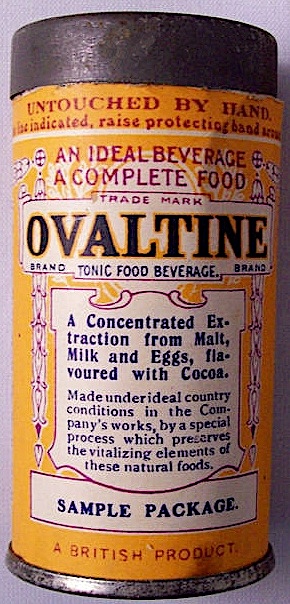
You're a boon
You're the dam at Boulder,
You're the moon over Mae West's shoulder,
I'm the nominee of the G.O.P.
But
if, baby, I'm the bottom,
You're the top!
You're the top!
You're a Waldorf salad.
You're the top!
You're a Berlin ballad.
You're the boats that glide
On the sleepy Zuider Zee,
You're an old Dutch master,
You're Lady Astor,
You're broccoli!
You're romance,
You're the steppes of Russia,
You're the pants, on a Roxy usher,
I'm a broken doll, a fol-de-rol, a blop,
But if, baby, I'm the bottom you're the top!
First lines of poems and novels
are, obviously, extremely important to set the
tone of an entire work,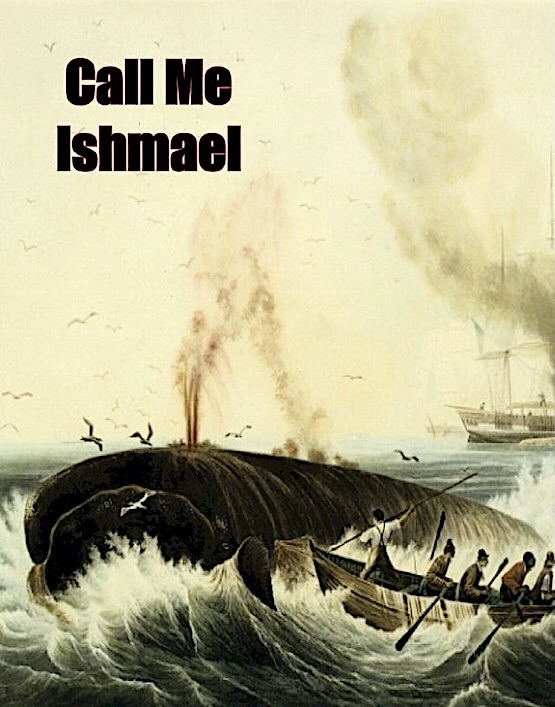 but how does one translate the
oddly haunting sonority and
tone of “Call me Ishmael” in Moby Dick
into Japanese ("Ishumēru to yonde kure ishuma")
or Cambodian ("haw khnhom tha ai sme")?
Indeed, arguments about how to give weight to a
single word have long gone on about the first line
of Albert Camus’ The Stranger: “Maman
est morte aujourdhui. Ou peut-être hier, je ne
sais pas.” Is it an unemotional reaction? Or
a simple statement of fact? Or so shocking that
the narrator can barely speak? What should the
right word be for “Maman” be? “Mother”
(Stuart Gilbert); “Maman” (Matthew Ward). “Mom” or
“Mommy?”
but how does one translate the
oddly haunting sonority and
tone of “Call me Ishmael” in Moby Dick
into Japanese ("Ishumēru to yonde kure ishuma")
or Cambodian ("haw khnhom tha ai sme")?
Indeed, arguments about how to give weight to a
single word have long gone on about the first line
of Albert Camus’ The Stranger: “Maman
est morte aujourdhui. Ou peut-être hier, je ne
sais pas.” Is it an unemotional reaction? Or
a simple statement of fact? Or so shocking that
the narrator can barely speak? What should the
right word be for “Maman” be? “Mother”
(Stuart Gilbert); “Maman” (Matthew Ward). “Mom” or
“Mommy?”
As
Ryan Bloom wrote of the quandary, “There is little
warmth, little bond or closeness or love in
‘Mother,’ which is a static, archetypal term, not
the sort of thing we use for a living, breathing
being with whom we have close relations. To do so
would be like calling the family dog ‘Dog’ or a
husband ‘Husband.’ The word forces us to see
Meursault [the
narrator] as distant from the woman who bore him.”
Perhaps the truest irony about translation is in the announcement by Emily Wilson, who has sold a million copies of her Odyssey, that she is about to undertake a second translation of the poem from scratch, “using somewhat more lines than the original, enabling more varied word-length and pacing. Also, I’ll have much more extensive end notes.” Wilson's announcement sounds as if like she has more marketing in the back of her mind rather than any radical alterations, but many scholars become obsessed with their subjects and spend their entire lives issuing volume after volume about writers about whom there is little left to be said, such as John Keats, Ernest Hemingway and Leo Tolstoy. It is worth asking, can a translator easily become a fanatic who, in the words of George Santayana, “redoubles his effort when he has forgotten his original aim?”
 One of the
most famous opening lines in literature is in
Tolstoy's Anna Karenina (1878), which
several eminent Russian-language expert translate
as “Happy families are all
alike; every unhappy family is unhappy in its own
way,” but modern translator Marian Schwartz
renders the line as
One of the
most famous opening lines in literature is in
Tolstoy's Anna Karenina (1878), which
several eminent Russian-language expert translate
as “Happy families are all
alike; every unhappy family is unhappy in its own
way,” but modern translator Marian Schwartz
renders the line as
However useful and fine any translation can
be, we may get a facsimile of the poem while the
poetry eludes all but those who read the original
text. We may
get the gist in a prose rendition, but in any
translation what you see is what you get, with
only a hint at what the poet aimed for. 
Perhaps the most
salient example of the ambiguity of a single word
is the famous
and hilarious story of American General Anthony
McAuliffe (right) of the 101st
Airborne Division during the Battle of the Bulge
in December 1944, when he responded to a
demand from German Major Henke to surrender by
sending a capitalized, one word response: “NUTS!”
Upon receipt Henke asked his subordinates what it
meant, not knowing if the reply was affirmative or
negative. A fast-thinking German-speaking G.I.
responded, “Du kanst zum Teufel gehen”––“You
can go to hell.” The meaning was then clear but
came nowhere near the colloquial kinetic punch of
what McAuliffe actually said.
❖❖❖

STRIKE UP THE BAND AND
GET THE BUG SPRAY!
"There is a
particular frequency at which the trellis wire
thrums when it is prodigiously and promiscuously
laden with fruit and bounces to the afternoon winds
racing in from the Bay. This
frequency: of the night earth exhaling and of the
birds cavorting in the canopy and the scritching of
the bugs catching the light as the sun’s long
shadows devolve to the blackness of the star-flecked
bowl. So
too, the metallic pitch of fluorescent lights
exploding over the wine aisle and the demo table in
the local big box store. Triad.”––Steven Kent
Mirassou, “”Wine Music,” Wine Saves Lives. Com.
❖❖❖
Any of John Mariani's books below may be ordered from amazon.com.
 The Hound in Heaven
(21st Century Lion Books) is a novella, and
for anyone who loves dogs, Christmas, romance,
inspiration, even the supernatural, I hope you'll find
this to be a treasured favorite. The story
concerns how, after a New England teacher, his wife and
their two daughters adopt a stray puppy found in their
barn in northern Maine, their lives seem full of promise.
But when tragedy strikes, their wonderful dog Lazarus and
the spirit of Christmas are the only things that may bring
his master back from the edge of despair.
The Hound in Heaven
(21st Century Lion Books) is a novella, and
for anyone who loves dogs, Christmas, romance,
inspiration, even the supernatural, I hope you'll find
this to be a treasured favorite. The story
concerns how, after a New England teacher, his wife and
their two daughters adopt a stray puppy found in their
barn in northern Maine, their lives seem full of promise.
But when tragedy strikes, their wonderful dog Lazarus and
the spirit of Christmas are the only things that may bring
his master back from the edge of despair. WATCH THE VIDEO!
“What a huge surprise turn this story took! I was completely stunned! I truly enjoyed this book and its message.” – Actress Ali MacGraw
“He had me at Page One. The amount of heart, human insight, soul searching, and deft literary strength that John Mariani pours into this airtight novella is vertigo-inducing. Perhaps ‘wow’ would be the best comment.” – James Dalessandro, author of Bohemian Heart and 1906.
“John Mariani’s Hound in Heaven starts with a well-painted portrayal of an American family, along with the requisite dog. A surprise event flips the action of the novel and captures us for a voyage leading to a hopeful and heart-warming message. A page turning, one sitting read, it’s the perfect antidote for the winter and promotion of holiday celebration.” – Ann Pearlman, author of The Christmas Cookie Club and A Gift for my Sister.
“John Mariani’s concise, achingly beautiful novella pulls a literary rabbit out of a hat – a mash-up of the cosmic and the intimate, the tragic and the heart-warming – a Christmas tale for all ages, and all faiths. Read it to your children, read it to yourself… but read it. Early and often. Highly recommended.” – Jay Bonansinga, New York Times bestselling author of Pinkerton’s War, The Sinking of The Eastland, and The Walking Dead: The Road To Woodbury.
“Amazing things happen when you open your heart to an animal. The Hound in Heaven delivers a powerful story of healing that is forged in the spiritual relationship between a man and his best friend. The book brings a message of hope that can enrich our images of family, love, and loss.” – Dr. Barbara Royal, author of The Royal Treatment.
 |
The Encyclopedia of American Food and Drink by John F. Mariani (Bloomsbury USA, $35) Modesty forbids me to praise my own new book, but let me proudly say that it is an extensive revision of the 4th edition that appeared more than a decade ago, before locavores, molecular cuisine, modernist cuisine, the Food Network and so much more, now included. Word origins have been completely updated, as have per capita consumption and production stats. Most important, for the first time since publication in the 1980s, the book includes more than 100 biographies of Americans who have changed the way we cook, eat and drink -- from Fannie Farmer and Julia Child to Robert Mondavi and Thomas Keller. "This book is amazing! It has entries for everything from `abalone' to `zwieback,' plus more than 500 recipes for classic American dishes and drinks."--Devra First, The Boston Globe. "Much needed in any kitchen library."--Bon Appetit. |
"Eating Italian will never be the same after reading John Mariani's entertaining and savory gastronomical history of the cuisine of Italy and how it won over appetites worldwide. . . . This book is such a tasteful narrative that it will literally make you hungry for Italian food and arouse your appetite for gastronomical history."--Don Oldenburg, USA Today. "Italian
restaurants--some good, some glitzy--far
outnumber their French rivals. Many of
these establishments are zestfully described
in How Italian Food Conquered the World, an
entertaining and fact-filled chronicle by
food-and-wine correspondent John F.
Mariani."--Aram Bakshian Jr., Wall Street
Journal.
"Equal parts
history, sociology, gastronomy, and just
plain fun, How Italian Food Conquered the
World tells the captivating and delicious
story of the (let's face it) everybody's
favorite cuisine with clarity, verve and
more than one surprise."--Colman Andrews,
editorial director of The Daily
Meal.com. "A fantastic and fascinating
read, covering everything from the influence
of Venice's spice trade to the impact of
Italian immigrants in America and the
evolution of alta cucina. This book will
serve as a terrific resource to anyone
interested in the real story of Italian
food."--Mary Ann Esposito, host of PBS-TV's
Ciao
Italia. "John Mariani has written the
definitive history of how Italians won their
way into our hearts, minds, and
stomachs. It's a story of pleasure over
pomp and taste over technique."--Danny Meyer,
owner of NYC restaurants Union Square
Cafe, The Modern, and Maialino.
|
 |
 |
 |
 |
 |
 |
MARIANI'S VIRTUAL GOURMET
NEWSLETTER is published weekly. Publisher: John Mariani. Editor: Walter Bagley. Contributing Writers: Christopher
Mariani, Misha Mariani, John A. Curtas, Gerry Dawes, Geoff Kalish.
Contributing
Photographer: Galina Dargery. Technical
Advisor: Gerry
McLoughlin.
If you wish to subscribe to this
newsletter, please click here: http://www.johnmariani.com/subscribe/index.html
© copyright John Mariani 2026