THIS WEEK
SEGOVIA
By John Mariani
NEW YORK CORNER
CHADA
By John Mariani
THE BISON
CHAPTER ONE
By John Mariani
NOTES FROM THE WINE CELLAR
WINE OF THE YEAR
By John Mariani
SEGOVIA
By John Mariani
Every
great city can be evoked by songs and music
associated with it––“La Vie
en Rose” with Paris, “A
Nightingale Sang in Berkeley Square” with
London, and, of course, “I Left My Heart in
San Francisco”––so to listen to Spanish guitar
music by
the master Andrés Segovia (though he was
actually born in Linares) is to be suffused
with the heart and soul of the city of Segovia
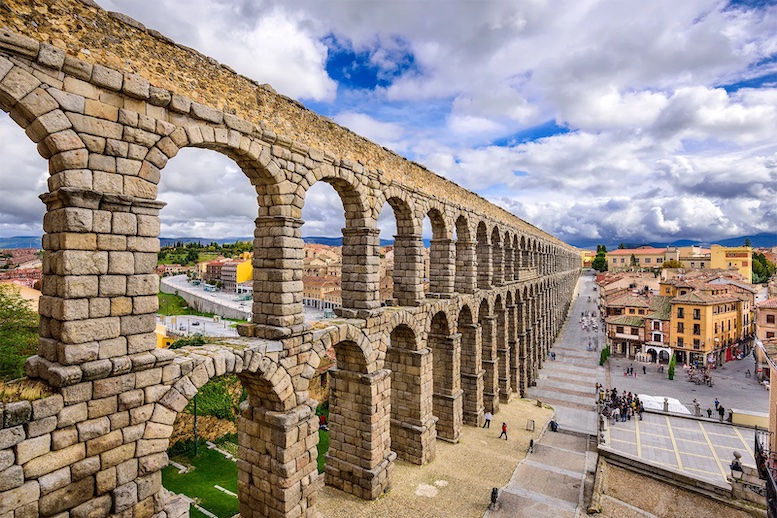
in central Spain. Sitting in the Plaza del Azoguelo in front of its
extraordinary Roman Aqueduct, dating back
2,000 years, and hearing the music of flamenco
or Spanish composers like Torroba, Mompou and
Albénez played by a street musician is a
unique experience. The
Aqueduct’s 170 arches consists of 25,000
granite blocks held together without mortar.
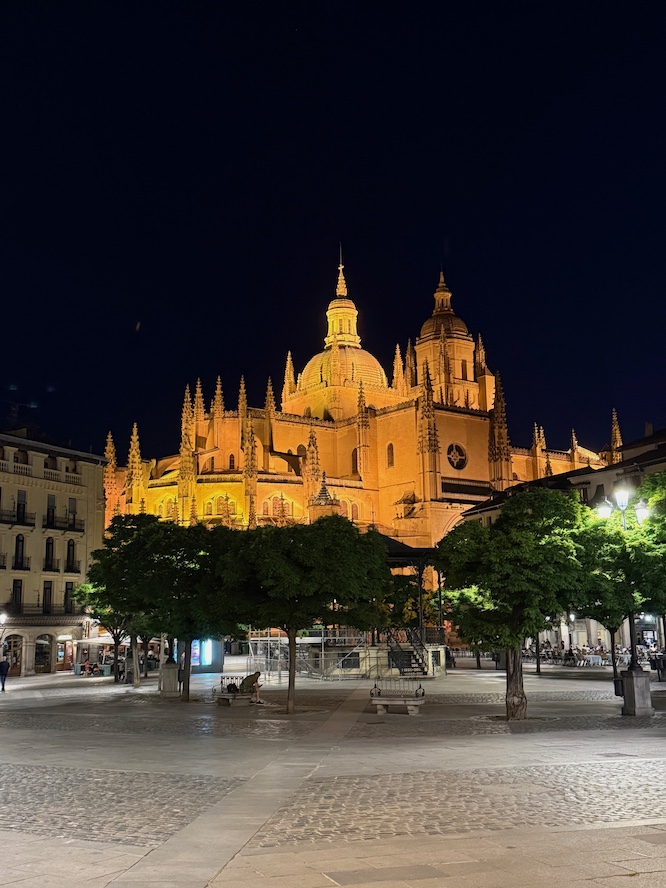 The
city of Segovia is not large, but its old town
was declared a UNESCO World
Heritage
Site in 1985. Its cathedral is one of the last
of the great Gothic churches built in the late
Middle Ages, and its Alcázar palace and
fortress in the Romanesque has its own stolid
magnificence.
The
city of Segovia is not large, but its old town
was declared a UNESCO World
Heritage
Site in 1985. Its cathedral is one of the last
of the great Gothic churches built in the late
Middle Ages, and its Alcázar palace and
fortress in the Romanesque has its own stolid
magnificence.
It is an enchanting city to walk around, with
two curving avenidas encircling the town, and
there are many excellent restaurantes serving
traditional Castillian food at La Portada de
Mediodia in a 16th century post house as well
as modern cuisine at Villena in a former
convent.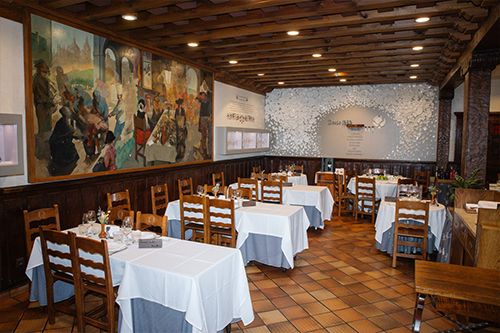
On a
recent trip this year I dined at two large
restaurantes known for their conviviality and
extensive menus. One was José Maria (Cronista
Lecea 11), an asador (grill
restaurant) whose suckling pigs come from the
owners’ family farm. Opened in 1982 by José
Maria Ruiz and his daughter Rocio, the
restaurant has eight dining rooms that have
been sound-proofed so the noise is kept to a
minimum, and they boast of having a
defibrillator in premises “becoming
a
cardioprotected space and honouring the
health of its clients and employees.”
José Maria is himself an accomplished wine
expert, so his 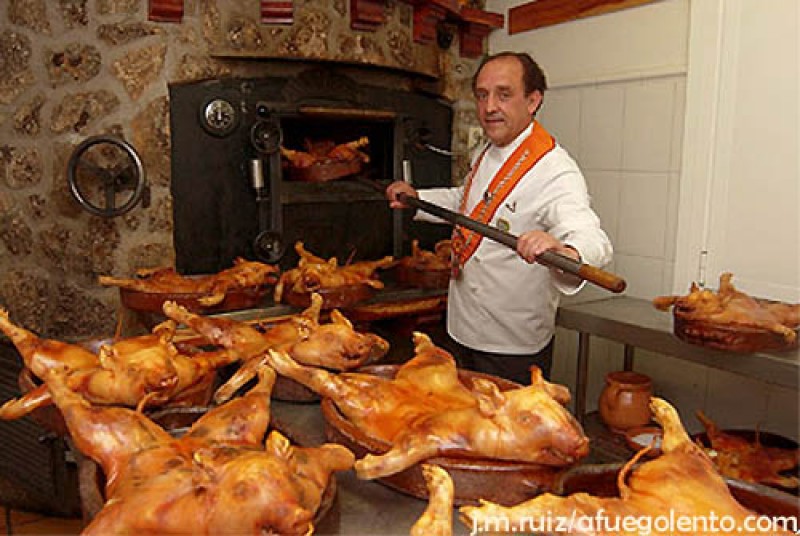 cellar is
full of the best Iberian bottlings, and Rocio
manages the family’s winery, named Pago de
Carravejas.
cellar is
full of the best Iberian bottlings, and Rocio
manages the family’s winery, named Pago de
Carravejas.
Of
course, I ordered the cochinilla suckling
pig, which was superb, seasoned only with salt
and pepper and deliberately never served with
a sauce, which would compromise the pure
flavors of the flesh, the fat and the crisp
skin. I began with crispy, piping hot ham
croquettes, and a “farmer’s tasting platter”
of charcuterie then a main course of marinated
partridge
with endives. A
friend ordered rare beef sirloin with foie
gras that had been marinated in Port wine. The
prices for main courses range from 24.50€ to
36€.
An
equally convivial spot is  El
Bernardino (Cervantes 2),
founded in 1939 by D. Mariano del Pozo Manso (right).
It’s a beautiful restaurant, civilized but
very friendly, with beige and white linens on
spacious tables, a carved timbered ceiling and
parquet floors, with the Segovian sun
streaming through its large windows.
El
Bernardino (Cervantes 2),
founded in 1939 by D. Mariano del Pozo Manso (right).
It’s a beautiful restaurant, civilized but
very friendly, with beige and white linens on
spacious tables, a carved timbered ceiling and
parquet floors, with the Segovian sun
streaming through its large windows.
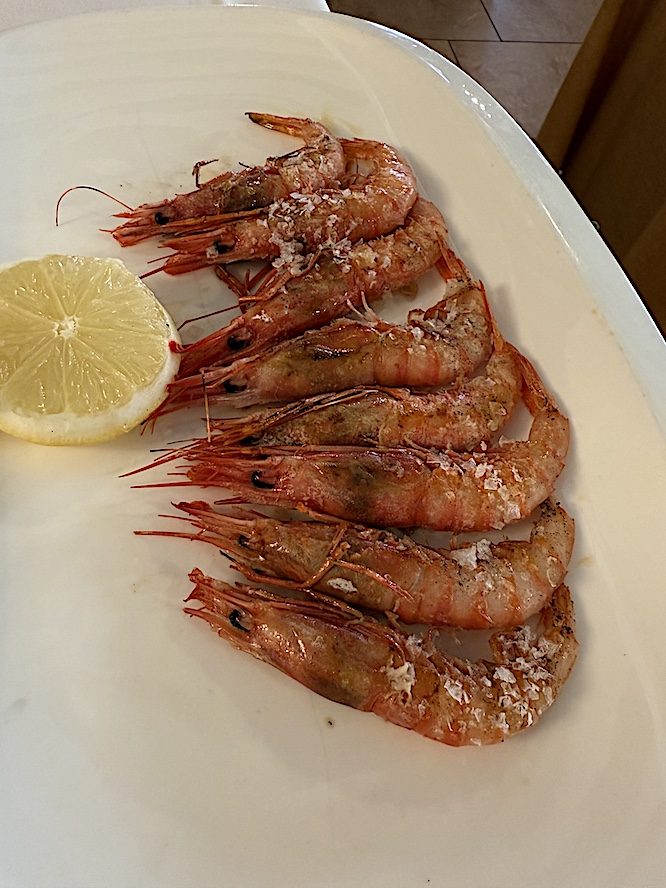 There
is both a tapas menu and a more comprehensive
dining room menu from which I chose a dish of
mushrooms in puff pastry and a plate of simply
grilled sweet red shrimp, then followed with
suckling pig––this time fried––and succulent
roast lamb. For dessert we enjoyed the
cheesecake with mixed fruit marmalade. Main
courses run 25.50€ to 50€. There are four set
menus of several courses, from 43€ to 58€.
There
is both a tapas menu and a more comprehensive
dining room menu from which I chose a dish of
mushrooms in puff pastry and a plate of simply
grilled sweet red shrimp, then followed with
suckling pig––this time fried––and succulent
roast lamb. For dessert we enjoyed the
cheesecake with mixed fruit marmalade. Main
courses run 25.50€ to 50€. There are four set
menus of several courses, from 43€ to 58€.
NEW YORK CORNER
646-370-6366
By John Mariani
As I faced the façade of the new Chada
restaurant, I realized it was once Da Silvano, the quintessential West
Village trattoria once embraced by the art
gallery and fashionistas. They’ve reproduced
the bright yellow awning, but now, I entered
into a restaurant named after the bejeweled
gold crowns ceremoniously worn by women in
Thailand.
 The
room
is sectioned in two, with one a handsome bar
featuring a wide array of specialty cocktails; the
other is done with pretty floral wallpaper, brass
motifs, carved wood and sculptural chandeliers.
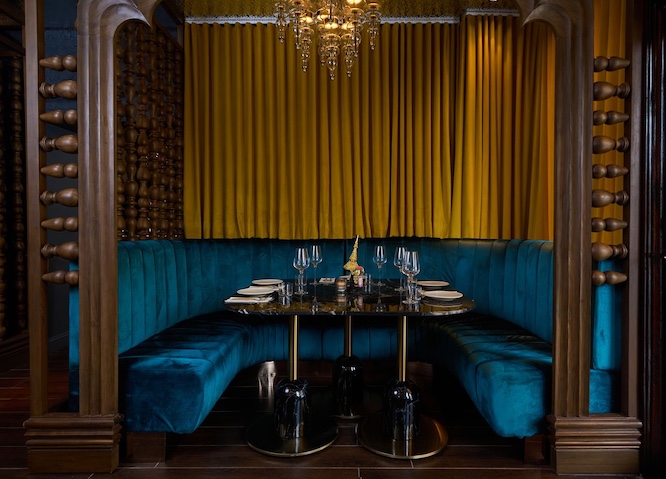
There is also a delightful semi-enclosed booth
with emerald green seating and black marble
tables. The noise level is fine.
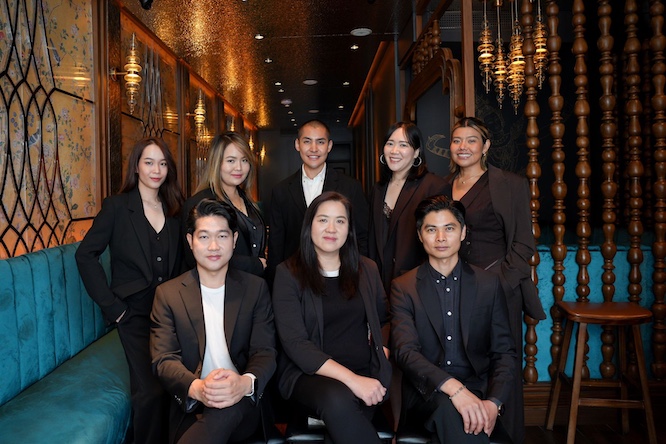
The booth in the photo is a real delight if you
can ask for it in advance.
The
room
is sectioned in two, with one a handsome bar
featuring a wide array of specialty cocktails; the
other is done with pretty floral wallpaper, brass
motifs, carved wood and sculptural chandeliers.
There is also a delightful semi-enclosed booth
with emerald green seating and black marble
tables. The noise level is fine.
The booth in the photo is a real delight if you
can ask for it in advance.
Rarely have I encountered a more cordial and
appealing staff. Everyone from hostess to waiter
smiles and in greeting you and at
evening’s end, 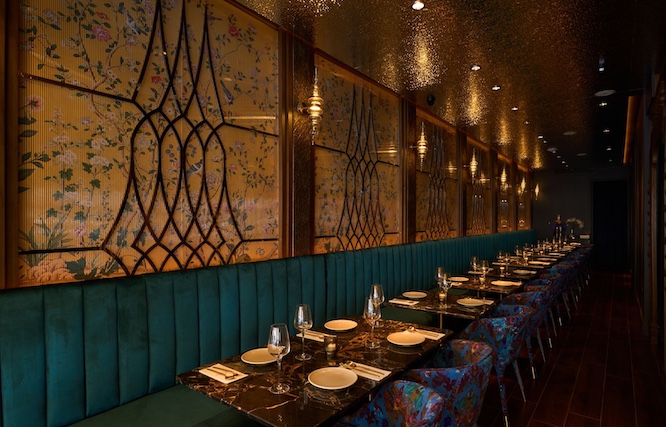 they all say
thank you so much for coming and seem genuinely
sad to see you leave.
they all say
thank you so much for coming and seem genuinely
sad to see you leave.
Two chefs with extensive
experience in Thai cuisine own Chada: Jade
Thipruetree, from Khon Kaen in the north,
came to New York six years ago and made his mark
at the much applauded
Tongin Brooklyn; Siripat Khaengkarn (“Chef Tom”) is from
Bangkok and spent time training in New Zealand and
Australia, before settling in New York to lead the
kitchens at Soothr, Sappe, Somtum Der
and Spice.
 Chada they focus on more
innovative dishes that are so much more exciting
than usual.
Chada they focus on more
innovative dishes that are so much more exciting
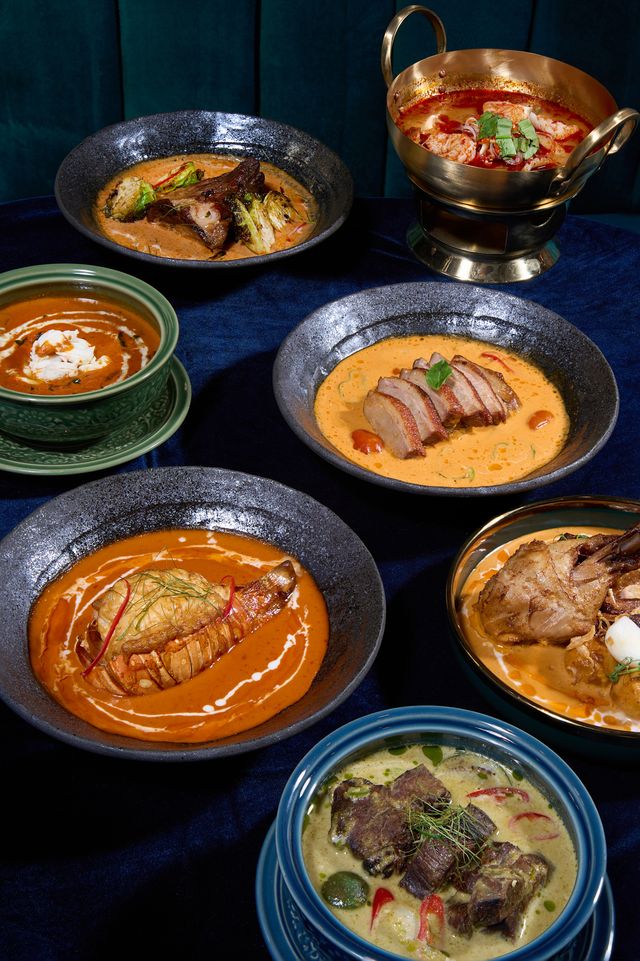
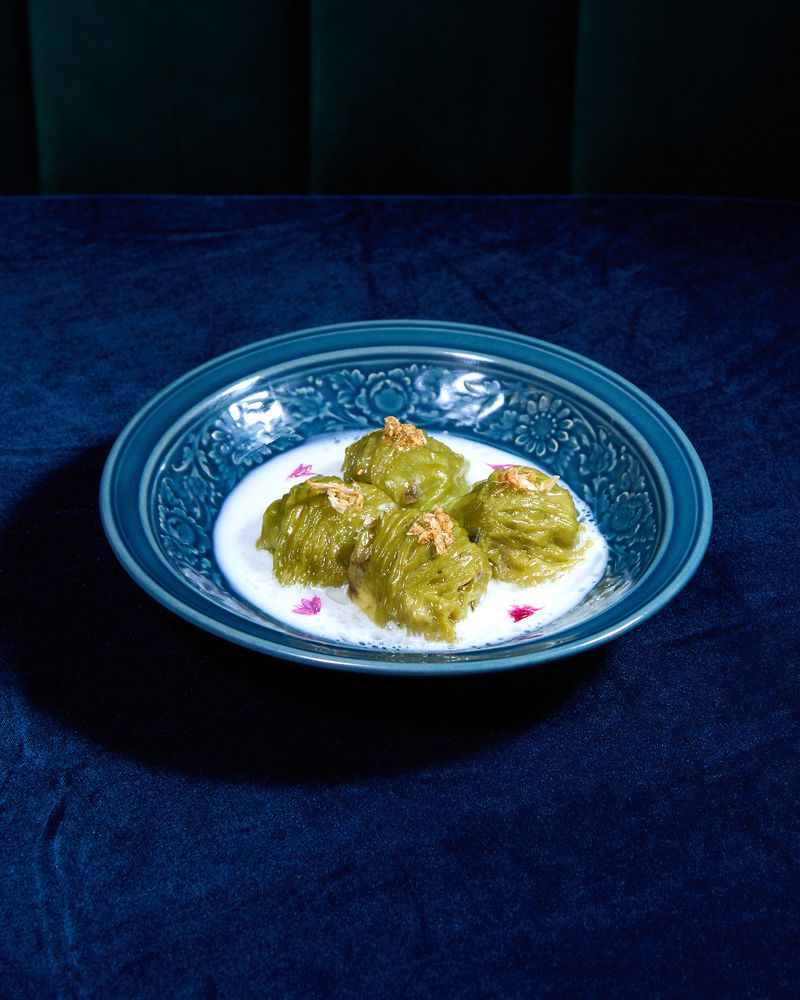
than usual.There are a dozen appetizers, and we could not resist Thai dumplings with the pandan-infused dough folded over preserved radish and peanuts with coconut milk and garlic (below). A salad with crabmeat, shredded green papaya, Thai eggplant, long bean, cherry tomato, chili, garlic and fermented fish sauce had a refreshing mildness, while crab marinated in a curry sauce and a simmered in coconut milk with betel leaf, served over vermicelli noodles had considerably more bite. A red curry flavored pink-roasted duck breast with pineapple, cherry tomatoes, bamboo shoots and the fragrance of basil.
Short Rib Panang Curry is a long-braised short rib with coconut milk, accompanied by roasted Brussels sprouts. There’s a complex fried rice dish riddled with beef tallow fat, grilled ribeye, garlic chips, egg, and marinated yolk. Equally as savory is the goong karee, a shrimp dish with onions, scallions, long, hot chili, a dash of curry powder, garlic, and egg that packed a punch.
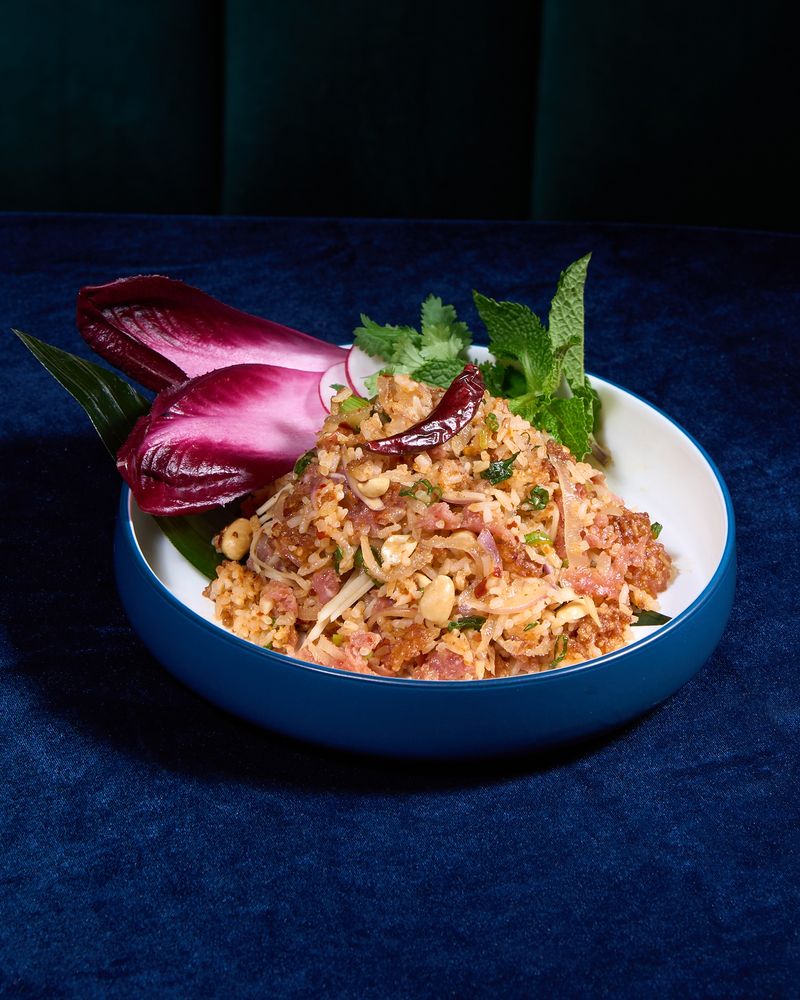
Contrary to the idea that pad Thai (left) is a pedestrian American-Thai dish, nothing could be further from the truth, for it is ubiquitous in Bangkok restaurants, originating during the 1930s under Prime Minister Plaek Phibunsongkhram, who promoted it as a national dish to foster national identity as well as to address a rice shortage during World War II. Chada’s version is a classic rendering of shrimp with noodles, egg, preserved radish, peanuts, chive and bean sprouts. Khao Soy is made with a roasted chicken thigh, egg noodles, coconut milk, shallot, pickled pearl onion and scallion.
The best dish I had was crispy pork tossed wit salt and pepper, long hot chili, plenty of garlic and kaffir lime leaf.
Instead of the desserts, have the Thai iced coffee instead.
Most of these dishes may be found as variants elsewhere, but there are no cliches on the menu at Chada, especially among the Chef’s Signature items and reminds me of some of the best restaurants in Bangkok.
Open daily for lunch and dinner. Brunch on weekends.
THE BISON
By John Mariani
It had been
snowing hard all day and the two men were
sitting in leather armchairs before a large
fireplace sipping Scotch.
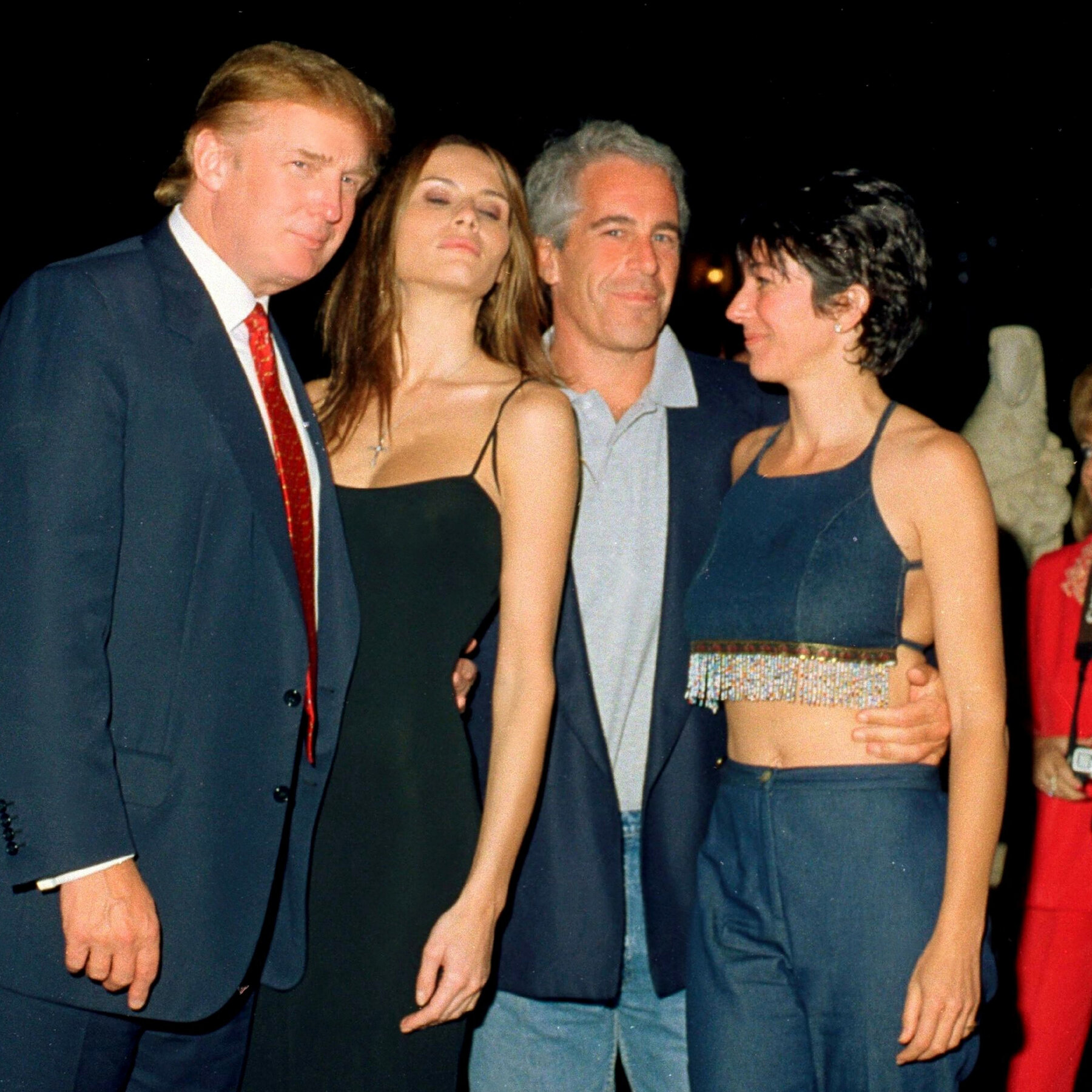
“Did you see the paper today
about Jeffrey Epstein?”
“No, what about him?” asked the
younger man.
“It seems the Palm Beach police are
investigating him for sex trafficking and
child abuse.”
The younger man shook his head hard
as if to clear it.
The older man took a slug of the
whiskey, stared into the fireplace, then
said slowly, “This . . . could cause a lot
of trouble for us.”
❖❖❖
 Katie Cavuto, an
investigative reporter for McClure’s
magazine, had just read the same story in the
tabloid newspaper, the New York Post,
while nursing a head cold with a cup of hot
tea in her Bronx apartment. She racked her
brain trying to remember who exactly Jeffrey
Epstein was and only recalled he was a
millionaire with a lot of celebrities for
friends. The kind of guy who would
occasionally make it onto the Post’s gossip
section, Page Six, in photos from some gala
party. Other than that, she knew nothing about
him and was certainly surprised at the
investigation of him as a sex trafficker and
child molester.
Katie Cavuto, an
investigative reporter for McClure’s
magazine, had just read the same story in the
tabloid newspaper, the New York Post,
while nursing a head cold with a cup of hot
tea in her Bronx apartment. She racked her
brain trying to remember who exactly Jeffrey
Epstein was and only recalled he was a
millionaire with a lot of celebrities for
friends. The kind of guy who would
occasionally make it onto the Post’s gossip
section, Page Six, in photos from some gala
party. Other than that, she knew nothing about
him and was certainly surprised at the
investigation of him as a sex trafficker and
child molester.
Katie usually read, or at least glanced
at, the Post after going through the New
York Times, Daily News and Wall
Street Journal, and, given the tabloid’s
penchant for sensational news stories, she
paid little attention to what it covered. It
was the antithesis in content to McClure’s,
which was a well-respected investigatory
journal for which Katie had won several prizes
for her articles. Katie turned the page about Epstein and read
the gossip on Page Six as a guilty pleasure.
Some Hollywood actress was hooking up with
another rap star; some ex-White House aide
signed to write a tell-all about the Bush
family.
Katie turned the page about Epstein and read
the gossip on Page Six as a guilty pleasure.
Some Hollywood actress was hooking up with
another rap star; some ex-White House aide
signed to write a tell-all about the Bush
family.
Katie’s last award-winning story had
been about a pandemic deliberately unleashed
in Paris that had involved Middle East
terrorists, the Marseille Mafia and Russian
President Vladimir Putin. She’d also done
stories on Al Capone, British double agent Kim
Philby, and an exposé of the abuse of young
women at Ireland’s Magdalene Laundries. All of
these were undertaken with the help of ex-NYPD
detective David Greco, and both of them had
escaped being murdered several times in
pursuit of those stories.
Katie hadn’t seen David since the Paris
investigation, but they’d kept in touch. He
was in his fifties, she in her mid-thirties,
and both had grown up in the Bronx, though his
neighborhood in the borough’s south had been a
lot tougher and grittier than hers in the
north. After twenty-five years as a cop—the
last few disillusioned by how politics had
become so invasive during Mayor Rudy
Giuliani’s second term—David had retired to a
modest house up the Hudson River near West
Point, and it was only because Katie had
approached him on the Capone investigation
back in 1995––and because she was a very
good-looking Italian-American woman––that he’d
agreed to help, using his contacts and
expertise as a detective. He was also well
compensated for his assistance by McClure’s.
 David didn’t
read any of the New York papers, except the
Sunday Daily News he’d pick up at the
local drugstore, and he mostly got his news
from cable TV, which had nothing about the
investigation of Jeffrey Epstein, who, if he’d
seen it, meant nothing to David.
David didn’t
read any of the New York papers, except the
Sunday Daily News he’d pick up at the
local drugstore, and he mostly got his news
from cable TV, which had nothing about the
investigation of Jeffrey Epstein, who, if he’d
seen it, meant nothing to David.
David’s time with Katie had certainly
been the most exciting of his life, although
his happiest days were when he was married to
a woman who, as a flight attendant, died
trying to get passengers out of a burning
plane that crashed at LaGuardia. He’d
never dated after that, and, given his age, he
allowed himself just to be infatuated with
Katie Cavuto but had given up any prospects
for a romance. For as long as he knew her
she’d been dating off and on an attorney in
Boston whom David only referred to as “the
lawyer guy.”
It was bittersweet for David that he
had worked so closely with Katie on the McClure’s
articles, traveling the world and enjoying countless
meals with her in southern Italy, France,
London, Taipei, Hong Kong and elsewhere, but
then, with the stories finished, they only
kept in touch by phone calls that were always
about current events, movies, television
series, rarely mentioning what they’d been
through while working on the stories. During
those months, David fantasized about Katie
calling him up and asking him to join her on a
new investigation, but it had been a year
since that had happened.
Now, three years
after 9/11 and a year after George W. Bush
invaded Iraq over assertions that Saddam
Hussein had weapons of mass destruction, Katie
was back working on national stories, which
had included an investigation into
questionable oil leases on Native Americans’
lands, the newspaper and magazine wars in the
wake of the dot.com bust, and a story on the
outrageous salaries paid to the heads of
non-profit hospitals in New York. Her work on
those stories was as solid as any she’d
written, but none had the magnitude—or
danger—of the stories she’d worked on with
David. Even though she swore she’d never put
herself in harm’s way again for a story—they’d
almost been drowned, poisoned and driven over
a cliff—she missed the adrenalin of those
adventures and found that spending her days
going through land grants and hospital
accounts was just grunt work.
© John Mariani, 2024
❖❖❖
My Pick for the Wine That Expresses
the Finest Caliber of Modern Viniculture
By John Mariani
It is a rare day when
I do not have wine with dinner, and it is equally
as rare that I taste wine without dinner, because
such an exercise is like testing a car in a
garage. The elements of a wine must interact with
those of food, just as the rubber must meet the
road.
I don’t
take notes on every wine I drink throughout the
year, and between the very fine and the mediocre is
a huge swathe of well-made bottlings from just about
every country that produces wine, which these days
constitute more offerings than ever in the market.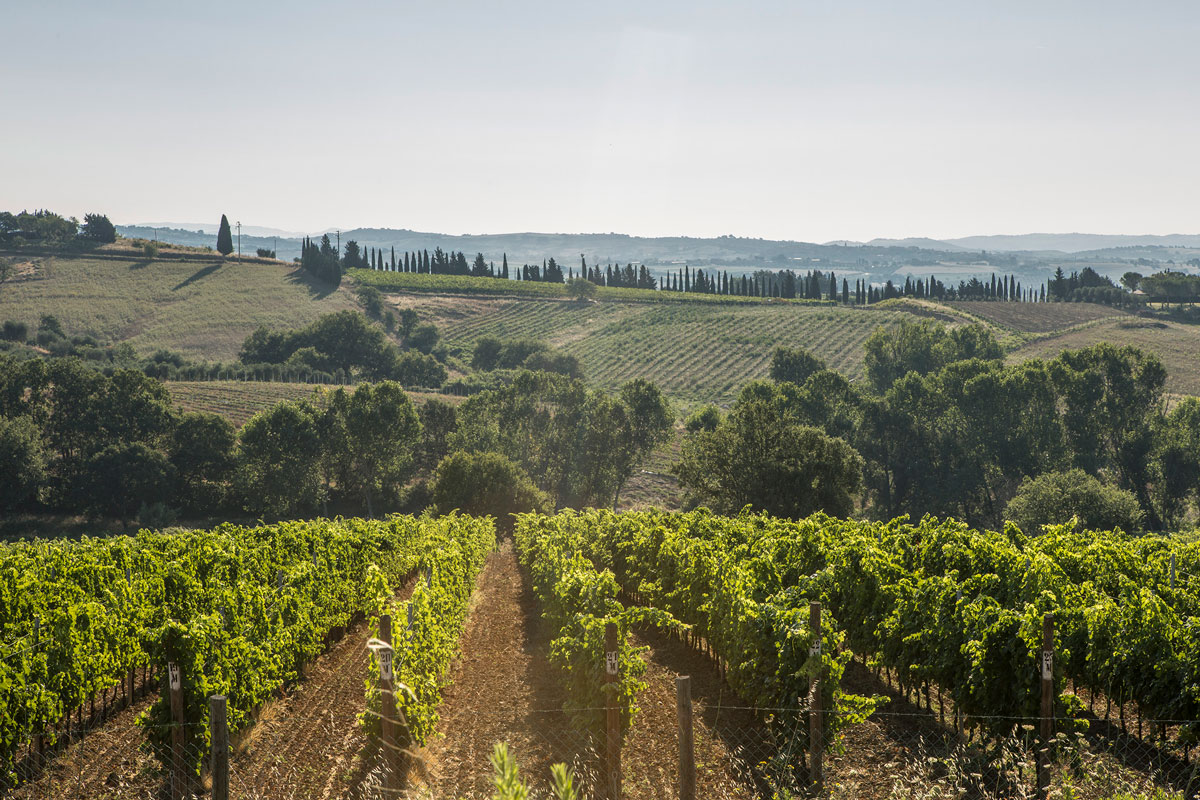
I also don’t
hide wines inside paper bags so that I don’t know
what the label is. I choose wines to go with what
I’m eating, so I don’t want to be surprised by a
wine or varietal I think would be inappropriate for
a dish on the table. On most occasions I have a
pretty good idea of how the wine chosen is going to
taste––after all, if I choose Pinot Noir
I expect it to taste like a Pinot Noir, although,
sadly, that is not always the case.
Sometimes a
wine––red or white––really impresses me for how it
stands out among the usual varietals. Recently I was
amazed at how good a sweet Beaumes-de-Venise was,
matched with roasted chestnuts.
Odd, then,
that the wine that I found well above the ordinary
was 15% alcohol––a level I’ve often inveighed
against as knocking a wine’s elements out of
balance. Yet as soon as I sniffed it and
took a sip, I audibly let out a definite “Wow!” Not
because it was massive, as so many California
Cabernet Sauvignons can be or because it indicated
it will be even better in the next few years––the
vintage was 2022––but because it was so expressive
of its terroir, with all elements of acid, fruit,
tannin and alcohol knit impeccably well together.
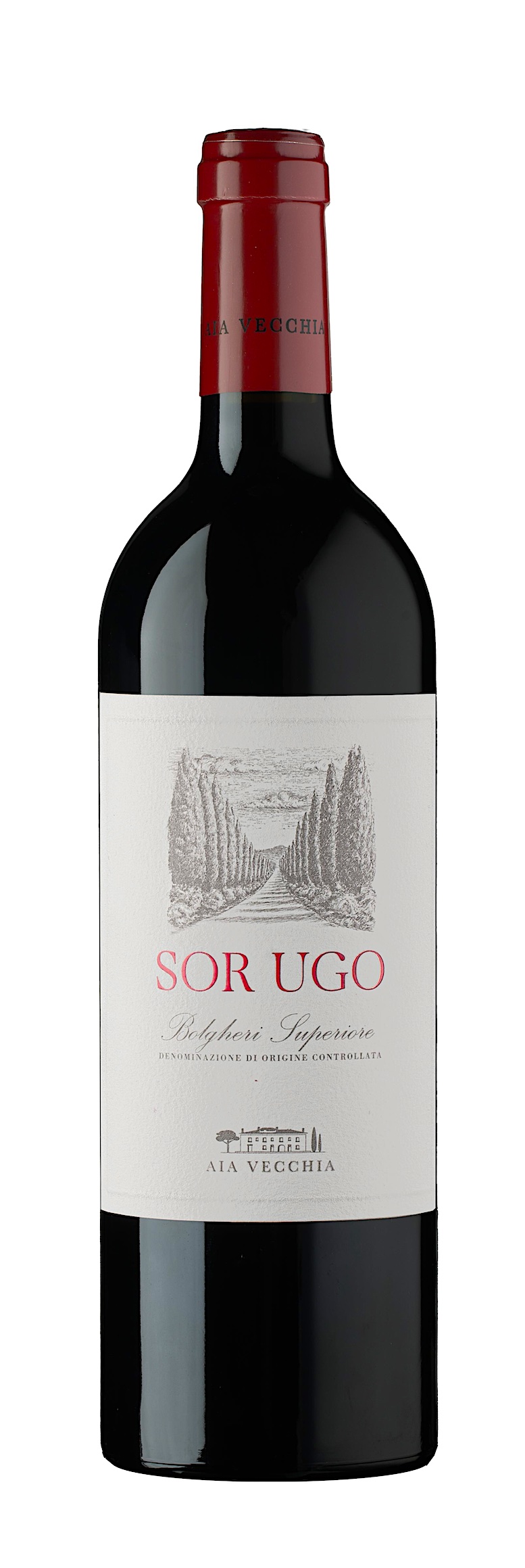
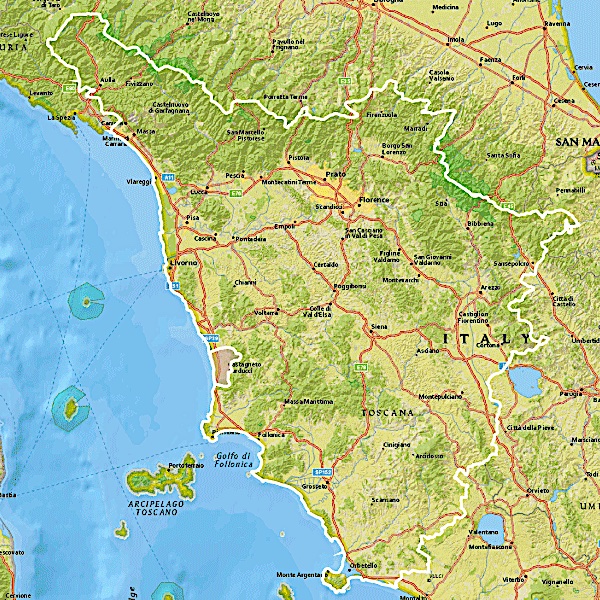 The wine is Sor Ugo, a
Bolgheri DOC Superiore ($57) from Tuscany, where
Sangiovese dominates.
But this is, in line with so many of the
so-called “Super Tuscans” (a title with no legal
status), is Bordeaux-style
blend of Cabernet
Sauvignon,
Merlot, Cabernet Franc and Petit Verdot, named in
honor of Ugo, the first Pellegrini family member to
grow grapes
more than a century ago. Now under
the name Aia Vecchia, the estate was founded in 1995
by the Pellegrini family with vineyard sites in
coastal Bolgheri
and Maremma regions, whose cooler climate is not
dissimilar to that in Bordeaux. The estate covers
The wine is Sor Ugo, a
Bolgheri DOC Superiore ($57) from Tuscany, where
Sangiovese dominates.
But this is, in line with so many of the
so-called “Super Tuscans” (a title with no legal
status), is Bordeaux-style
blend of Cabernet
Sauvignon,
Merlot, Cabernet Franc and Petit Verdot, named in
honor of Ugo, the first Pellegrini family member to
grow grapes
more than a century ago. Now under
the name Aia Vecchia, the estate was founded in 1995
by the Pellegrini family with vineyard sites in
coastal Bolgheri
and Maremma regions, whose cooler climate is not
dissimilar to that in Bordeaux. The estate covers 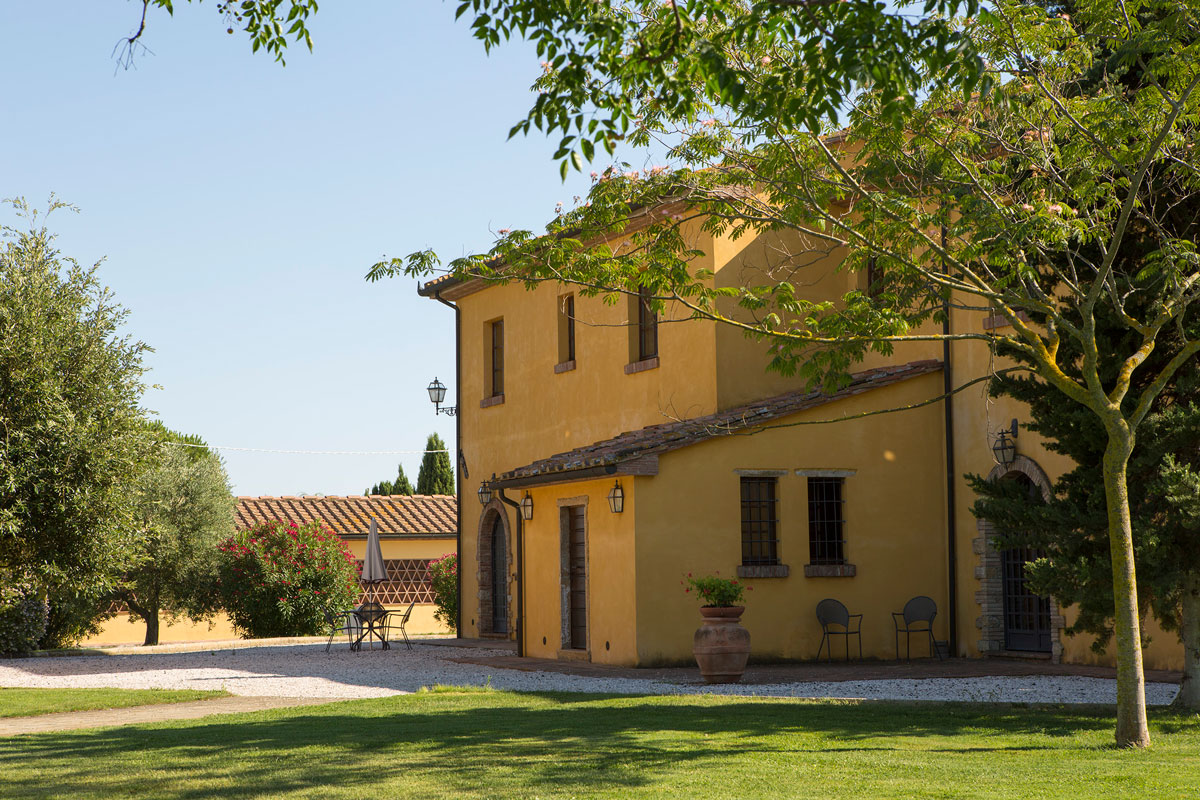 112 acres
Agronomist Daniel Schuster and the Pellegrinis
brought root stock from Bordeaux, and together with
noted Hungarian winemaker Tibor Gal, once the chief
winemaker at the winery Ornellaia, produced at the
current Sor Ugo blend of 50% Cabernet Sauvignon, 30%
Merlot, 13% Cabernet Franc and 7% Petit
Verdot. The vines are 23 years old, and the
wines goes through malolactic fermentation in
barriques, both new and used, aging for 18 months,
then bottled and aged for another six months. A
total of 33,000 bottles are made annually. The 2022
is their second vintage.
It is a more sumptuous wine than most Bordeaux under
the Premier Crus, which will take years more to
mature. Right now, as I found, it is certainly ready
to drink. I enjoyed it with a massive veal chop and
roasted potatoes, and it will be a good match for
any traditional Christmas dinner.
With three weeks to go in
December, I may well find a wine to surpass Sor Ugo,
but for the moment, this is one I’ll use as a
standard for great winemaking for the year 2025.
❖❖❖
PLINK, PLINK, RUSTLE, RUSTLE
"It started to
rain. But no: There are no windows in that cocoon of
a room. It took me a moment, and then I understood.
It was the hydrangea’s secret cache of carbonated
sugar, plinking and rustling, as if bringing news
from another world."––Ligaya Nishan, "Four
Stars for Yamada, the Height of Kaiseki Cuisine in
New York," NY Times (Dec 3, 2025).
❖❖❖
Any of John Mariani's books below may be ordered from amazon.com.
 The Hound in Heaven
(21st Century Lion Books) is a novella, and
for anyone who loves dogs, Christmas, romance,
inspiration, even the supernatural, I hope you'll find
this to be a treasured favorite. The story
concerns how, after a New England teacher, his wife and
their two daughters adopt a stray puppy found in their
barn in northern Maine, their lives seem full of promise.
But when tragedy strikes, their wonderful dog Lazarus and
the spirit of Christmas are the only things that may bring
his master back from the edge of despair.
The Hound in Heaven
(21st Century Lion Books) is a novella, and
for anyone who loves dogs, Christmas, romance,
inspiration, even the supernatural, I hope you'll find
this to be a treasured favorite. The story
concerns how, after a New England teacher, his wife and
their two daughters adopt a stray puppy found in their
barn in northern Maine, their lives seem full of promise.
But when tragedy strikes, their wonderful dog Lazarus and
the spirit of Christmas are the only things that may bring
his master back from the edge of despair. WATCH THE VIDEO!
“What a huge surprise turn this story took! I was completely stunned! I truly enjoyed this book and its message.” – Actress Ali MacGraw
“He had me at Page One. The amount of heart, human insight, soul searching, and deft literary strength that John Mariani pours into this airtight novella is vertigo-inducing. Perhaps ‘wow’ would be the best comment.” – James Dalessandro, author of Bohemian Heart and 1906.
“John Mariani’s Hound in Heaven starts with a well-painted portrayal of an American family, along with the requisite dog. A surprise event flips the action of the novel and captures us for a voyage leading to a hopeful and heart-warming message. A page turning, one sitting read, it’s the perfect antidote for the winter and promotion of holiday celebration.” – Ann Pearlman, author of The Christmas Cookie Club and A Gift for my Sister.
“John Mariani’s concise, achingly beautiful novella pulls a literary rabbit out of a hat – a mash-up of the cosmic and the intimate, the tragic and the heart-warming – a Christmas tale for all ages, and all faiths. Read it to your children, read it to yourself… but read it. Early and often. Highly recommended.” – Jay Bonansinga, New York Times bestselling author of Pinkerton’s War, The Sinking of The Eastland, and The Walking Dead: The Road To Woodbury.
“Amazing things happen when you open your heart to an animal. The Hound in Heaven delivers a powerful story of healing that is forged in the spiritual relationship between a man and his best friend. The book brings a message of hope that can enrich our images of family, love, and loss.” – Dr. Barbara Royal, author of The Royal Treatment.
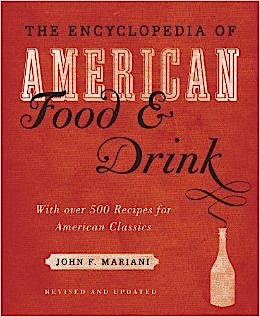 |
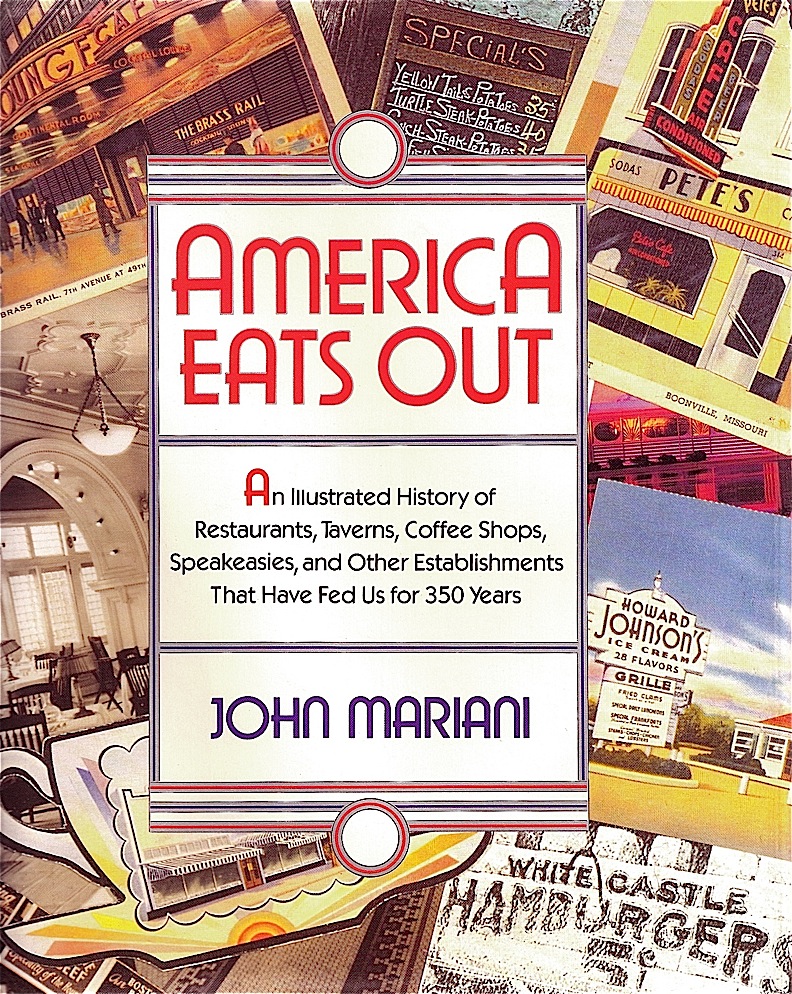
The Encyclopedia of American Food and Drink by John F. Mariani (Bloomsbury USA, $35) Modesty forbids me to praise my own new book, but let me proudly say that it is an extensive revision of the 4th edition that appeared more than a decade ago, before locavores, molecular cuisine, modernist cuisine, the Food Network and so much more, now included. Word origins have been completely updated, as have per capita consumption and production stats. Most important, for the first time since publication in the 1980s, the book includes more than 100 biographies of Americans who have changed the way we cook, eat and drink -- from Fannie Farmer and Julia Child to Robert Mondavi and Thomas Keller. "This book is amazing! It has entries for everything from `abalone' to `zwieback,' plus more than 500 recipes for classic American dishes and drinks."--Devra First, The Boston Globe. "Much needed in any kitchen library."--Bon Appetit. |
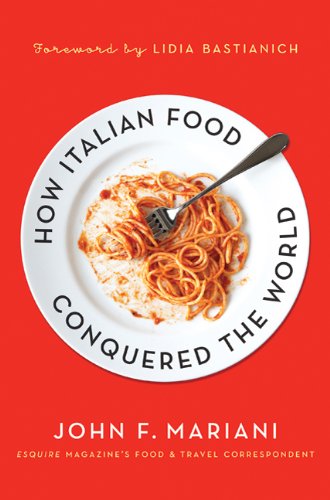
"Eating Italian will never be the same after reading John Mariani's entertaining and savory gastronomical history of the cuisine of Italy and how it won over appetites worldwide. . . . This book is such a tasteful narrative that it will literally make you hungry for Italian food and arouse your appetite for gastronomical history."--Don Oldenburg, USA Today. "Italian
restaurants--some good, some glitzy--far
outnumber their French rivals. Many of
these establishments are zestfully described
in How Italian Food Conquered the World, an
entertaining and fact-filled chronicle by
food-and-wine correspondent John F.
Mariani."--Aram Bakshian Jr., Wall Street
Journal.
"Equal parts
history, sociology, gastronomy, and just
plain fun, How Italian Food Conquered the
World tells the captivating and delicious
story of the (let's face it) everybody's
favorite cuisine with clarity, verve and
more than one surprise."--Colman Andrews,
editorial director of The Daily
Meal.com. "A fantastic and fascinating
read, covering everything from the influence
of Venice's spice trade to the impact of
Italian immigrants in America and the
evolution of alta cucina. This book will
serve as a terrific resource to anyone
interested in the real story of Italian
food."--Mary Ann Esposito, host of PBS-TV's
Ciao
Italia. "John Mariani has written the
definitive history of how Italians won their
way into our hearts, minds, and
stomachs. It's a story of pleasure over
pomp and taste over technique."--Danny Meyer,
owner of NYC restaurants Union Square
Cafe, The Modern, and Maialino.
|
 |
 |
 |
 |
 |
 |
MARIANI'S VIRTUAL GOURMET
NEWSLETTER is published weekly. Publisher: John Mariani. Editor: Walter Bagley. Contributing Writers: Christopher
Mariani, Misha Mariani, John A. Curtas, Gerry Dawes, Geoff Kalish.
Contributing
Photographer: Galina Dargery. Technical
Advisor: Gerry
McLoughlin.
If you wish to subscribe to this
newsletter, please click here: http://www.johnmariani.com/subscribe/index.html
© copyright John Mariani 2025